
TL;DR

Get business pricing on tools and workshop supplies
- Business-only prices and quantity discounts
- Tax-exempt purchasing
- Multiple users, one account, clear invoices
Moving your gear into a closet cuts noise more than foam alone. Proper placement and ventilation are key. Treat reflections and leaks for a clean, focused sound.
Ever tried recording in a tiny closet and wondered why it sounds so reverb-heavy and noisy? The truth is, many think they need thick foam or fancy panels to soundproof a space, but the real magic comes from smart placement and understanding your space’s physics.
If you want a quiet, professional-quality setup, the first step is moving the rig away from your workspace. It’s surprising how much noise drops when you put distance between you and the machine — often more than any foam or blanket can achieve. This guide reveals simple but effective tricks to make your closet into a silent sanctuary for voice, music, or streaming.
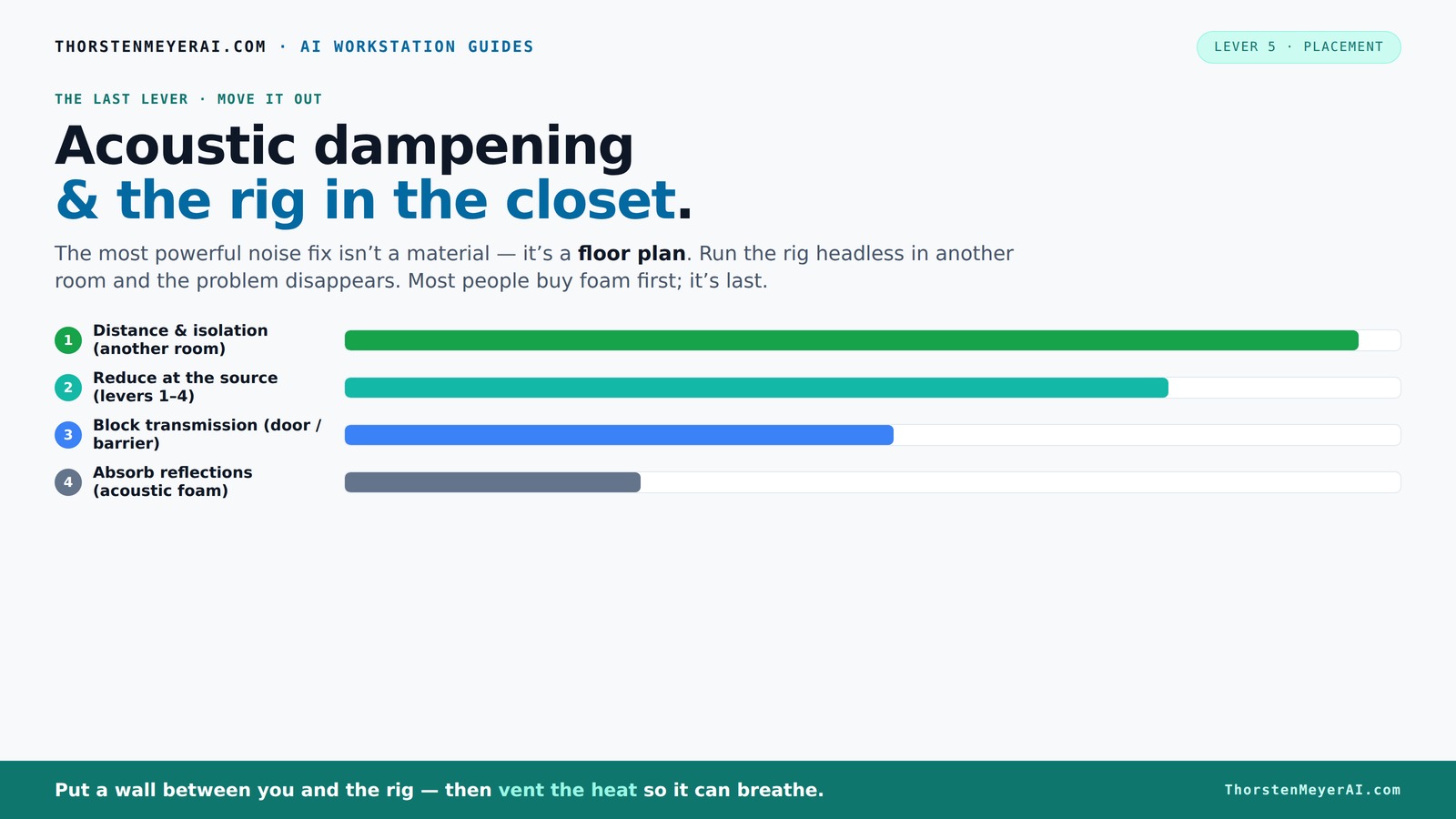
Acoustic dampening
& the rig in the closet.
The most powerful noise fix isn’t a material — it’s a floor plan. A rig you can’t hear because it’s in another room beats any amount of foam. Tap the approaches in Part 1 to see what actually works.
(another room)
(levers 1–4)
(door / barrier)
(acoustic foam)
Contain the noise, not the heat
Key Takeaways
- Moving your rig into a separate room or closet is the most effective way to cut noise, often more than foam treatments.
- Proper ventilation is critical in enclosed spaces; without airflow, heat buildup can damage your equipment and cause noise spikes. You can learn more about proper placement and ventilation.
- Treat the reflective surfaces near your mic first — the wall behind it and the ceiling — for clearer, less reverb-heavy recordings.
- Seal leaks around the door and other open points to prevent sound escape, which makes your closet more effective as a recording space.
- Don’t overdo it on foam; 20-30% wall coverage with thick panels and strategic placement beats full coverage in small spaces.
As an affiliate, we earn on qualifying purchases.
Why Distance Outperforms Foam in Soundproofing
The biggest leap in reducing noise isn’t adding foam; it’s moving the rig out of your workspace altogether. A rig tucked in a closet, on the other side of a wall, can be inaudible from your desk — even if it’s loud inside.
Think of it like this: a loud GPU or CPU can generate over 600W of heat and noise. If you place it in a separate room or closet with a proper ventilation system, you no longer have to drown out the noise with foam. Instead, you just don’t hear it. This approach is often the least expensive and most effective fix.
For example, a streamer I know moved his gaming PC into a closet across the hall. His microphone never catches the fan hum anymore, even though the PC still runs hot. All he did was run a sturdy Ethernet cable, install a vent fan, and seal the door with weatherstripping.
As an affiliate, we earn on qualifying purchases.
The "Rig in the Closet" Setup — How to Ventilate and Avoid Overheating
Placing a hot, high-performance machine in a closet sounds perfect until you realize heat is the enemy. Without proper airflow, trapped heat can turn your quiet closet into a sauna, causing thermal throttling and fan noise to spike.
Here’s what you do: Consider reading about rig in the closet setup for more detailed tips.
- Install an exhaust fan that pulls hot air out, and a passive intake vent for fresh air.
- Use ducting to direct airflow, especially if you want to keep noise down with a ducted exhaust system.
- In some cases, a purpose-built soundproof cabinet with temperature control is worth the investment.
- Monitor ambient temperature regularly, especially during long workloads. If it creeps past 80°F (27°C), you need better airflow.
Proper ventilation isn’t just about keeping the equipment cool; it directly impacts your sound quality. Overheating can cause your rig’s fans to spin faster or become louder, which defeats the purpose of a quiet closet setup. By designing a ventilation system that efficiently removes heat while minimizing noise, you ensure your equipment stays cool without adding unwanted background noise. The tradeoff is balancing airflow with soundproofing — too much ducting or an overly loud fan can introduce noise, so choosing quiet fans and strategic duct placement is key. The goal is a system that silently exhausts heat while maintaining the acoustic integrity of your space.
As an affiliate, we earn on qualifying purchases.
Treating Reflections: The Secret to Clear, Focused Sound
Acoustic dampening isn’t just about stopping sound from leaving — it’s about controlling how sound bounces inside the space. Small closets are full of reflective surfaces: walls, ceiling, floor, and even the door.
Start by identifying your mic position. Place your mic at the point where reflections are least. Then treat nearby surfaces with a combination of: You might find it helpful to explore acoustic treatment strategies.
- Thick acoustic foam panels behind the mic
- Moving blankets or quilted fabric on the walls
- Adding a soft rug or a blanket on the ceiling
- Using a portable reflection filter around your mic
Why does this matter? Because reflections can cause reverberation, echo, and comb-filter effects that muddy your recordings. By strategically placing absorption materials, you’re effectively reducing the early reflections that hit the mic capsule directly, which translates into a clearer, more focused sound. This is especially important in small spaces where every surface is a potential reflector. The tradeoff is that over-treating can make the space sound too muffled; the goal is to find a balance that preserves natural tone while controlling problematic echoes.
portable vocal booth for recording
As an affiliate, we earn on qualifying purchases.
As an affiliate, we earn on qualifying purchases.
Where to Focus Your Acoustic Treatment for the Best Results
In a tiny closet, the biggest gains come from treating the areas where reflections are strongest: the wall behind the mic, the ceiling, and the door. Corners matter less than most think, especially in small spaces.
Here’s a quick guide:
| Surface | Priority | Why |
|---|---|---|
| Behind the mic | High | Controls direct reflections into your mic capsule, ensuring your recordings are focused and clean. |
| Ceiling | Medium | Prevents early reflections from above, which can cause subtle reverberation and muddiness. |
| Door and walls | High | Stops sound leaks and flutter echoes, maintaining the integrity of your recording environment. |
| Corners | Lower | Help with low-frequency buildup but are less impactful in small closets where low-end issues are less prominent. |
Focusing your treatment on these key areas maximizes your sound quality without unnecessary clutter. For example, sealing the door and placing foam behind the mic can drastically improve clarity, often more than covering every corner with foam panels. The key is strategic placement and understanding where reflections originate and how they affect your recordings. To learn more, check out this guide on acoustic treatment.
How Much Material Do You Really Need? Covering Walls Without Overdoing It
In a small closet, you don’t need to cover every inch with foam. About 20-30% of wall coverage can drastically reduce echo while keeping the space functional and comfortable. For more tips on acoustic treatment, visit this resource on acoustic dampening.ce and comfort.
Thicker panels (2-4 inches) are more effective at damping low frequencies, which are often the hardest to control. In larger closets or rooms, these help prevent bass buildup and standing waves. For smaller spaces, thinner panels (1 inch) are usually sufficient for high-frequency absorption, which significantly improves clarity without creating a dead-sounding environment. Layering blankets, curtains, and foam allows you to fine-tune the absorption profile based on your needs. The tradeoff is balancing absorption with natural sound; too much treatment can cause a ‘boxy’ sound that reduces intelligibility. The goal is strategic, targeted treatment that enhances clarity without sacrificing natural tone.
Sealing Leaks and Blocking Sound Leaks — The Key to Real Silence
Foam absorbs reflections, but leaks are the biggest source of noise escape. The door is the main weak point in a closet. Seal it with weatherstripping and add a heavy blanket or acoustic curtain for extra blocking. Proper sealing prevents external noise from entering and your sound from escaping, which is crucial for professional-quality recordings.
Use acoustic sealant around the door frame and any gaps to create an airtight barrier. Consider adding a door sweep or draft stopper at the bottom. For the floor, a dense rug or carpet pad can help absorb vibrations and prevent sound transmission. These measures are about creating a comprehensive barrier — the more airtight your space, the more effective your soundproofing. The tradeoff involves balancing ease of installation with effectiveness; some sealants and barriers are simple to implement but highly effective, while others require more effort but provide better isolation. Remember, sealing leaks often yields more noticeable improvements than adding additional foam panels.
What Not to Waste Money On in a Tiny Closet Studio
Many spend too much on unnecessary foam and forget the basics: sealing leaks, proper placement, ventilation, and coverage. Thick panels don’t matter if the door leaks or the rig overheats. Overspending on foam without addressing these core issues results in minimal improvements and wasted money.
Instead, prioritize sealing gaps with weatherstripping, ensuring good ventilation, and strategically placing a few well-placed acoustic panels where reflections are strongest. For instance, a hobbyist bought a set of expensive foam panels but neglected to seal the door or set up proper airflow, leading to persistent noise issues. Focus on these fundamental steps first, then add more treatment only if needed. The key is understanding that effective soundproofing and acoustic treatment are about holistic solutions, not just filling the space with foam.
Frequently Asked Questions
How do I know if I should treat the walls or the ceiling first?
Start with the wall behind your mic, then treat the ceiling if you notice echoes or reverb. Focus on areas that directly impact your recording quality, not every surface at once.Can I use moving blankets instead of foam panels?
Yes, moving blankets work well for general absorption and are easy to hang. They’re especially handy in DIY setups where full foam panels aren’t feasible. Just ensure they cover enough surface area near reflection points.Is sealing the door enough, or should I treat the entire room?
Sealing the door is a great start, but for optimal soundproofing, treat the adjacent walls and ceiling as well. In small closets, sealing the door often makes the biggest difference.How do I prevent my PC or rig from overheating in a closet?
Use an exhaust fan, ducting, and possibly an AIO liquid cooler that vents heat outside. Regularly monitor temperatures, especially during long sessions, to keep everything running smoothly.Will acoustic foam stop sound from escaping entirely?
No, foam absorbs reflections but doesn’t block sound leaks. For true soundproofing, seal gaps and use mass-loaded barriers around your space.Conclusion
Transforming a closet into a quiet studio isn’t about buying the fanciest foam. It’s about smart placement, sealing leaks, and ensuring your rig stays cool. When you treat the space as a whole — not just with absorbent materials — the results speak for themselves.
Remember, the goal isn’t to silence your gear completely. It’s to make it disappear into the background so your voice shines. The quietest, clearest recordings come from understanding your space, not just filling it with foam.
Fall yard work Picks
leaf blowers
As an affiliate, we earn on qualifying purchases.