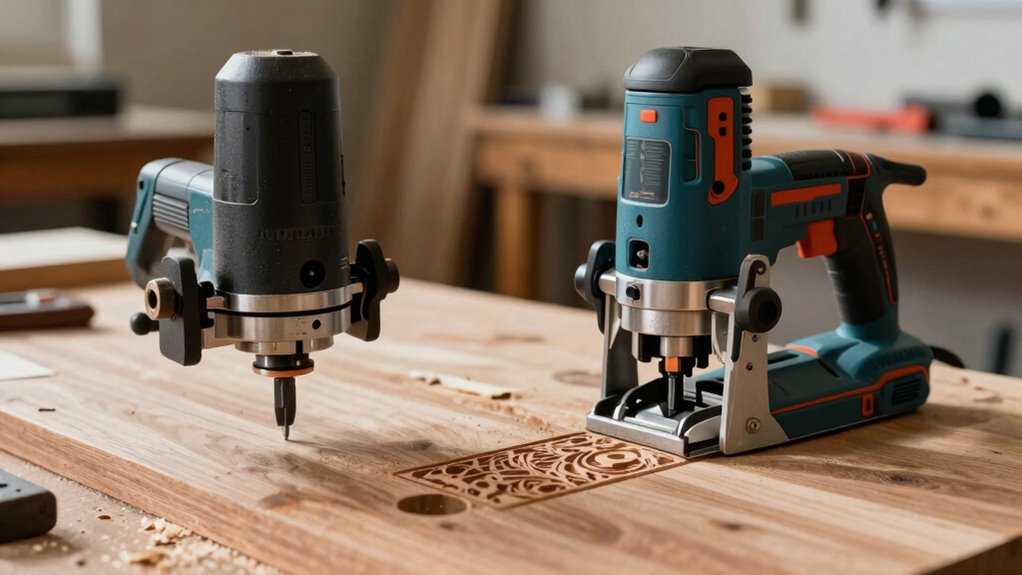

Choosing between a fixed base and a plunge base depends on what kind of cut you need. If you’re doing straight, repetitive cuts on large surfaces, the fixed base offers stability and ease. For precise, intricate, or starting cuts in mid-air, the plunge base gives you better control. Each performs best for specific tasks, so understanding their strengths helps you pick the right tool. Keep exploring to discover how to match your projects with the right router setup.

Get business pricing on tools and workshop supplies
- Business-only prices and quantity discounts
- Tax-exempt purchasing
- Multiple users, one account, clear invoices
Key Takeaways
- Fixed bases excel for straight, repetitive cuts on flat surfaces, offering stability and consistent depth control.
- Plunge bases are ideal for intricate, starting, or hollowing cuts requiring precise control and flexibility.
- Choose fixed bases for tasks needing fast, repetitive cuts; opt for plunge bases for detailed or complex projects.
- Combination routers provide versatility, accommodating both fixed and plunge functions for varied cutting needs.
- Consider the specific project type and cut complexity to determine whether a fixed or plunge base is most suitable.
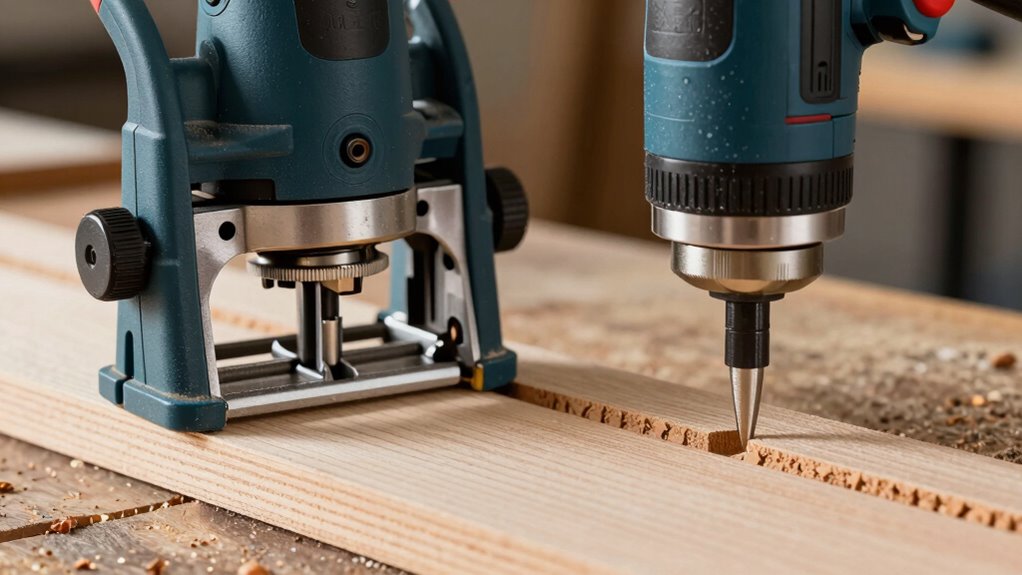
Choosing between a fixed base and a plunge base can considerably impact your woodworking projects, as each offers distinct advantages for different tasks. The decision largely depends on the type of cut you’re making and the level of control you need. A fixed base router provides excellent router stability, making it ideal for guiding straight, clean cuts with consistent depth. Its design keeps the motor locked at a specific height, which means once you set the depth adjustment, you can focus on guiding the tool smoothly along your workpiece without worrying about accidental shifts. This stability is especially beneficial for repetitive cuts or when working on large, flat surfaces, ensuring precision and reducing fatigue. Additionally, a fixed base router is typically easier for beginners to operate due to its straightforward design. Moreover, fixed bases are generally more affordable and tend to have fewer moving parts, which can contribute to greater durability over time.
On the other hand, a plunge base router shines when versatility and detailed control are essential. The plunge mechanism allows you to start cutting in mid-air, which is vital for tasks like mortising, inlay work, or hollowing out areas. With a plunge base, you can easily lower the bit into the material, maintaining consistent depth adjustment throughout the cut. This feature gives you the flexibility to start cuts precisely where you want and to make adjustments on the fly, which is often difficult with a fixed base. Since the bit can be plunged into the material vertically, you gain better control over complex or intricate cuts, especially where precision is critical. Understanding the differences between these bases can help you choose the right tool for your specific projects. Each base type also has its ideal application environments, so understanding their strengths and limitations can help ensure you select the best tool for your needs. Additionally, some users prefer a combination router, which offers both fixed and plunge capabilities in one versatile tool.
However, each type has its limitations. The fixed base excels in stability and ease of use for straight, shallow cuts but isn’t suitable for tasks requiring starting in the middle of a workpiece or for plunge cuts. Conversely, the plunge base offers unmatched maneuverability for detailed work, but it can be less stable when making long, straight cuts, especially if not properly supported. Your choice should consider the primary type of work you’ll be doing — if you need consistent, straight cuts with minimal fuss, a fixed base might be your best option. But if your projects involve more complex, controlled cuts or start-and-stop drilling, then a plunge base will serve you better. Understanding the different router bases can help you make an informed decision tailored to your woodworking needs.
As an affiliate, we earn on qualifying purchases.
Frequently Asked Questions
Can a Router Switch Easily Between Fixed and Plunge Bases?
Yes, you can switch your router between fixed and plunge bases easily if it offers good router versatility and compatible bases. Many routers are designed with quick-release mechanisms or compatible mounting systems, making the changeover smooth and efficient. Check your router’s base compatibility before switching to guarantee it fits securely. This flexibility allows you to adapt to different projects, providing precise control whether you need a stable fixed base or a plunge for depth adjustments.
Which Base Offers Better Safety Features During Operation?
You’ll find that fixed bases often have better safety features, like stable clamps and solid construction, reducing the risk of slips. Plunge bases usually include ergonomic designs that help you control the router better, enhancing safety during complex cuts. Ultimately, your choice depends on your comfort and the safety features you prioritize—both types aim to keep you secure, but fixed bases typically offer more stability, while plunge bases focus on maneuverability.
How Does Each Base Impact the Router’s Precision?
A fixed base enhances router stability, providing consistent control and making it easier to achieve precise, straight cuts, which boosts cutting accuracy. Conversely, a plunge base allows you to make controlled depth adjustments during operation, improving precision for complex or detailed work. Your choice impacts how accurately you can guide the router, with the fixed base excelling in stability and straight cuts, and the plunge base offering better flexibility for nuanced, intricate cuts.
Are There Specific Projects Better Suited for One Base Type?
When tackling delicate curved cuts or intricate inlay work, a plunge base shines, making it your go-to—think of it as a versatile tool for detailed projects. For straightforward, repetitive cuts like edge shaping or dados, a fixed base can be more stable. You might consider alternative router attachments or custom base modifications to adapt your tool for specific projects, ensuring precision and efficiency wherever your creativity takes you.
What Is the Maintenance Difference Between Fixed and Plunge Bases?
You’ll find that fixed bases generally require less maintenance because they offer greater tool stability, reducing wear on moving parts. Plunge bases, with their adjustable components, might need more frequent checks and lubrication to guarantee smooth operation. Over time, this affects motor longevity, especially if not properly maintained. Regular cleaning, proper lubrication, and careful handling will keep both bases performing well, but fixed bases tend to be more durable with less upkeep.
As an affiliate, we earn on qualifying purchases.
Conclusion
Choosing between a fixed base and a plunge base depends on your project’s needs. If you want steady, precise cuts, the fixed base offers stability and control. If you need versatility for depths and intricate work, the plunge base provides flexibility and finesse. Think of your tools as extensions of your hands—steady, controlled, adaptable. By matching your task to the right base, you’ll carve with confidence, craft with clarity, and complete your project with precision and pride.
combination router with fixed and plunge bases
As an affiliate, we earn on qualifying purchases.
As an affiliate, we earn on qualifying purchases.
As an affiliate, we earn on qualifying purchases.
Fall yard work Picks
leaf blowers
As an affiliate, we earn on qualifying purchases.