
TL;DR

Get business pricing on tools and workshop supplies
- Business-only prices and quantity discounts
- Tax-exempt purchasing
- Multiple users, one account, clear invoices
Pro Tool Reviews tested six stud finders on a mock-up that included lath and plaster and found the Franklin ProSensor M210/X2100 had a 100% on-center detection rate in that test. It also recorded false stud detections, while the less expensive Franklin M70/X700 found every stud but centered on them 67% of the time. The results apply to the test setup; repeated readings remain important on plaster walls.
Pro Tool Reviews tested six stud finders on a mock-up wall containing lath and plaster and found the Franklin ProSensor M210/X2100 was the only model in the comparison to locate the center of every stud in that section. The device also produced false stud readings, the report said, so the results do not remove the need to check marks before drilling or fastening.
The test used a mock-up built by Tom Gaige, with separate sections of single-layer drywall, double-layer drywall, and lath and plaster. Behind the sections, the team placed a range of targets: standard and metal studs, a stud with live AC, electrical conduit with live AC, PVC pipe, and a water-filled copper pipe. Pro Tool Reviews said it tested the devices using repeated readings and compared their performance by category.
For the plaster section, the report gave the M210/X2100 a 100% on-center detection rate, with no off-center detections or missed studs. It also reported a 33% false stud detection rate and 100% AC detection. The report lists the model at $59.99, while noting it may be sold as the M210 or X2100 depending on the retailer.
The Franklin M70/X700 recorded 67% on-center detection, 33% off-center detection, no missed studs and no false stud detections. Its listed price was $21.99, nearly $40 below the M210/X2100, but it did not offer AC detection. The report also included the Zircon HD70 and JAXWQ 139-FYELLOW among the alternatives; both had some missed and false readings in the plaster test.
Choosing a Finder for Plaster
The findings matter to homeowners and tradespeople because lath and plaster can be harder to scan than modern drywall. The report points to thicker wall construction and less distinct density changes as factors that can challenge sensors. A mistaken reading can lead someone to mark the wrong location for a screw or mount, or to overlook pipes and wiring behind a wall.
The results also show why a single number should not be treated as a guarantee. The M210/X2100 had the strongest center-detection result, but its false readings show that a device can identify a non-stud object as a stud. The M70/X700 offered fewer false readings in this test and cost less, but it did not identify every center precisely and lacked AC detection. Which trade-off matters depends on the task and the conditions at the wall.
For work involving drilling or cutting, a stud finder reading is only one clue. The report recommends taking repeated measurements from opposite directions and comparing the marks. AC detection is not a substitute for safe work practices or a guarantee that a wall is clear of every hazard.
Products Worth Considering

Blueair Blue Pure 511i Max Smart Air Purifier

Samsung 65-Inch QN70FA Neo QLED 4K Smart TV with 8-Foot WireLogic Ruby Ultra High Speed HDMI Cable (2025)

Philips Hue Festavia 65-Foot Smart LED String Lights, 250 Color-Changing Mini LEDs
As an affiliate, we earn on qualifying purchases.
How the Wall Test Worked
The report describes stud finding as difficult even on ordinary drywall, with devices sometimes marking a stud edge, missing one, or indicating a stud where none is present. It says the narrow face of a typical stud is about 1½ inches wide, although framing in older homes can vary. That leaves limited room for error when locating a fastening point.
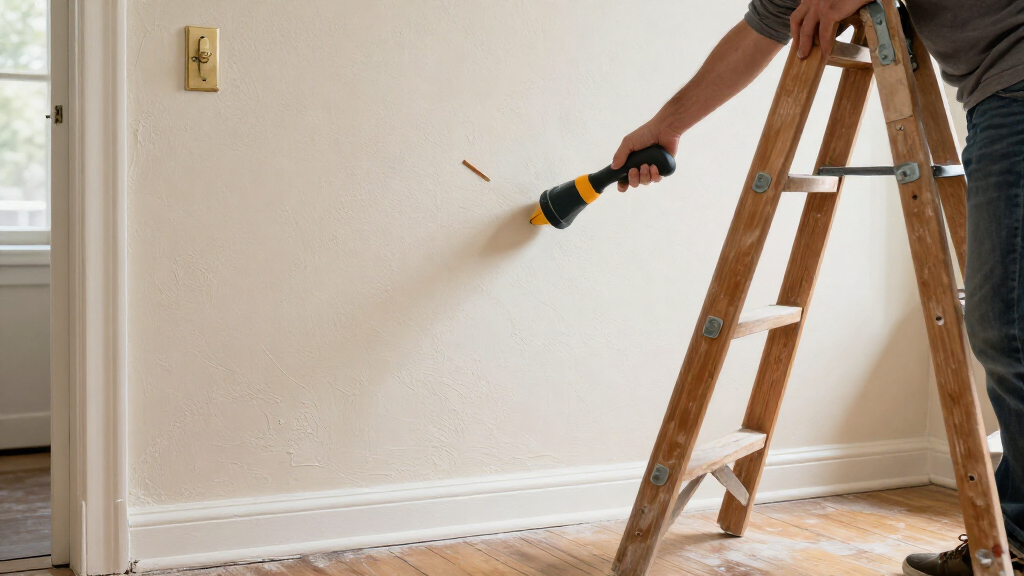
To reduce errors, the tester started in an area without a stud, scanned until the finder indicated a center, and marked it. He then repeated the process from the opposite side after allowing the device to reset or recalibrate. The report advises taking additional readings on plaster if the marks do not agree. It also cautions that stud spacing in lath-and-plaster walls can be inconsistent, so users should not automatically assume a second stud is 16 or 24 inches from the first.
Pro Tool Reviews converted its observations into percentages for on-center detection, off-center detection, missed studs, false stud detection and AC detection. Those categories describe the tested devices in this mock-up; they are not a universal performance rating for every wall, building or installation.
““Only one nailed the center of every stud.””
— Pro Tool Reviews
Limits of the Reported Results
The source material does not provide the full number of scans behind each percentage, the exact wall dimensions or plaster thickness, or results for every model on every wall section. It also does not establish how the devices would perform in different homes, where lath materials, framing, repairs and hidden objects may vary. The report’s percentages should therefore be read as outcomes from its stated test setup, not as a guarantee for a particular wall.
The supplied material gives only partial results for the Zircon HD70 and JAXWQ 139-FYELLOW and does not include complete findings for all six models. It says Zircon had 67% on-center detection, 27% off-center detection, 7% missed studs, 47% false detections and 50% AC detection. JAXWQ had 60%, 33%, 7%, 33% and 50%, respectively. The source excerpt does not identify the remaining models or provide their complete results, so a full ranking cannot be established from the supplied information.
Verify Marks Before Fastening
The practical next step in the report is to scan from both directions and compare multiple marks, especially when the device signals more than one possible stud or readings do not line up. Users should also account for irregular spacing in older walls rather than relying only on a measurement from a known stud. If a project involves cutting into a wall, the report’s AC-detection results alone cannot confirm that the work area is safe; the source does not describe a separate procedure for verifying all concealed services.
Pro Tool Reviews does not announce a follow-up test or additional testing date in the supplied material. Until more results are available, its findings remain a comparison of six selected devices on one mock-up, with the M210/X2100 leading on center detection and the M70/X700 offering a lower-cost option with no false detections in that test.
Key Questions
Which stud finder performed best on the tested lath-and-plaster wall?
The Franklin ProSensor M210/X2100 recorded a 100% on-center detection rate in the reported plaster test. It also had a 33% false stud detection rate, so the report recommends taking multiple readings.
Was the Franklin M70/X700 also effective?
It detected every stud in the test and had no false stud detections, but its on-center rate was 67%. It was listed at $21.99 and did not include AC detection.
Can these results guarantee a stud finder will work in my home?
No. The percentages come from one mock-up wall and may not match different plaster thicknesses, lath, framing or hidden objects. The report recommends comparing repeated readings rather than relying on one scan.
Why are lath-and-plaster walls difficult to scan?
The report says the thicker construction and density differences can make it harder for sensors to distinguish studs from surrounding material and other objects.
Does AC detection mean it is safe to cut into the wall?
No. The test reports how often devices detected live AC in its setup, but that is not proof that a wall is clear of wiring, pipes or other hazards. The supplied report does not provide a complete safety procedure for cutting into walls.
Source: rss