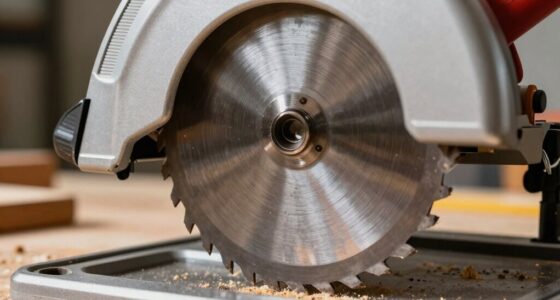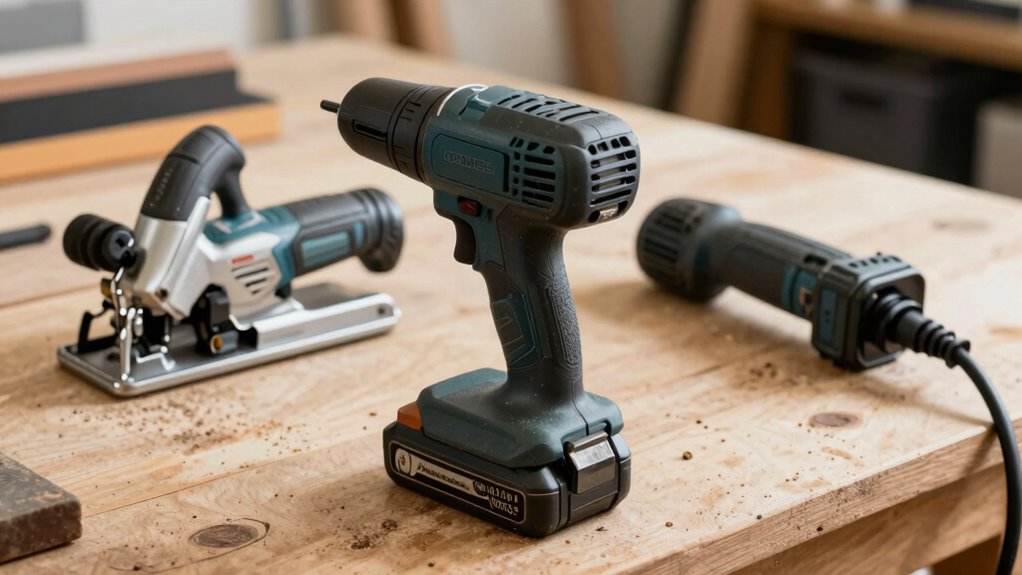

In daily use, choosing a cordless track saw gives you mobility and quick setup, making it ideal for remote jobsites or when you need to move around often. However, you’ll need to watch your battery levels and deal with limited runtime. A corded saw offers consistent power and is better for lengthy, precise cuts but restricts your movement due to the cord. Keep exploring to discover how these differences can shape your workday even further.
Key Takeaways
- Cordless track saws offer increased mobility and quick setup, ideal for remote or on-site work.
- Corded track saws provide consistent power for prolonged, precise cuts without battery concerns.
- Battery life limits continuous cordless operation, requiring monitoring or charging during busy tasks.
- Cordless models are lighter, reducing fatigue, while corded saws are generally more durable and suitable for heavy-duty use.
- Future battery advancements may influence the balance of convenience versus power in daily work.
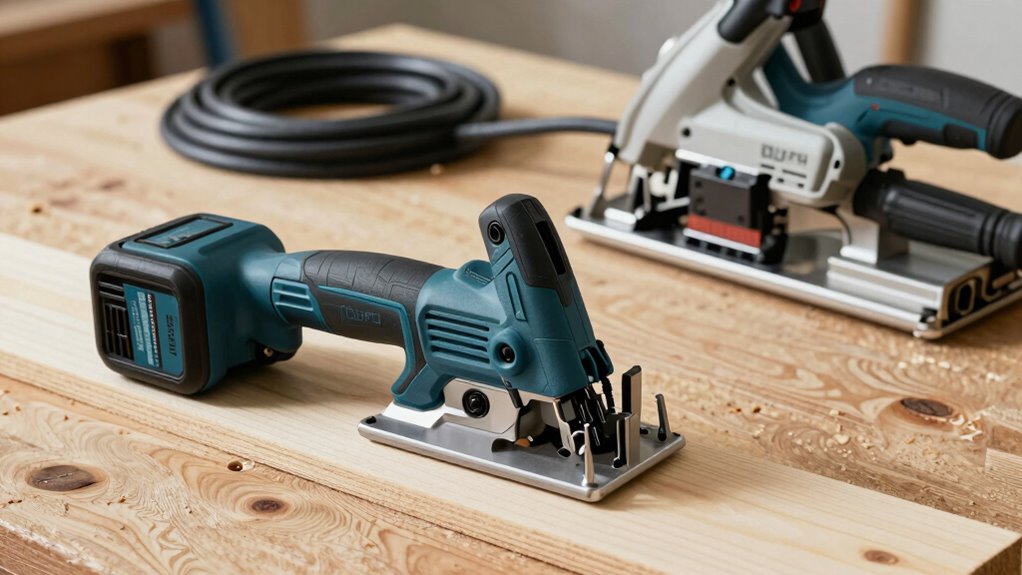
Are cordless and corded track saws truly interchangeable, or do their differences considerably impact your cutting tasks? The answer depends on how you work and what your priorities are. Cordless track saws offer the freedom to move around without being tethered to a power outlet, which can be a game-changer for job sites or projects in remote locations. However, they come with limitations, mainly centered around battery life. You might find yourself pausing work to recharge or swap batteries, especially during prolonged or intensive tasks. This can slow down your workflow and introduce unexpected delays. On the other hand, corded track saws provide consistent power without interruption, ensuring that your cuts remain precise and steady throughout the job. The power consistency they deliver is often superior, especially when dealing with thicker or denser materials that demand sustained energy.
When you consider daily use, these differences become more apparent. A cordless saw’s convenience is undeniable—you won’t trip over cords or worry about power outlets nearby. Yet, you need to keep an eye on the battery level and plan your work around charging times, which can be inconvenient if you’re working on a large project. The trade-off is that modern lithium-ion batteries tend to offer impressive runtime, but their capacity still limits continuous use, especially when you’re pushing the tool to its limits. In addition, advancements in battery technology are continuously enhancing performance, but the limitations still influence daily workflow. Notably, ongoing research in power storage is expected to further improve battery efficiency in the future.
The choice ultimately hinges on your typical workload and environment. If you prioritize mobility and quick setups, a cordless saw might suit you best. But if your work involves lengthy sessions or requires consistent power for precision cuts, a corded model could be more reliable. Also, think about the weight: cordless saws tend to be lighter, which can reduce fatigue during extended use, yet their batteries add bulk. Conversely, corded saws are generally heavier but more straightforward in their design, often resulting in greater durability and lower maintenance.

WEN Cordless 6.5-Inch Track Saw, Brushless with Variable Speed, Two 20V Max 4.0 Ah Batteries, and Charger (20691)
Ditch the table saw: rip boards up to 2.25 inches thick or create 45-degree bevel cuts in boards…
As an affiliate, we earn on qualifying purchases.
As an affiliate, we earn on qualifying purchases.
Frequently Asked Questions
How Does Battery Life Impact Long-Term Projects?
Battery life considerably impacts your long-term projects. If your cordless saw has high battery capacity, you get longer sessions without frequent recharges, ensuring power consistency throughout the day. However, limited battery life can cause interruptions, slowing progress and requiring downtime to swap or recharge batteries. For sustained work, choose a saw with ample battery capacity to maintain power consistency, so your project stays on track without frustrating delays.
Are Cordless Track Saws Suitable for Heavy-Duty Tasks?
Cordless track saws can handle heavy-duty tasks if they have high battery capacity and power capacity. Look for models with robust batteries that provide longer run times and strong motors for demanding cuts. While they’re portable and convenient, make certain the saw’s specifications match your project’s intensity. For consistent performance on tough jobs, choose a cordless saw designed with high-capacity batteries and ample power capacity, just like corded models.
What Maintenance Is Required for Corded Vs Cordless Models?
Think of your track saw as a finely tuned orchestra. For corded models, you’ll need to regularly check blade maintenance, ensuring the blade stays sharp and clean, and manage the cord to prevent tangles during use. Cordless saws require less cord management but still need occasional blade checks and battery care, like keeping the contacts clean and batteries charged. Both need proper maintenance to keep your projects precise and safe.
Do Cordless Saws Perform Well in Outdoor Conditions?
Cordless saws perform well outdoors, especially when battery performance is reliable. Modern models are designed with weather resilience in mind, handling light rain or humidity better than before. However, extreme weather conditions can still impact their performance, so it’s best to avoid using them in heavy rain or wet environments. Overall, for outdoor tasks, cordless saws offer great portability and convenience, with advancements making them increasingly dependable under various weather conditions.
How Does Weight Difference Affect User Fatigue?
A lighter saw is like a feather in your hand, easing your workday. When you choose a lighter cordless track saw, it improves ergonomics and reduces user fatigue, making it easier to maneuver for extended periods. Heavier models may cause strain, especially during precise cuts or sustained use. So, prioritize weight to stay comfortable, maintain control, and get the job done efficiently without wearing yourself down.
corded track saw
As an affiliate, we earn on qualifying purchases.
As an affiliate, we earn on qualifying purchases.
Conclusion
In the end, choosing between a cordless or corded track saw is like picking your adventure partner—each has its own rhythm. Picture yourself effortlessly gliding through plywood, the cordless’s freedom letting you move freely, while the corded’s steady power keeps your focus sharp. Think about your daily tasks, the way sunlight filters through the workshop window, and pick the tool that feels like an extension of your hand—ready to turn your woodworking dreams into reality.
battery-powered track saw
As an affiliate, we earn on qualifying purchases.
As an affiliate, we earn on qualifying purchases.
professional track saw for woodworking
As an affiliate, we earn on qualifying purchases.
As an affiliate, we earn on qualifying purchases.