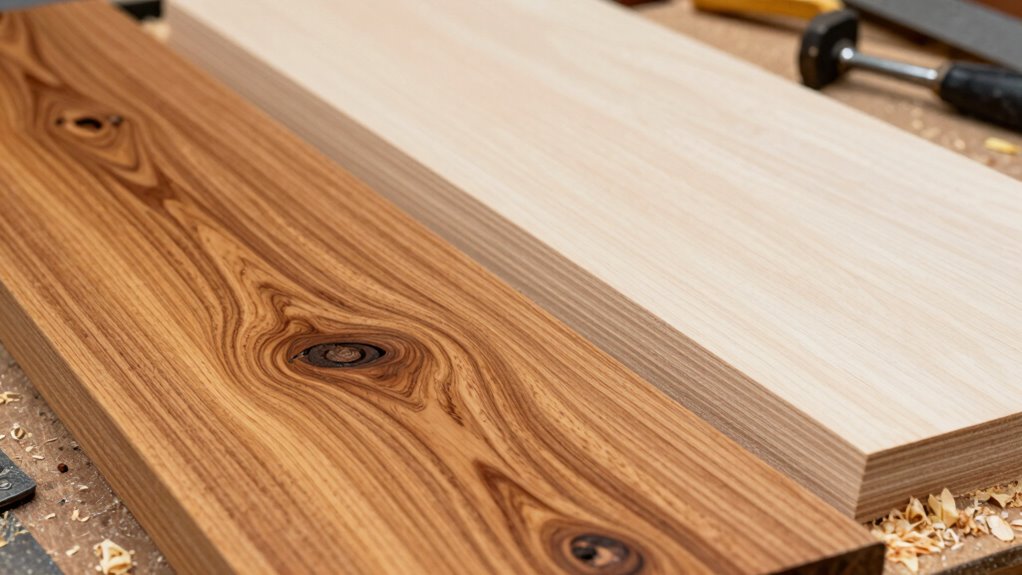

When routing hardwood, you’ll notice a stable, consistent surface that’s easier to shape sharply and cleanly, often requiring fewer finishing steps. Plywood, with layered edges and varied grain, can chip or splinter easily if not routed carefully, needing specialized bits or edge banding. Your techniques should adapt based on these properties to avoid damage and achieve a pristine finish. If you keep exploring, you’ll discover detailed tips to optimize your routing process for both materials.
Key Takeaways
- Hardwood provides a uniform, dense surface ideal for clean, sharp edges, while plywood edges reveal layered structures requiring special finishing.
- Routing hardwood along the grain yields smooth edges, whereas plywood’s layered grain increases the risk of splintering and requires careful technique.
- Plywood often needs edge banding or sealing after routing due to its layered cross-section, unlike hardwood which usually needs less finishing.
- Material properties like density and grain structure influence routing difficulty and final edge quality differently for hardwood and plywood.
- Proper bit selection and routing techniques tailored to each material are essential to achieve clean, professional edges in both hardwood and plywood.

When deciding between routing hardwood and plywood, understanding their differences can considerably impact your project’s outcome. One vital aspect to consider is how each material responds to routing, especially when it comes to edge finishing and grain alignment. Hardwood provides a consistent, dense surface that allows for clean, sharp edges after routing. Its fine grain and tight fibers mean you can achieve precise edge finishing with minimal chipping or splintering. If your project demands smooth, detailed edges, hardwood is often the better choice because it accepts routing tools well, giving you a crisp, professional look. Plywood, on the other hand, is made of multiple layers, and its edge reveals the cross-section of these layers. Routing plywood can be trickier because the layers might splinter or chip if you’re not careful. To improve edge finishing on plywood, you might need to use specialized bits or apply edge banding afterward. Grain alignment is another critical factor. Hardwood has a uniform grain pattern that runs consistently in one direction, so routing along the grain enhances the smoothness and reduces tear-out. Routing against the grain can cause splintering, which compromises both the look and structural integrity of your edges. With plywood, the grain orientation varies across layers, and routing can sometimes cause splintering or uneven edges if the layers are not aligned properly. When routing plywood, you need to pay close attention to grain directions on each layer, especially if you’re aiming for a smooth, finished edge. Proper planning can help you minimize tear-out and achieve a cleaner edge finish. Additionally, edge finishing on plywood often involves sealing or covering the layered edges with edge banding or veneers to hide the layer lines and give a more polished appearance. In contrast, hardwood’s homogeneous surface means you can often skip extra edge finishing steps, making it quicker and easier to achieve a sleek look. Being aware of how each material responds to routing ensures you can plan your process accordingly, delivering a professional result regardless of your choice. Recognizing the grain structure and how it affects routing can help prevent common issues like chipping and splintering. Proper technique and understanding of material properties are essential for achieving high-quality results. Understanding the density and composition of each material can further guide your routing approach to prevent damage and ensure a smooth finish. Additionally, considering the moisture content of your materials can influence how they respond during routing, affecting the final quality of your edges. Being mindful of these factors can also help you select the appropriate routing bits to optimize your results.

Pattern Flush Trim Router Bit 1/4 Shank Carbide Tipped Router Template Bit
- Set Includes Five Bits: Various sizes for versatility
- High-Quality Precision: Ultra-sharp, long-lasting edges
- Durable Carbide Construction: Smooth, chip-free cuts
As an affiliate, we earn on qualifying purchases.
As an affiliate, we earn on qualifying purchases.
Frequently Asked Questions
How Does Routing Affect the Longevity of Hardwood Compared to Plywood?
Routing can impact the longevity of hardwood more than plywood because it enhances the grain and surface smoothness of the wood. When you route hardwood carefully, you minimize surface stress and reduce chances of cracks or splinters over time. Plywood, with its layered structure, handles routing better, but it doesn’t benefit from grain enhancement the same way. Overall, proper routing extends hardwood’s durability by improving its surface integrity.
Are There Specific Router Bits Recommended for Hardwood Versus Plywood?
You should choose specific bit recommendations for hardwood and plywood based on your cutting techniques. For hardwood, use sharp, carbide-tipped bits like straight or spiral bits to guarantee clean cuts and reduce splintering. For plywood, opt for down-cut bits to minimize tear-out on the surface. Always match your bits to the material and cutting style, and keep them sharp for the best results in your routing projects.
What Are the Safety Concerns When Routing Hardwood or Plywood?
You might worry about safety when routing hardwood or plywood, but focusing on dust control and noise reduction helps you stay safe. Wear a dust mask and safety glasses to protect your lungs and eyes, and use hearing protection to reduce noise. Keep your workspace clean and secure your material firmly. These precautions prevent injuries, keep the environment healthier, and make your routing experience safer and more enjoyable.
How Does Routing Impact the Environmental Sustainability of Each Material?
Routing impacts the environmental sustainability of hardwood and plywood through eco-friendly practices and material recycling. When you router hardwood, you generate less waste since it’s a natural, durable material that can be repurposed easily. Plywood, made from layers of recycled wood veneer, already promotes material recycling. By choosing eco-conscious routing techniques, you reduce waste and energy consumption, helping both materials stay environmentally sustainable.
Can Routing Techniques Be Adjusted for Different Project Complexities?
Yes, you can adjust routing techniques for different project complexities by focusing on routing precision and tool maintenance. For intricate designs, use finer bits and slower speeds to improve detail, while larger bits and faster speeds suit simpler projects. Regularly maintaining your tools guarantees clean cuts and prevents damage, allowing you to adapt effectively. This way, you achieve ideal results regardless of project complexity.

BEVTEE Wood Edge Banding 3/4 in × 50 ft, Iron on Birch Plywood Veneer Roll
- Length and Width: 50 ft x 3/4 inch roll
- Thickness: 0.6 mm thick
- Application Method: Iron-on adhesive
As an affiliate, we earn on qualifying purchases.
As an affiliate, we earn on qualifying purchases.
Conclusion
Ultimately, whether you’re routing hardwood or plywood, the key is understanding how each material responds to your tools. It’s a coincidence of sorts—your technique and the material’s nature intersect to determine the outcome. With a bit of practice, you’ll find that the subtle differences become second nature, revealing that the real change isn’t just in the material, but in how you work with it. Embrace these nuances, and your projects will speak for themselves.

EilxMag 100 Pieces Router Bit Set, Router Bits 1/4 Inch Shank with Aluminum Storage Case Tungsten Carbide Router Bits Kit for Professional Woodworking
- Durable Alloy Steel Construction: High-quality alloy steel with coating
- Precise Tungsten Carbide Blades: Cuts cleanly and accurately on all woods
- Heat-Resistant Design: Excellent heat resistance for prolonged use
As an affiliate, we earn on qualifying purchases.
As an affiliate, we earn on qualifying purchases.

JORGENSEN Chamfer Plane, Edge Corner Plane, 4 Cutter Heads Built-In Storage
- Professional Blade Material: O1 tool steel for durability and efficiency
- Multiple Tip Shapes: Four different shaped cutter tips included
- Built-In Blade Storage: Secure storage at the end of the tool
As an affiliate, we earn on qualifying purchases.
As an affiliate, we earn on qualifying purchases.



![How Blackwing Pencils Are Made [Video]](https://woodworkslibrary.com/wp-content/uploads/2026/08/how-blackwing-pencils-are-made-video-featured-260x140.jpg)