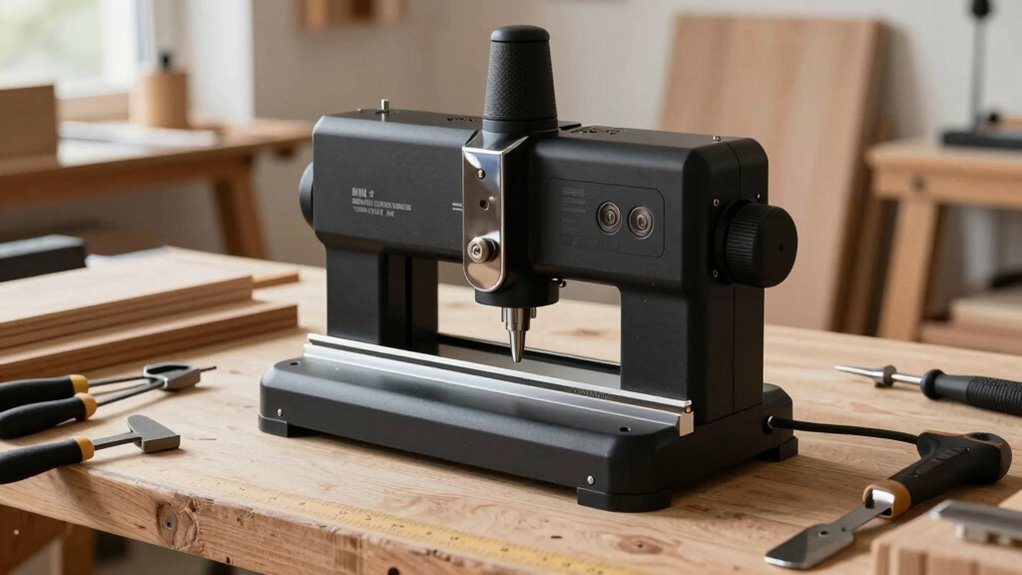
If you are choosing a loose tenon joiner for a small shop, my shortlist comes down to two different ways to make mortises. The Kreg MortiseMate is the more self-contained option, using a drill and integrated clamping features for straightforward work on stock from 1/2 to 1 1/2 inches thick. The Woodpeckers MJ-24 turns a plunge router into a portable benchtop mortiser, with travel stops and scales that suit repeatable batches. My main tradeoff is simple, drill-based setup versus router-based repeatability: the Kreg asks less of your tool setup, while the Woodpeckers needs a compatible plunge router and more bench space. I rank them by how well each fits a compact shop’s joinery needs, not by treating them as interchangeable machines.

Get business pricing on tools and workshop supplies
- Business-only prices and quantity discounts
- Tax-exempt purchasing
- Multiple users, one account, clear invoices
Complete the kit


Key Takeaways
- The Kreg MortiseMate is my pick for a compact, drill-based workflow and stock between 1/2 and 1 1/2 inches thick.
- The Woodpeckers MJ-24 is better suited to repeated, controlled mortises when you already own a plunge router.
- The MJ-24’s stated maximum mortise length is 3 1/2 inches; the supplied details do not specify the Kreg’s maximum mortise length.
- Kreg’s integrated work surface and trigger-style clamps help reduce setup steps for panel and 90-degree joints.
- Neither is a complete fit for every small shop: Kreg’s thickness range is limited, while the MJ-24 depends on a plunge router and takes a more involved tool setup.
| Kreg MortiseMate Loose Tenon Jig |  | Best Overall for a Compact, Drill-Based Setup | Power source: Manual | Stated workpiece thickness: 1/2 to 1 1/2 inches | Depth adjustment: Auto-indexing steps in 1/16-inch increments | VIEW ON AMAZON | See Our Full Breakdown |
| Woodpeckers MJ-24 Mortising Jig for Plunge Router |  | Best for Repeatable Router-Based Mortising | Tool required: Plunge router | Maximum mortise length: 3 1/2 inches | Travel controls: Adjustable travel stops | VIEW ON AMAZON | See Our Full Breakdown |
| loose tenon joiner for a small shop | Model number | Power source | Stated workpiece thickness | Depth adjustment |
|---|---|---|---|---|
| Kreg MortiseMate Loose Tenon J | KLTJ100 | Manual | 1/2 to 1 1/2 inches | Auto-indexing steps in 1/16-inch increments |
| Woodpeckers MJ-24 Mortising Ji | MJ-24 | — | — | — |
More Details on Our Top Picks
Kreg MortiseMate Loose Tenon Jig
The Kreg MortiseMate earns my top spot for a small shop because its workflow is comparatively self-contained: use a drill, position the work on the integrated mini surface, and secure it with the built-in trigger-style clamps. That arrangement can be appealing when bench space and setup time matter more than producing a long run of identical mortises. Its supported stock thickness of 1/2 to 1 1/2 inches gives the buyer a clear fit range for furniture parts, panels, and other modest-sized workpieces.
Its main point of difference is the auto-indexing step-down mechanism, which lowers the cutter tip in 1/16-inch increments. That gives the operator a controlled way to work toward depth rather than relying on one uninterrupted plunge. Micro-adjustment screws and laser-etched markings also help with width and depth settings, while the clamps are intended to simplify panel and right-angle setups. Compared with the Woodpeckers MJ-24, this is the more approachable route if you do not already want a plunge-router-based mortising station.
The tradeoff is that the Kreg’s convenience comes with boundaries. Its stated thickness range rules out stock outside that window, and the supplied details do not give a maximum mortise length, so I would verify capacity before planning unusually long joints. Manual operation may also feel slower than a powered mortising system, particularly on batches. The listed specifications identify a drill press as the drill type, while the description says the jig cuts using a drill; I would check the manufacturer’s instructions for the intended drill configuration before purchase. This pick makes the most sense when its capacity matches your work and simple clamping matters more than batch-oriented travel stops.
Pros:- Auto-indexing depth steps lower the cutter in 1/16-inch increments.
- Integrated mini work surface and trigger-style clamps support quick workholding.
- Micro-adjustment screws and laser-etched markings aid width and depth setup.
- Uses a drill-based approach rather than requiring a dedicated plunge-router jig setup.
Cons:- Limited to workpieces from 1/2 to 1 1/2 inches thick.
- Manual operation may take longer than a powered mortising workflow.
- Maximum mortise length is not specified in the supplied details.
Best for: Small-shop woodworkers making occasional panel or 90-degree joints in stock from 1/2 to 1 1/2 inches thick, especially those who prefer a drill-based jig with integrated workholding.
Not ideal for: Buyers working outside the stated stock-thickness range, planning long mortises without first confirming capacity, or producing large batches where a router jig’s adjustable travel stops may better suit the workflow.
- Power source:Manual
- Stated workpiece thickness:1/2 to 1 1/2 inches
- Depth adjustment:Auto-indexing steps in 1/16-inch increments
- Adjustment aids:Micro-adjustment screws and laser-etched markings
- Workholding:Integrated mini work surface and trigger-style clamps
- Material:Metal
- Included component:Carbide-tipped mortising cutter
- Model number:KLTJ100
Our verdict“I recommend the MortiseMate as the more self-contained small-shop pick when your stock fits its stated range and you value integrated clamping over router-based batch controls.”
Woodpeckers MJ-24 Mortising Jig for Plunge Router
The Woodpeckers MJ-24 is the stronger choice for a small shop that already has a plunge router and expects to make matching mortises across multiple parts. Rather than supplying its own cutting motor, it converts the router into a portable benchtop mortiser. That makes it less self-contained than the Kreg MortiseMate, but the adjustable travel stops and laser-engraved scales offer a more explicit route to repeating a setup from one workpiece to the next.
Its listed maximum mortise length is 3 1/2 inches, giving buyers a concrete figure for project planning. The phenolic work surface, powder-coated steel base, and stainless-steel scales are also relevant to a shop tool that needs a stable working platform and readable settings. Compared with the Kreg, the MJ-24 is the more batch-minded option: its controls are aimed at setting travel consistently, while Kreg’s selling points center on its integrated clamping and stepped manual depth approach.
That difference only helps if the rest of your shop supports it. The MJ-24 requires a plunge router, so a buyer without one must account for that additional tool and its compatibility with the jig. The supplied details do not state a full range of mortise widths, stock thicknesses, or every supported router, so I would confirm those points before choosing it for a specific project. It is also described as a higher-cost option than basic jigs, and a more involved setup may be unnecessary for occasional joinery. I would choose it over the Kreg for repeated, controlled router work, not simply because its construction sounds more substantial.
Pros:- Adjustable travel stops support repeatable mortise placement and length.
- Laser-engraved scales make settings easier to reference between parts.
- Lists a maximum mortise length of 3 1/2 inches for project planning.
- Phenolic surface, powder-coated steel base, and stainless-steel scales form a substantial jig platform.
Cons:- Requires a plunge router, adding a tool and compatibility check to the setup.
- Higher-cost than basic jigs, according to the supplied product information.
- The supplied details do not state its full stock-thickness or mortise-width capacity.
Best for: Woodworkers who already own a compatible plunge router and want adjustable stops and scales for making repeatable mortises, with a stated maximum length of 3 1/2 inches.
Not ideal for: Beginners seeking a self-contained jig, buyers without a plunge router, or anyone whose work requires capacity details that have not been confirmed, such as a specific stock-thickness range.
- Tool required:Plunge router
- Maximum mortise length:3 1/2 inches
- Travel controls:Adjustable travel stops
- Scale markings:Laser-engraved scales
- Work surface:Phenolic
- Base:Powder-coated steel
- Scale material:Stainless steel
- Model number:MJ-24
- Origin:Made in the USA
Our verdict“I would choose the MJ-24 over the Kreg when I already own a compatible plunge router and want a jig oriented toward repeatable batches rather than the simplest standalone workflow.”

How We Picked
I ranked these two jigs around the practical constraints of a small woodworking shop: limited bench area, existing tools, setup time, and the kinds of stock a woodworker can reliably hold and machine. Since the supplied information does not establish a head-to-head test, I do not claim measured speed, accuracy, or durability beyond the stated features. Instead, I compare what each design offers and the work patterns those features support.
The first distinction is the drive system. The MortiseMate uses a drill and has an integrated clamping surface, so it is the more self-contained choice for a buyer who wants a dedicated jig without adding a plunge router to the process. Its stated stock range is 1/2 to 1 1/2 inches, which gives a useful boundary for deciding whether it fits common project parts. The MJ-24 requires a plunge router, but adjustable travel stops and laser-engraved scales point toward repeatable setups, especially when making a run of matching parts.
I also weighed scope and tradeoffs. The Woodpeckers lists a maximum mortise length of 3 1/2 inches, a useful planning detail, while no maximum length is supplied for the Kreg. The Kreg’s micro-adjustment screws, step-down depth mechanism, and clamps make its setup approach clear, but its manual operation may take longer than a powered mortising workflow. I gave each product a distinct role: Kreg for accessible, compact joinery and Woodpeckers for router-based repeatability. A buyer should still confirm compatibility, capacity, and the actual instructions before committing to a particular project.
| loose tenon joiner for a small shop | Model number |
|---|---|
| Kreg MortiseMate Loose Tenon J | KLTJ100 |
| Woodpeckers MJ-24 Mortising Ji | MJ-24 |
Factors to Consider When Choosing Loose Tenon Joiner For A Small Shop
I would choose between these jigs by matching the tool workflow to the work you actually do, then checking capacity before buying. The Kreg favors an integrated, drill-based process; the Woodpeckers favors plunge-router control and repeatable setups.Start with the tools already in your shop
The Kreg MortiseMate is the clearer fit if you want a drill-based jig with its own small work surface and clamps. The Woodpeckers MJ-24 is built around a plunge router, so it makes more sense when that tool is already part of your shop and you are comfortable setting it up for mortising. If you would need to buy or rearrange tools to use the MJ-24, compare that added setup with the Kreg’s more direct workflow rather than focusing only on the jig itself.
The Kreg specifications list manual power and identify a drill press under drill type, while the description says it works using a drill. Because the information does not fully resolve that distinction, check the maker’s current instructions for the exact tool arrangement. For the MJ-24, confirm that your router is compatible before planning around it.
Match capacity to your stock and joint dimensions
Kreg lists supported stock thickness from 1/2 to 1 1/2 inches. That provides a useful boundary, but it does not answer every capacity question: the supplied details do not state a maximum mortise length. The MJ-24 lists a 3 1/2-inch maximum mortise length, but the supplied information does not give its complete stock-thickness or mortise-width range.
Before choosing either jig, write down the thickest and thinnest parts you expect to join and the mortise dimensions your project calls for. Do not assume that a stated mortise length tells you the supported stock thickness, or that one model’s figures can be applied to the other. When a dimension is missing, confirm it with the manufacturer instead of building a project plan around an assumption.
Decide whether simple setup or repeatability matters more
For occasional joinery, Kreg’s integrated workholding and trigger-style clamps can be a practical advantage. They are intended to help secure pieces for panel and right-angle joints without relying on a separate jig arrangement. Its stepped depth control and micro-adjustments provide settings to work with, though the manual process may be slower than a powered workflow.
For a group of similar parts, the MJ-24’s adjustable travel stops and engraved scales are the more relevant distinction. They are designed to help repeat a setting, not to remove the need for careful setup. Decide how often you will make matching joints: if most projects involve only a few mortises, the Kreg’s simpler approach may suit you better; if repeated positioning is routine, the Woodpeckers may fit your habits.
Plan for bench space and workholding
A small-shop jig should fit the way you use your bench, not just the storage shelf. The Kreg includes a mini work surface and clamps, which can reduce the need to assemble a separate workholding setup for the described joint types. The MJ-24 has a phenolic surface and steel base, but it still needs a plunge router mounted or used as intended by the maker. Check the footprint, access to controls, and room to support long workpieces before reserving a spot.
Also plan for safe, stable support of the work and the router or drill. A jig can guide a cut, but it does not make an awkward or poorly secured workpiece safe. Consult each product’s instructions for clamping, cutter selection, depth settings, and tool compatibility.
Choose the tradeoff you can live with
My ranking puts the MortiseMate first for general small-shop fit because its stated stock range, integrated surface, and drill-based approach make its intended role easy to understand. It is not the best choice for every project: the thickness limit and unspecified maximum mortise length are real constraints. The MJ-24 ranks first for router-based repeatability, but it is a more conditional recommendation because it depends on a plunge router and the supplied details leave other capacity questions open.
In short, buy the Kreg when its dimensions match your work and a compact, clamped setup is your priority. Choose the Woodpeckers when a plunge router is already available and repeated travel settings matter more than keeping the operation self-contained.
Frequently Asked Questions
Which loose tenon jig is the better fit for a small shop?
I give the Kreg MortiseMate the broader small-shop recommendation because it includes a mini work surface and trigger-style clamps and is described as using a drill. The Woodpeckers MJ-24 can be the better choice for a shop already set up around a plunge router, particularly when repeating mortise settings is a priority. Your stock dimensions and existing tools should decide between them.
Does the Woodpeckers MJ-24 include a router?
No router is listed as included in the supplied product details. The MJ-24 is a jig that requires a plunge router to function. I would check the manufacturer’s compatibility information for your router before purchase, since the provided details do not list specific supported router models.
What stock thickness does the Kreg MortiseMate support?
The supplied description gives a workpiece thickness range of 1/2 to 1 1/2 inches. If your parts fall outside that range, the MortiseMate may not suit the job. The supplied product information does not state a maximum mortise length, so verify that capacity separately if your joint design depends on it.
Which model is better for making a batch of matching mortises?
The Woodpeckers MJ-24 is the more batch-oriented option in this comparison because it has adjustable travel stops and laser-engraved scales intended to support repeatable settings. That advantage is most useful when you already have a compatible plunge router and have confirmed the jig’s capacity for your parts. Kreg offers adjustment features too, but its description puts more emphasis on step-down depth control and integrated clamping.
What should I verify before ordering either jig?
Check the required tool, workpiece thickness, mortise length and width, and workholding method against your project plans. For Kreg, confirm the intended drill configuration and ask about maximum mortise length if that dimension matters. For Woodpeckers, confirm plunge-router compatibility and the stock-thickness and mortise-width capacities, which are not stated in the supplied details. Also check the footprint and follow the manufacturer’s operating and safety instructions.
Conclusion
For a small shop seeking a straightforward, drill-based setup, I recommend the Kreg MortiseMate—provided your workpieces stay within its 1/2-to-1 1/2-inch range and its unlisted mortise-length capacity suits your joints. For a woodworker who already owns a compatible plunge router and wants to repeat settings across a batch, I recommend the Woodpeckers MJ-24, with its travel stops and stated 3 1/2-inch maximum mortise length. If router compatibility or capacity remains uncertain, verify those details before ordering. The best choice is the jig that fits your stock, tools, and usual workload, not simply the one with the longer feature list.