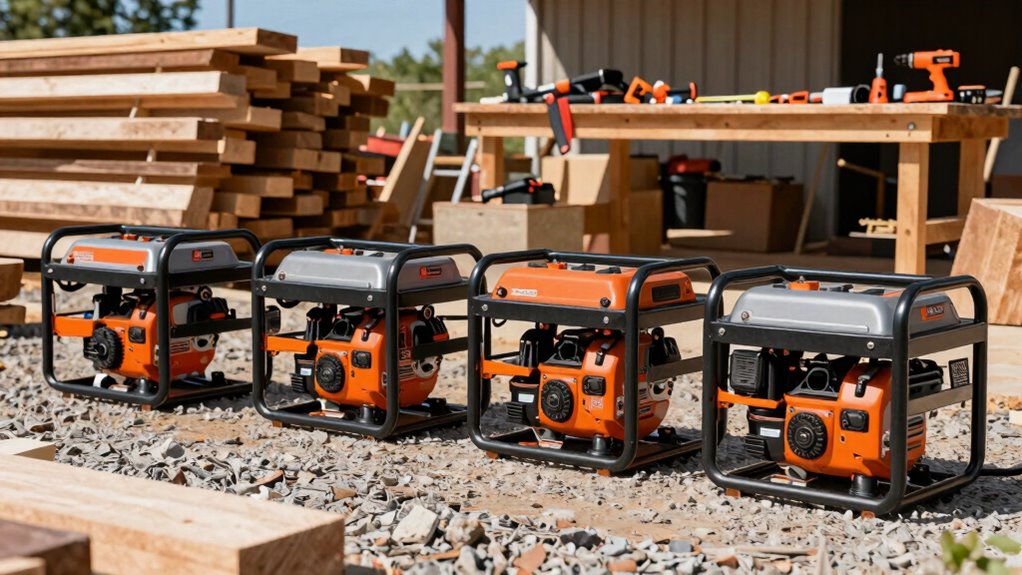

For professional jobsite woodworking, I’d put the Champion 11,000-Watt Wireless Remote Start Portable Inverter Generator first for shops that need substantial output, while the Westinghouse 5000 Peak Watt is a more manageable fit for a smaller tool setup and the Honda EB2200i suits lighter, carefully prioritized work. The main choice is between enough capacity for demanding startup loads and a generator that is easier to move, quieter, or more economical to run. Fuel flexibility and runtime also matter when a crew works far from reliable refueling. No generator should be sized from peak watts alone: check the running and startup requirements of the tools you plan to power. Read on for the full breakdown of where each of these 11 models fits—and where its tradeoffs may rule it out.

Get business pricing on tools and workshop supplies
- Business-only prices and quantity discounts
- Tax-exempt purchasing
- Multiple users, one account, clear invoices
Complete the kit


Key Takeaways
- The Champion 11,000-watt model leads for capacity: it is the clearest fit in this lineup for a professional crew with multiple high-draw tools, though its size and fuel use make it less appealing for frequent solo transport.
- The two large dual- and tri-fuel options prioritize job flexibility: the Westinghouse 12000 and WEN 13,000-watt tri-fuel models suit buyers who value output and fuel choice more than compact handling.
- The middle-output choices are more practical for limited tool lists: the Westinghouse 5000, GENMAX 6000W, and WEN 3800W offer a more manageable scale, but buyers must check simultaneous loads and motor startup surges.
- The Honda EB2200i is a niche pick, not a whole-jobsite solution: its lower output favors a small, deliberately sequenced setup rather than running several woodworking machines at once.
- Several listings leave important comparisons unresolved: the 3000W, Oxseryn 4400W, and Westinghouse iGen4000DFcv may fit lighter work, but buyers should verify continuous wattage, receptacle type, and exact model specifications before choosing them for professional tools.
| Champion 11,000-Watt Wireless Remote Start Portable Inverter Generator |  | Best for High-Demand Shop Loads | Starting watts: 11,000 | Running watts: 9,000 | Engine displacement: 459cc | VIEW ON AMAZON | See Our Full Breakdown |
| Westinghouse 12000 Peak Watt Dual Fuel Portable Inverter Generator with Remote Electric Start and Transfer Switch Ready |  | Best for Fuel Flexibility | Peak power: 12,000W | Running power: 9,000W | Fuel types: Gasoline and propane | VIEW ON AMAZON | See Our Full Breakdown |
| Westinghouse 5000 Peak Watt Super Quiet Portable Inverter Generator with Remote Start |  | Best for Noise-Sensitive Sites | Peak watts: 5,000 | Fuel tank capacity: 3.4 gallons | Noise level: 52 dBA | VIEW ON AMAZON | See Our Full Breakdown |
| GENMAX Portable Inverter Generator, 6000W Gas-Powered with Electric Start, Lightweight for Home Backup & Job Site |  | Best Mid-Range Jobsite Fit | Starting watts: 6,000 | Running watts: 5,250 | Fuel type: Gasoline | VIEW ON AMAZON | See Our Full Breakdown |
| Honda EB2200i 2200 Watt 120V Super Quiet Inverter Generator |  | Best Compact Commercial Option | Starting watts: 2,200 | Running watts: 1,800 | Fuel type: Gasoline | VIEW ON AMAZON | See Our Full Breakdown |
| WEN Super Quiet 3800-Watt RV-Ready Portable Inverter Generator with Fuel Shut-Off and Electric Start |  | Best for Quiet, Steady Shop Power | Surge output: 3,800 watts | Engine: 212cc 4-stroke OHV | Noise level: 57 dB at quarter load | VIEW ON AMAZON | See Our Full Breakdown |
| WEN 13,000-Watt Tri-Fuel Inverter Generator with Quiet 550cc Engine, Electric Start, and CO Watchdog |  | Best for High-Demand, Multi-Tool Crews | Surge output: 13,000 watts gasoline; 11,250 watts propane; 10,000 watts natural gas | Running output: 10,500 watts gasoline; 9,000 watts propane; 8,000 watts natural gas | Engine: 550cc 4-stroke OHV | VIEW ON AMAZON | See Our Full Breakdown |
| AIVOLT 11250W Dual Fuel Inverter Generator 50A for Home Backup |  | Best for Extended Runs and Dual-Fuel Flexibility | Starting output: 11,250 watts gasoline; 10,570 watts propane | Running output: 9,000 watts gasoline; 8,540 watts propane | Fuel types: Gasoline and propane | VIEW ON AMAZON | See Our Full Breakdown |
| 3000W Inverter Generator, Ultra Quiet Portable Gas Generator for RV and Camping |  | Best Compact Pick for One Tool at a Time | Starting output: 3,000 watts | Running output: 2,350 watts | Engine: 97.7cc 4-stroke OHV | VIEW ON AMAZON | See Our Full Breakdown |
| Oxseryn Power Equipment 4400 Watts Inverter Generator Gas Powered, Portable Open Frame Generator, Low Noise with ECO Mode, RV Ready, Emergency Home Backup |  | Best Value-Style Power for a Small Crew | Peak output: 4,400 watts | Running output: 3,400 watts | Fuel tank: 2 gallons | VIEW ON AMAZON | See Our Full Breakdown |
| Westinghouse iGen4000DFcv Dual Fuel Inverter Generator with Wheels & Handle Kit |  | Best Compact Dual-Fuel Pick | Peak watts: 4,000 | Fuel type: Gasoline and propane | Run time: Up to 7 hours | VIEW ON AMAZON | See Our Full Breakdown |
| inverter generator for jobsite woodworking for professional woodworking | Noise level | Outlets | Warranty | Runtime |
|---|---|---|---|---|
| Champion 11,000-Watt Wireless | 64 dBA from 23 feet | Two 120V 20A GFCI duplex outlets; 120/240V 30A locking outlet; 120/240V 37.5A outlet; 12V automotive outlet | 3-year limited | — |
| Westinghouse 12000 Peak Watt D | 64 dBA | 50A; 30A twist lock; GFCI 20A duplex | — | — |
| Westinghouse 5000 Peak Watt Su | 52 dBA | 120V duplex; RV-ready TT-30R; two USB outlets | — | — |
| GENMAX Portable Inverter Gener | — | — | — | Up to 9 hours at 50% load |
| Honda EB2200i 2200 Watt 120V S | — | — | 3 years | 8 hours |
| WEN Super Quiet 3800-Watt RV-R | 57 dB at quarter load | — | 2 years | Up to 8.5 hours at half load |
| WEN 13,000-Watt Tri-Fuel Inver | — | Two 120V 5-20R, 120V/240V 14-50R, 120V L5-30R, 120V 10-50R, 12V DC, two USB | 3 years | 7.7 hours at half load |
| AIVOLT 11250W Dual Fuel Invert | 60 dBA at 23 feet | — | 2 years | Up to 19 hours |
| 3000W Inverter Generator | 53–56 dB | Dual 120V 20A, USB-A, USB-C, 12V DC | — | — |
| Oxseryn Power Equipment 4400 W | Under 72 dBA | — | — | Up to 14 hours at 25% load |
| Westinghouse iGen4000DFcv Dual | 52 dBA | 5-20R duplex, TT-30R RV outlet, USB ports | 3-year limited | — |
More Details on Our Top Picks
Champion 11,000-Watt Wireless Remote Start Portable Inverter Generator
I rank the Champion as the strongest fit here for crews that need to run substantial jobsite woodworking equipment from one generator. Its 9,000 running watts and 120/240V outlets provide more capacity for a larger tool mix than the Westinghouse 5000 Peak Watt model, while the wireless remote start lets an operator start it without walking back to the unit. The 6.1-gallon tank is rated for up to 15 hours of runtime, which can reduce fuel stops during a long shift. The tradeoff is its size: at 64 dBA, it is not the quietest choice, and the listing provides no weight figure to help plan loading and transport. I’d choose it for power capacity, not frequent solo moves.
Pros:- 9,000 running watts support a larger combined tool load than the smaller inverter models here.
- 120/240V outlets, including a 37.5A outlet, offer multiple connection options for demanding equipment.
- Wireless remote start is useful when the generator is positioned away from the work area.
- Up to 15 hours of stated runtime helps limit refueling interruptions.
Cons:- The 64 dBA noise rating is higher than the Westinghouse 5000 Peak Watt model’s 52 dBA rating.
- Heavy, bulky construction can make transport and repositioning harder.
- The product data does not state weight, so transport planning is less clear.
Best for: Professional woodworking crews running several corded tools or higher-demand equipment at a fixed or semi-fixed jobsite.
Not ideal for: One-person crews who frequently load and unload a generator, or jobsites where low noise is a priority.
- Starting watts:11,000
- Running watts:9,000
- Engine displacement:459cc
- Tank capacity:6.1 gallons
- Run time:Up to 15 hours
- Noise level:64 dBA from 23 feet
- Outlets:Two 120V 20A GFCI duplex outlets; 120/240V 30A locking outlet; 120/240V 37.5A outlet; 12V automotive outlet
- Warranty:3-year limited
Our verdict“Choose the Champion when high output and longer work sessions matter more than compact transport or the quietest operation.”
Westinghouse 12000 Peak Watt Dual Fuel Portable Inverter Generator with Remote Electric Start and Transfer Switch Ready
For woodworking contractors who want a high-output generator with a backup fuel option, the Westinghouse iGen12000DFc is the clearest match. Its 9,000 running watts equal the Champion’s rating, but this model adds gasoline-and-propane operation and a 50A outlet, giving owners more ways to fuel or connect it when the jobsite setup changes. At up to 19 hours at 25% load, it also has the longest stated light-load runtime among these five. That figure is tied to a modest load, though, so it should not be read as a full-shift promise while running saws. Like the Champion, it is large and heavy; its advantages matter most when the generator can stay put. I’d skip it for mobile crews that prize easy handling over fuel choice and output.
Pros:- Dual-fuel operation gives crews a choice between gasoline and propane.
- 9,000 running watts and a 50A outlet suit higher-capacity setups.
- Up to 19 hours of runtime at 25% load can reduce refueling on lighter-duty runs.
- Remote electric start and a digital data center add convenience and operating information.
Cons:- Large, heavy construction makes frequent loading and unloading less practical.
- The stated 19-hour runtime applies at 25% load, not sustained heavy woodworking loads.
- Its high output may be more generator than a small crew needs for one or two tools.
Best for: Professional crews needing high-capacity power with the option to run on propane when gasoline access is limited.
Not ideal for: Woodworkers who need a compact generator to move between sites or expect long runtime while operating near full load.
- Peak power:12,000W
- Running power:9,000W
- Fuel types:Gasoline and propane
- Fuel tank capacity:7.9 gallons
- Runtime at 25% load:Up to 19 hours
- Engine:457cc 4-stroke OHV
- Noise level:64 dBA
- Outlets:50A; 30A twist lock; GFCI 20A duplex
- Parallel capable:Yes
Our verdict“Pick the iGen12000DFc if you need Champion-level running output plus propane flexibility and can accommodate a large generator.”
Westinghouse 5000 Peak Watt Super Quiet Portable Inverter Generator with Remote Start
The Westinghouse 5000 Peak Watt model is the quietest listed option here, with a stated 52 dBA noise level. That gives it an advantage over both large 64 dBA Westinghouse and Champion units when a woodworking setup is near occupied spaces or when noise from the generator would compete with communication. Its 5,000 peak watts can suit a limited tool setup, but the provided data does not give rated running watts, making sustained-load planning less certain than with the GENMAX GM6000XiE, which lists 5,250 running watts. The Westinghouse offers remote, electric, and recoil starting, plus up to 18 hours of runtime, though that runtime is not tied to a load level in the supplied specs. I’d favor it for quieter, moderate-duty work rather than several high-draw tools at once.
Pros:- 52 dBA noise rating is lower than the 64 dBA ratings listed for the Champion and Westinghouse iGen12000DFc.
- Remote, electric, and recoil starting offer multiple ways to start the unit.
- Up to 18 hours of stated runtime supports extended operation between refills.
- RV-ready TT-30R and USB outlets expand its usefulness beyond standard 120V tools.
Cons:- The supplied specs omit rated running watts, limiting confidence when planning sustained tool loads.
- Weight and dimensions are not provided, so portability is difficult to judge.
- Its 5,000 peak watts provide less headroom than the Champion or iGen12000DFc.
Best for: Woodworkers working near homes, occupied buildings, or other noise-sensitive areas with a modest tool load.
Not ideal for: Crews that need confirmed running-watt capacity for multiple demanding tools or want clearly stated transport dimensions and weight.
- Peak watts:5,000
- Fuel tank capacity:3.4 gallons
- Noise level:52 dBA
- Run time:Up to 18 hours
- Outlets:120V duplex; RV-ready TT-30R; two USB outlets
- Start types:Remote, electric, and recoil
Our verdict“Choose this Westinghouse for lower-noise work with a modest tool load, but favor a model with specified running watts for heavier shop demands.”
GENMAX Portable Inverter Generator, 6000W Gas-Powered with Electric Start, Lightweight for Home Backup & Job Site
The GENMAX GM6000XiE fills the practical middle ground: its 5,250 running watts give buyers a clearer sustained-output figure than the Westinghouse 5000 Peak Watt model, without stepping up to the Champion’s 9,000 running watts. That makes it a more grounded choice for a crew running a smaller combination of woodworking tools rather than trying to power a full shop. It has electric start, wheels, and a handle, but “lightweight” needs qualification: the stated 106.9-pound weight is still a substantial lift for one person. The tradeoff is runtime, listed at up to nine hours at 50% load, and gasoline-only operation. Compared with Honda’s EB2200i, it offers much more output but is far less convenient to carry and less suited to quiet, small-load work.
Pros:- 5,250 running watts provide a stated sustained-output figure for planning tool loads.
- Electric start avoids relying solely on recoil starting.
- Wheels and a handle support repositioning around a site.
- CO detection adds a listed safety feature.
Cons:- At 106.9 pounds, it remains heavy to lift despite the portable design.
- Runtime is listed at up to nine hours at 50% load, shorter than the long-runtime claims on larger alternatives.
- Gasoline-only operation offers less fuel flexibility than the Westinghouse iGen12000DFc.
Best for: Small professional crews needing mid-range running capacity, electric start, and wheeled repositioning at a jobsite.
Not ideal for: Solo mobile woodworkers who need a genuinely light carry, or crews needing dual-fuel operation or long runtime under load.
- Starting watts:6,000
- Running watts:5,250
- Fuel type:Gasoline
- Tank volume:3.8 gallons
- Engine displacement:312cc
- Runtime:Up to 9 hours at 50% load
- Voltage:120V
- Weight:106.9 pounds
Our verdict“Choose the GENMAX for a mid-sized crew that wants more stated running capacity than a compact inverter without moving up to a 9,000-watt unit.”
Honda EB2200i 2200 Watt 120V Super Quiet Inverter Generator
The Honda EB2200i makes the most sense when portability and modest tool demand outrank the ability to run several machines at once. Its 1,800 running watts and 47-pound-plus weight place it far below the GENMAX GM6000XiE in capacity, but make it a more manageable choice for a carpenter who needs to move a small generator between locations. The 120V output and two outlets suit a limited setup; they do not provide the headroom of the Champion or Westinghouse iGen12000DFc for a larger tool combination. Honda lists an eight-hour runtime and GFCI protection, while the recoil-only start is a clear convenience tradeoff beside the electric-start alternatives. I’d select it for light-duty jobsite tasks and transportability, not as the power source for a full woodworking station.
Pros:- At just over 47 pounds, it is easier to transport than the 106.9-pound GENMAX.
- 1,800 running watts suit a limited load where compact size matters more than broad capacity.
- GFCI protection is listed for jobsite use.
- Three-year warranty is stated in the product data.
Cons:- Its 1,800 running watts are far below the capacity of the GENMAX, Champion, and larger Westinghouse models.
- Recoil start only; it lacks the remote or electric start offered by several alternatives.
- The 0.95-gallon tank and eight-hour stated runtime mean it is not the strongest fit for extended, demanding shifts.
- The supplied product data says it is not available in California.
Best for: Solo finish carpenters or service woodworkers who need a portable generator for a limited 120V tool load.
Not ideal for: Crews operating multiple high-draw tools, needing electric start, or requiring more than 120V output.
- Starting watts:2,200
- Running watts:1,800
- Fuel type:Gasoline
- Voltage:120V
- Runtime:8 hours
- Tank volume:0.95 gallons
- Engine displacement:121cc
- Number of outlets:2
- Warranty:3 years
Our verdict“Pick the EB2200i when a light, compact generator for a small tool load matters more than high-output jobsite power.”
WEN Super Quiet 3800-Watt RV-Ready Portable Inverter Generator with Fuel Shut-Off and Electric Start
For a woodworking crew that values a quieter work area and needs enough capacity for a focused tool setup, the WEN 3800 is a more jobsite-friendly fit than the lightweight 3000W Inverter Generator, which has only 2,350 running watts. Its 3,400 rated watts can cover modest loads such as a jobsite saw or dust extractor, though I would check startup and simultaneous-load demands before relying on it for both. At 57 dB at quarter load, it is also a quieter choice than the open-frame Oxseryn, whose noise rating is under 72 dBA. The 2.2-gallon tank and stated half-load runtime of up to 8.5 hours reduce refueling interruptions, while wheels and a folding handle help with moves around the site. Its main limits are capacity and weight: for several high-draw tools, I would step up to the AIVOLT or WEN tri-fuel model.
Pros:- 3,400 rated watts suit a modest woodworking tool setup better than the 3000W unit’s 2,350 running watts
- 57 dB noise rating at quarter load is suited to noise-sensitive sites
- Up to 8.5 hours at half load helps limit refueling breaks
- Wheels and folding handle make repositioning easier
Cons:- Rated output may not support several demanding tools running at once
- Relatively heavy, so wheels help on smooth ground but not with lifting or rough terrain
- Parallel connection kit is sold separately if more capacity is needed
Best for: Woodworkers running a small set of 120V tools who prioritize quieter operation and want a wheeled generator for moving between work areas.
Not ideal for: Crews running multiple high-startup-draw tools or a full-size saw and dust collector together; its 3,400 rated watts may leave too little capacity.
- Surge output:3,800 watts
- Engine:212cc 4-stroke OHV
- Noise level:57 dB at quarter load
- Fuel tank:2.2 gallons
- Runtime:Up to 8.5 hours at half load
- Receptacles:Two 120V, one 120V NEMA TT-30R, one 12V DC, two USB
- Features:Fuel shutoff, digital load and fuel display, Eco-Mode, automatic shutdown, spark arrestor
- Warranty:2 years
Our verdict“Choose the WEN 3800 for quieter, moderate-duty woodworking power, but pick a higher-output model if your crew needs to run several demanding tools together.”
WEN 13,000-Watt Tri-Fuel Inverter Generator with Quiet 550cc Engine, Electric Start, and CO Watchdog
Among these five, the WEN 13,000 tri-fuel has the strongest output for a woodworking crew that needs to run multiple tools or accommodate substantial startup loads. On gasoline it provides 10,500 running watts, well beyond the WEN 3800 and the AIVOLT 11250W’s 9,000 running watts. That reserve can make it easier to power a saw alongside dust collection, but crews still need to total tool loads and check each outlet’s limits. Its ability to run on gasoline, propane, or natural gas gives it useful fuel flexibility when supply conditions change; the included hose and adapter support propane hookup. This is a large, heavy machine rather than an easy carry-around unit, and its stated 7.7-hour half-load runtime is shorter than the AIVOLT’s claimed maximum of 19 hours. I would choose it for capacity and fuel choice, not frequent solo transport.
Pros:- 10,500 gasoline running watts provide the most stated continuous output in this group
- Gasoline, propane, and natural gas options add flexibility when a preferred fuel is unavailable
- Multiple transfer-switch-ready outlets support varied power setups
- CO Watchdog shutdown adds a safety measure when operating outdoors
Cons:- Bulky and heavy for frequent manual transport around a jobsite
- 7.7-hour stated runtime at half load may mean more refueling than the AIVOLT’s claimed maximum runtime
- High output can be unnecessary for crews with only a single modest-load tool
Best for: Professional crews with several power-hungry 120V tools, access to different fuel types, and a fixed or wheeled staging spot on the jobsite.
Not ideal for: Solo woodworkers who need to lift a generator in and out of a vehicle often or run only one small tool; its size and capacity are more than that use requires.
- Surge output:13,000 watts gasoline; 11,250 watts propane; 10,000 watts natural gas
- Running output:10,500 watts gasoline; 9,000 watts propane; 8,000 watts natural gas
- Engine:550cc 4-stroke OHV
- Fuel types:Gasoline, propane, natural gas
- Fuel tank:7.1 gallons
- Runtime:7.7 hours at half load
- Outlets:Two 120V 5-20R, 120V/240V 14-50R, 120V L5-30R, 120V 10-50R, 12V DC, two USB
- Included fuel accessories:5-foot LPG connection hose and quick-connect adapter
- Warranty:3 years
Our verdict“Pick the WEN tri-fuel when your crew needs the most continuous output and multiple fuel choices, and skip it if portability matters more than capacity.”
AIVOLT 11250W Dual Fuel Inverter Generator 50A for Home Backup
The AIVOLT 11250W offers a strong middle ground for woodworking crews that need substantial output but do not need the WEN tri-fuel’s natural-gas option. It delivers 9,000 running watts on gasoline and 8,540 on propane, giving it more continuous capacity than the WEN 3800 while remaining a dual-fuel alternative to the WEN’s three-fuel setup. Its claimed runtime of up to 19 hours can reduce interruptions during lighter-load work, though that figure should not be treated as full-load runtime. The 50A RV outlet and remote start are useful for backup-oriented setups, but the provided data does not specify a broader outlet lineup for jobsite tool connections, so I would verify the receptacles needed before buying. At 60 dBA at 23 feet, it has a stated noise figure, but no supplied weight makes portability hard to judge; it is described as heavy.
Pros:- 9,000 gasoline running watts and 8,540 propane running watts support substantial loads
- Dual-fuel operation gives crews an alternative to gasoline
- Claimed runtime of up to 19 hours can reduce refueling during lighter-load use
- Remote start and CO shutoff add convenience and a safety layer
Cons:- Heavy construction limits easy solo repositioning
- Provided outlet details are limited to the 50A RV outlet, making jobsite connection planning harder
- Engine oil is not included, and maintenance intervals are not specified in the supplied data
Best for: Woodworkers who need high output, want gasoline or propane flexibility, and may also use the generator for home backup or RV power.
Not ideal for: Crews needing natural-gas operation or a clearly documented selection of tool-ready outlets; the WEN tri-fuel lists more fuel options and a fuller receptacle set.
- Starting output:11,250 watts gasoline; 10,570 watts propane
- Running output:9,000 watts gasoline; 8,540 watts propane
- Fuel types:Gasoline and propane
- Fuel tank:7.1 gallons
- Runtime:Up to 19 hours
- Noise level:60 dBA at 23 feet
- Outlet listed:50A RV outlet
- Starting feature:Remote start
- Warranty:2 years
Our verdict“Choose the AIVOLT for high-output gasoline-or-propane use and extended lighter-load runs, but verify its outlets match your woodworking tools before purchase.”
3000W Inverter Generator, Ultra Quiet Portable Gas Generator for RV and Camping
For a woodworker who values easy transport more than running several machines, this 41.8-pound inverter is the most portable option in this batch. Its 2,350 running watts are well below the WEN 3800’s 3,400, so I would treat it as a one-tool-at-a-time source for appropriately rated equipment rather than power for a full saw-and-dust-collection setup. The 53–56 dB noise rating and less-than-3% THD claim suit sensitive electronics and quieter outdoor work, while USB-A, USB-C, and 12V DC connections add charging flexibility. Unlike the Oxseryn, which offers 3,400 running watts, this model trades capacity for a much lower stated weight. That makes it easier to load and carry, but the small engine and limited output narrow its role on a professional site. It is also gasoline-only, so fuel flexibility is limited.
Pros:- 41.8-pound weight is easier to carry than the larger-output WEN and Oxseryn models
- 53–56 dB noise rating suits quieter outdoor work
- Less-than-3% THD is specified for sensitive electronics
- USB-A, USB-C, 12V DC, and dual 120V outlets provide varied connections
Cons:- 2,350 running watts restricts it to modest loads and limited tool combinations
- Gasoline-only operation offers less fuel flexibility than the AIVOLT or WEN tri-fuel
- Outdoor-only operation means it cannot be used indoors
Best for: Solo woodworkers or finish carpenters who need a portable source for one modest-load tool, chargers, and electronics at outdoor work locations.
Not ideal for: Crews operating a table saw and dust collector together or needing all-day power for multiple tools; 2,350 running watts limits simultaneous loads.
- Starting output:3,000 watts
- Running output:2,350 watts
- Engine:97.7cc 4-stroke OHV
- Noise level:53–56 dB
- Weight:41.8 lb
- Dimensions:20.08 × 13.39 × 19.69 in
- Outlets:Dual 120V 20A, USB-A, USB-C, 12V DC
- Power quality:Less than 3% THD
- Fuel:Gasoline
Our verdict“Choose this compact generator for portable, one-tool-at-a-time woodworking power, not for a crew that needs to run multiple high-draw machines.”
Oxseryn Power Equipment 4400 Watts Inverter Generator Gas Powered, Portable Open Frame Generator, Low Noise with ECO Mode, RV Ready, Emergency Home Backup
The Oxseryn 4400 gives a small woodworking crew more running capacity than the compact 3000W unit without moving up to a large dual-fuel machine. Its 3,400 running watts match the WEN 3800 on rated output, while its 4,400 peak rating provides extra starting headroom on paper. The supplied data does not give a tool-specific startup guarantee, so I would still compare actual saw and extractor demands before pairing them. A stated runtime of up to 14 hours at 25% load helps for lighter work, but that is a low-load figure, not a promise of a full workday at high draw. At 56 pounds, it is portable for its class, though heavier than the 41.8-pound compact generator. Its open-frame design is also rated under 72 dBA, making it a less attractive choice for noise-sensitive sites than the quieter WEN 3800.
Pros:- 3,400 running watts provide more capacity than the compact 3000W model
- 4,400 peak watts offer additional stated startup headroom
- Up to 14 hours at 25% load can reduce refueling during light-duty operation
- 56-pound weight is manageable for short moves compared with larger backup generators
Cons:- Under 72 dBA is a less quiet rating than the WEN 3800’s 57 dB at quarter load
- Gasoline-only operation lacks the fuel alternatives offered by the AIVOLT and WEN tri-fuel
- The 14-hour runtime applies at only 25% load, so heavy tool use will reduce runtime
Best for: Small crews seeking 3,400 running watts for moderate woodworking loads, with a 56-pound unit they can move between nearby work areas.
Not ideal for: Woodworkers on noise-sensitive sites or those requiring propane or natural-gas operation; the WEN 3800 has a lower stated noise level, while the WEN tri-fuel offers more fuel choices.
- Peak output:4,400 watts
- Running output:3,400 watts
- Fuel tank:2 gallons
- Runtime:Up to 14 hours at 25% load
- Noise level:Under 72 dBA
- Weight:56 lb
- Ports:Two 120V AC, one 12V DC, one RV port
- Operating mode:Eco Mode
Our verdict“Choose the Oxseryn for moderate-load woodworking when output and manageable weight matter more than quiet operation or multiple fuel choices.”
Westinghouse iGen4000DFcv Dual Fuel Inverter Generator with Wheels & Handle Kit
I’d shortlist the iGen4000DFcv for woodworking crews who need quiet, portable power for a modest tool load rather than a generator sized to run a full shop. Its 3,300 rated watts can suit chargers, lights, and selected smaller tools, while the 52 dBA noise figure is a welcome fit for residential or noise-sensitive sites. The gasoline-or-propane option also gives crews another way to fuel up when one source is inconvenient.
Compared with the larger GENMAX 6000W, this Westinghouse gives up output in exchange for a more compact, easier-to-move format. Its wheels and extendable handle help, but the missing weight and dimension figures make transport planning less certain. The 1.66-gallon tank and up-to-7-hour runtime call for load-aware work planning, and neither peak watts nor quiet operation means it can handle every saw’s startup demand. I’d skip it as the sole source for several high-draw tools running together.
Pros:- Dual-fuel operation offers gasoline and propane flexibility.
- 52 dBA noise rating suits noise-sensitive work areas better than many higher-output choices.
- Wheels and an extendable handle support portability around a jobsite.
- USB ports and a TT-30R outlet add charging and RV-style connection options.
Cons:- 3,300 rated watts may limit simultaneous use of demanding woodworking tools.
- The 1.66-gallon tank and load-dependent runtime require fuel planning during longer shifts.
- Weight and dimensions are not specified, making transport fit harder to judge.
Best for: Professional woodworkers doing trim, installation, or punch-list work who need quieter power for lights, chargers, and a limited selection of smaller tools, with gasoline and propane as fuel options.
Not ideal for: Crews running multiple high-draw saws or dust-collection equipment at once, or buyers who need published weight and dimensions to plan frequent vehicle loading.
- Peak watts:4,000
- Fuel type:Gasoline and propane
- Run time:Up to 7 hours
- Fuel tank capacity:1.66 gallons
- Noise level:52 dBA
- Outlets:5-20R duplex, TT-30R RV outlet, USB ports
- Warranty:3-year limited
Our verdict“Choose this Westinghouse for quieter, portable dual-fuel support of a modest woodworking tool load, but choose a higher-output model for several demanding tools running together.”

How We Picked
I ranked these generators around the demands of professional woodworking away from dependable mains power: running watts, motor startup headroom, usable outlets, fuel flexibility, portability, and noise. For woodworking, a planer, dust extractor, table saw, and compressor can each create a different load profile; a high peak-watt figure does not tell the full story. I give more weight to models whose stated output and configuration appear better suited to demanding or varied tool loads, while treating advertised descriptions as prompts to verify exact specifications—not as proof of compatibility.
The order reflects the balance between work capacity and jobsite practicality, not a claim that one generator suits every crew. Larger models rank higher when professional output is the priority, but their bulk, fuel needs, and handling count against them. Smaller units remain relevant for finish work, single-tool operation, or crews that can sequence loads. I also account for incomplete listing details: when continuous output, outlets, or other work-critical specifications are not clear, I avoid treating the model as a confident heavy-duty recommendation.
Factors to Consider When Choosing Inverter Generator For Jobsite Woodworking For Professional Woodworking
Choosing a generator for woodworking starts with the tools and work pattern, not the largest wattage printed in a listing. I’d map the equipment that must run together, then weigh startup demand, power quality, refueling, and how the unit will reach the work area. These checks can prevent buying an oversized machine that is hard to move—or a compact one that trips as soon as a motor starts.
Size for Startup Loads and Simultaneous Work
List each tool’s running watts and startup requirements, then identify which tools will operate at the same time. Induction motors in saws, planers, compressors, and dust collectors can briefly draw more power at startup than while running. A common mistake is adding only running watts or trusting a peak rating without checking how the manufacturer defines it. If a crew can start machines one at a time and keep some tools off during cuts, it may work with less capacity than a shop running extraction and cutting equipment together. When the tool labels do not show startup demand, ask the tool maker or an electrician rather than guessing from motor horsepower alone. Leave practical headroom for job changes and avoid running a generator at its limit all day.
Check Power Quality and Outlet Compatibility
Before buying, confirm the generator’s voltage, frequency, receptacle types, and continuous output against the tools and any distribution equipment you use. Inverter technology can provide steadier output than many conventional open-frame designs, but the word “inverter” alone does not confirm every tool’s compatibility. Check whether a saw or dust collector needs a particular circuit, plug, or voltage; an adapter cannot create capacity the generator does not have. If you plan to run several tools, account for which outlets share a circuit rather than treating every receptacle as independent. Also review the manufacturer’s instructions for sensitive controls, chargers, and electronics. That homework matters more than a broad claim that a unit is suitable for a jobsite.
Choose Fuel Around the Workday
Gasoline-only models keep the fuel plan straightforward, while dual- and tri-fuel generators can give crews alternatives when one fuel is scarce or storage plans change. That flexibility has value on remote or long-running jobs, but it does not mean every fuel delivers identical output or runtime. Check the manual for fuel-specific ratings, approved connections, and operating procedures before relying on a propane or natural-gas setup. Runtime claims also depend on load, so a figure measured at a light load may not describe a day running a saw and extractor. Plan refills around the actual work schedule and follow safe fuel-storage rules. Paying for extra fuel options makes more sense when your crew will use them, not simply because the feature appears on a spec sheet.
Balance Noise, Dust Control, and Safe Placement
A quieter generator can make communication easier on a small site, but the noise level should be judged alongside distance, barriers, and the sound of the woodworking tools themselves. Avoid placing a generator where exhaust can enter a building, vehicle, or enclosed work area; operate it outdoors and follow the manufacturer’s clearance guidance. Carbon-monoxide protection is a useful safety feature, not permission to run a generator indoors or near openings. Think through cable routing as well: long or undersized extension cords can cause voltage drop and create trip hazards. Keep the unit away from sawdust accumulation and combustible debris, and follow the manual’s ventilation and maintenance instructions. Site layout is part of the power plan, not an afterthought.
Treat Portability as a Crew and Terrain Question
Generator weight matters most when someone must move it repeatedly between a truck, uneven ground, and the cutting area. Wheels and a handle help on firm surfaces, but they do not make a large generator easy to lift into a vehicle or maneuver across mud and steps. Consider who will transport it, whether loading equipment is available, and how far it will sit from the tools. A lighter unit can reduce setup effort but may limit which machines can run at once. Conversely, a high-output frame generator can be sensible when it stays near a stationary cutting station. Compare the full workflow rather than using weight alone as a proxy for portability.
Plan Maintenance and Worksite Electrical Safety
Professional use puts more hours on a generator than occasional backup use, so review service intervals, oil access, air-filter care, and parts availability before choosing. Fuel shutoff can help reduce fuel left in the carburetor during storage, but it does not replace the maintenance schedule. Check whether the unit has the protection and grounding arrangement required for your intended setup, and have a qualified professional review any connection to a transfer switch or jobsite distribution system. Never connect a generator to building wiring through an improvised method. Keep cords rated for the load and length, inspect them for damage, and protect connections from moisture and dust. A lower purchase cost can be outweighed by downtime if service access or routine care is difficult.
Frequently Asked Questions
Can one inverter generator run a table saw and dust collector at the same time?
Possibly, but the answer depends on both tools’ running draw, their startup surges, and how the generator’s outlets are configured. Add the loads that will overlap and account for the moment when a motor starts while the other tool is already running. A generator’s peak rating is not a safe substitute for its continuous rating. If the combined demand is close to the limit, sequence starts or choose more capacity rather than relying on repeated overload protection. Check the tool manuals and generator documentation before connecting the setup.
Is a 2,200-watt generator enough for professional woodworking?
It can support selected low-draw tasks or a single compatible tool, but it is not a general answer for a professional shop running multiple machines. The Honda EB2200i is best treated as a compact, limited-load option in this roundup, not a replacement for the larger models. A saw’s startup demand may consume much of the available capacity, leaving little room for extraction or other equipment. Build a load list and check startup figures before deciding. If your workflow depends on concurrent tools, a higher-output unit is the more practical direction.
Should I choose dual fuel or tri-fuel for a jobsite?
Choose multiple-fuel capability when your crew has a real supply plan for the alternate fuels or needs flexibility across changing sites. Dual- and tri-fuel models can reduce dependence on gasoline, but output and runtime may vary by fuel, and cylinders or supply connections add logistics. For a fixed crew using one reliable fuel source, a simpler gasoline model may be easier to operate and maintain. Confirm the manual’s fuel-specific ratings and connection requirements before comparing capacity. Fuel flexibility is most useful when it solves a known supply problem.
How much extra capacity should I leave for woodworking tools?
There is no single percentage that fits every saw, planer, or compressor, because startup behavior varies by motor and tool design. First calculate the continuous load for the machines that run together, then account for the largest startup surge that can occur while other equipment remains on. Keep additional room for changing tasks and avoid treating the generator’s maximum output as a normal operating target. If specifications are unclear, get guidance from the tool manufacturer or a qualified electrician. Choosing capacity from measured or documented loads is safer than using a rule of thumb.
Can I connect one of these generators to a workshop or building circuit?
Only with equipment and wiring designed for that purpose and installed according to local requirements. A transfer-switch-ready label does not mean a generator can be connected through an ordinary outlet or improvised cord. Have a qualified electrician confirm the transfer equipment, grounding arrangement, circuit loads, and generator compatibility. For temporary tools, use suitable extension cords and follow the generator and tool manuals. Never run a generator indoors, in a garage, or near openings where exhaust could enter.
Conclusion
For the broadest professional jobsite woodworking needs, I’d choose the Champion 11,000-Watt as best overall among these listings, provided its size and fuel demands fit the crew’s setup. The GENMAX 6000W is my best value direction for a buyer whose tool list fits a mid-output gas unit, while the Westinghouse 12000 is the best premium-style choice for crews that want substantial capacity and dual-fuel flexibility. Beginners with a small, carefully sequenced setup should look first at the Westinghouse 5000 rather than assume a compact generator can power a full shop. For light, single-tool work, the Honda EB2200i is the most focused compact pick; for alternate-fuel flexibility, compare the WEN 13,000-watt tri-fuel and AIVOLT 11250W dual fuel after confirming their exact output and connections. Before ordering any model, match continuous watts, startup demand, and outlets to the tools that must run together.
Columbus Day / Indigenous Peoples' Day Picks
long weekend sales
As an affiliate, we earn on qualifying purchases.