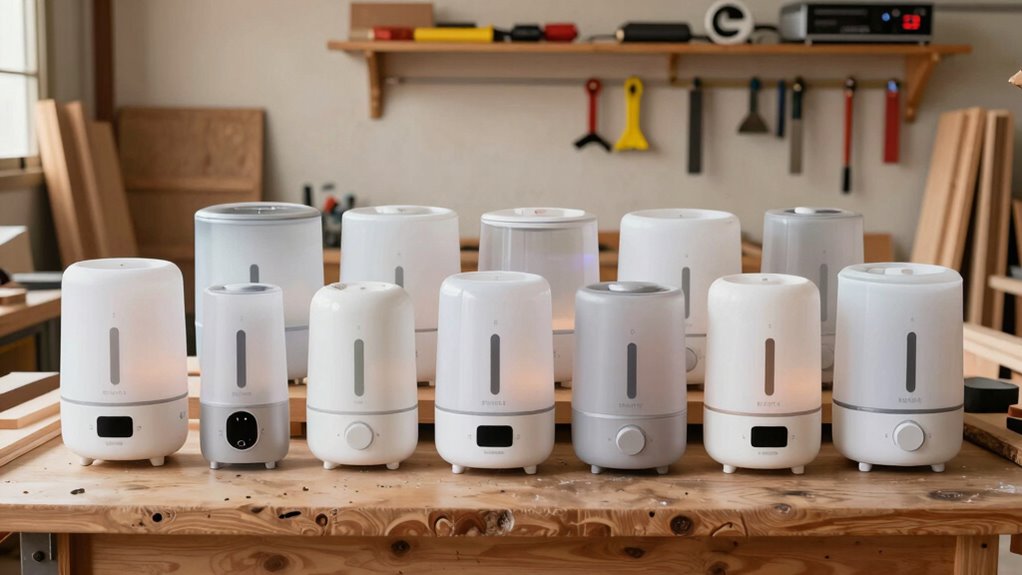
For most garage wood shops, I’d start with the 200 Pint Commercial Grade Humidifier for its shop-scale capacity and directional fogging, while the AIRCARE console models suit woodworkers who prefer evaporative operation and broad room coverage. The AC Infinity Cloudforged T3 is a more targeted choice when precise humidity control matters more than humidifying an entire workshop. The main tradeoffs are capacity, control over humidity, maintenance, and how well a unit fits an unconditioned garage. Read on for how each option compares and which one matches your shop.

Get business pricing on tools and workshop supplies
- Business-only prices and quantity discounts
- Tax-exempt purchasing
- Multiple users, one account, clear invoices
Complete the kit


Key Takeaways
- The 200 Pint Commercial Grade model is the lineup’s shop-capacity pick, but its scale may be excessive for a small, enclosed garage workspace.
- The Canyon, Oak Burl AIRCARE, 696 400HB, and Valiant are all console-style evaporative options; their differences matter more in controls, design, and fit than in basic humidifier type.
- The Cloudforged T3 offers a different approach, with VPD controls and a 4.5L tank suited to targeted, controlled humidification rather than broad shop coverage.
- A garage’s air leakage and temperature swings can limit performance, so a larger stated capacity does not automatically mean stable humidity around lumber and tools.
- The right pick depends on the shop: prioritize coverage for a large space, adjustable control for sensitive work, and simpler operation if frequent refilling or upkeep would be a burden.
| Whole-House Console-Style Evaporative Humidifier (Canyon) |  | Best for Broad, Low-Fuss Coverage | Coverage area: Up to 3,700 sq ft | Water capacity: 4.75 gallons | Operation mode: Evaporative | VIEW ON AMAZON | See Our Full Breakdown |
| AC Infinity Cloudforged T3 Plant Humidifier with 4.5L Capacity and VPD Controls |  | Best for Targeted Humidity Control | Capacity: 4.5 liters | Humidity settings: Up to 10 levels | Controls: VPD controls | VIEW ON AMAZON | See Our Full Breakdown |
| 200 Pint Commercial Grade Humidifier with Multi-Directional Fogging Head |  | Best for High-Output, Plumbed Workshops | Maximum output: Up to 200 pints per day | Coverage area: 1,176 to 1,614 sq ft | Reservoir capacity: 1 gallon (4 liters) | VIEW ON AMAZON | See Our Full Breakdown |
| AIRCARE Digital Whole-House Console-Style Evaporative Humidifier (Oak Burl) |  | Best for Digital Console Controls | Coverage area: Up to 3,700 sq ft | Listed capacity: 0.93 gallons per day | Operation mode: Evaporative | VIEW ON AMAZON | See Our Full Breakdown |
| AirCare 696 400HB Digital Whole-House Console-Style Evaporative Humidifier, Light Oak |  | Best for Large-Tank, Adjustable Operation | Water capacity: 5.6 gallons | Coverage area: Up to 3,600 sq ft | Daily output: 11.45 gallons | VIEW ON AMAZON | See Our Full Breakdown |
| AirCare Valiant Digital Whole-House Console-Style Evaporative Humidifier |  | Best for Long, Steady Workshop Runs | Operation mode: Evaporative | Water capacity: 5 gallons | Listed floor area: 2,900 square feet | VIEW ON AMAZON | See Our Full Breakdown |
| humidifier for wood shop for a garage workshop | Controls | Dimensions | Coverage area | Runtime |
|---|---|---|---|---|
| Whole-House Console-Style Evap | Analog | 23"D x 25"W x 15"H | Up to 3,700 sq ft | Up to 45 hours |
| AC Infinity Cloudforged T3 Pla | VPD controls | — | — | — |
| 200 Pint Commercial Grade Humi | — | 17 in tall x 15 in diameter | 1,176 to 1,614 sq ft | — |
| AIRCARE Digital Whole-House Co | Touch control | 13.75"D x 21.75"W x 23.5"H | Up to 3,700 sq ft | Up to 45 hours |
| AirCare 696 400HB Digital Whol | Digital display and analog controls | 15.5"D x 28.25"W x 23.75"H | Up to 3,600 sq ft | Up to 45 hours |
| AirCare Valiant Digital Whole- | Touch control with digital humidistat | 13.8 inches deep x 21.8 inches wide x 23.5 inches high | — | 55 hours |
More Details on Our Top Picks
Whole-House Console-Style Evaporative Humidifier (Canyon)
For a garage workshop that needs moisture across a broad area, the AIRCARE Canyon offers a useful balance of coverage and straightforward operation. Its stated 3,700-square-foot reach is the largest listed here, and the 4.75-gallon tank plus up-to-45-hour runtime can reduce refill interruptions during long shop sessions. The adjustable humidistat and multiple fan speeds let you tune output without relying on the digital controls found on the AIRCARE 696 400HB. That simplicity is a tradeoff: the Canyon uses analog controls, and its console footprint needs a clear spot in the workshop. Like other evaporative models in this lineup, it uses a wick-based approach rather than the commercial unit’s directed fogging head, so it is a better fit for general room humidification than targeted moisture delivery. Plan for regular refilling and maintenance.
Pros:- Stated coverage up to 3,700 square feet suits a large workshop.
- 4.75-gallon capacity and up-to-45-hour runtime can reduce refill frequency.
- Adjustable humidistat supports setting a humidity target.
- Multiple fan speeds offer control over output and operation.
Cons:- Large console dimensions may take up valuable workshop floor space.
- The reservoir still needs regular refilling.
- Analog controls lack the digital interface offered by the AIRCARE 696 400HB.
Best for: Woodworkers who want broad, steady evaporative humidification in a large garage workshop and prefer simple analog controls.
Not ideal for: Shops with limited floor space or buyers who want digital settings and targeted mist delivery.
- Coverage area:Up to 3,700 sq ft
- Water capacity:4.75 gallons
- Operation mode:Evaporative
- Controls:Analog
- Humidistat:Adjustable
- Runtime:Up to 45 hours
- Dimensions:23″D x 25″W x 15″H
- Weight:26 pounds
Our verdict“Choose the Canyon for wide-area workshop humidification with simple controls, provided you have room for its console and can manage refills.”
AC Infinity Cloudforged T3 Plant Humidifier with 4.5L Capacity and VPD Controls
The AC Infinity Cloudforged T3 is the specialist pick for a workshop where humidity needs to be directed toward a particular zone, such as a lumber storage area or a small enclosed finishing space. Its extendable tubing and multiple humidity levels offer more targeted distribution than the room-filling console approach of the AIRCARE Canyon or AIRCARE 696 400HB. VPD controls, timers, auto-start, and backup memory add useful control options for a setup that runs on a schedule. The tradeoff is scale: the 4.5-liter capacity is modest beside the 5.6-gallon AIRCARE 696, and the product is designed for plant environments rather than presented specifically as a wood-shop humidifier. Its controls may also take more setup than a basic console. I’d choose it for precision in a smaller zone, not as the default for humidifying an entire garage.
Pros:- Extendable tubing can direct moisture toward a selected area.
- Multiple humidity levels and VPD controls provide fine adjustment.
- Timers, auto-start, and backup memory support scheduled operation.
- Water-resistant seal is a useful feature in a moisture-producing device.
Cons:- 4.5-liter capacity is small compared with the AIRCARE 696’s 5.6-gallon capacity.
- Plant-focused controls may require extra setup for a wood-shop application.
- Product data does not state coverage area, making whole-garage suitability harder to judge.
Best for: Woodworkers managing humidity in a small, defined area or enclosed lumber zone who want programmable controls and directed output.
Not ideal for: Owners of large open garages who need high-capacity, whole-room humidification with minimal setup.
- Capacity:4.5 liters
- Humidity settings:Up to 10 levels
- Controls:VPD controls
- Distribution:Extendable tubing
- Scheduling:Timers
- Automatic operation:Auto-start and backup memory
- Display:Backlit display
- Water resistance:Water-resistant seal
Our verdict“Pick the Cloudforged T3 for controlled, directed humidification in a smaller workshop zone, not for broad coverage of an open garage.”
200 Pint Commercial Grade Humidifier with Multi-Directional Fogging Head
When a large shop needs stronger output and a direct water feed is practical, this commercial-grade humidifier stands apart from the console models. Its stated output of up to 200 pints per day and multi-directional fogging head are aimed at moving moisture across a substantial area, while a 1/4-inch water connection can avoid the frequent manual refills associated with the AIRCARE Canyon and AIRCARE 696 400HB. That makes it the most work-oriented option in this group, but not the simplest: continuous operation depends on setting up a water line, and its stated operating noise is 58 dBA. Coverage is listed as 1,176 to 1,614 square feet, below the consoles’ stated maximums, so high output should not be mistaken for the broadest stated coverage. I’d favor it when output and plumbing matter more than quiet, portable convenience.
Pros:- Up to 200 pints per day is the highest stated output in this lineup.
- Multi-directional fogging head allows moisture to be aimed across the space.
- Water connection can support continuous operation without routine tank refills.
- Compact 17-inch height is easier to place than a large console cabinet.
Cons:- Water-line setup is needed to take advantage of continuous operation.
- 58 dBA noise level may be distracting during detailed shop work.
- Listed coverage of 1,176 to 1,614 square feet is narrower than the AIRCARE consoles’ stated coverage.
Best for: Woodworkers with a large, frequently used shop who can connect a water line and want high output with directional mist.
Not ideal for: Small or quiet workshops, and garages without a practical water connection or space for a dedicated unit.
- Maximum output:Up to 200 pints per day
- Coverage area:1,176 to 1,614 sq ft
- Reservoir capacity:1 gallon (4 liters)
- Water connection:Yes; uses 1/4-inch tubing
- Fogging head:Multi-directional
- Noise level:58 dBA
- Power:110 volts, 60 Hz, 0.9 amps
- Dimensions:17 in tall x 15 in diameter
Our verdict“Choose this commercial unit when your workshop can support a water connection and needs high, directional output more than quiet operation.”
AIRCARE Digital Whole-House Console-Style Evaporative Humidifier (Oak Burl)
The Oak Burl AIRCARE console is the control-focused alternative for woodworkers who want a familiar room humidifier format with a touch-control interface. Its stated coverage reaches 3,700 square feet, matching the Canyon’s listed area, and casters make it easier to reposition when the workshop layout changes. Compared with the analog Canyon, the touch controls offer a more modern operating interface; compared with the larger-tank AIRCARE 696 400HB, the listed 0.93-gallon capacity is a clear limitation for a shop that needs sustained moisture output. The stated runtime is up to 45 hours, but the data does not clarify how that runtime relates to its capacity figure, so buyers should not assume fewer refills than a larger-tank model. It is a reasonable fit for someone prioritizing mobility and touch controls, though its listed wattage also deserves a check against the shop’s electrical setup.
Pros:- Stated coverage up to 3,700 square feet suits a broad area.
- Touch controls offer a different interface from the analog Canyon.
- Casters help move the console as shop zones or equipment change.
- Includes a wick and filters according to the product description.
Cons:- Listed 0.93-gallon capacity is far smaller than the AIRCARE 696’s 5.6-gallon tank.
- Listed wattage of 5,760 watts warrants checking against available workshop power.
- Console dimensions may still occupy meaningful floor space.
Best for: Woodworkers who want a movable evaporative console with touch controls and broad stated coverage.
Not ideal for: Buyers prioritizing a large water reserve, low listed wattage, or confirmed workshop-specific performance details.
- Coverage area:Up to 3,700 sq ft
- Listed capacity:0.93 gallons per day
- Operation mode:Evaporative
- Controls:Touch control
- Runtime:Up to 45 hours
- Voltage:120 volts
- Wattage:5,760 watts
- Dimensions:13.75″D x 21.75″W x 23.5″H
- Weight:20 pounds
Our verdict“Choose the Oak Burl console if touch controls and casters matter more than a large water reserve or a compact footprint.”
AirCare 696 400HB Digital Whole-House Console-Style Evaporative Humidifier, Light Oak
For a garage shop where avoiding constant water runs matters, the AirCare 696 400HB has the most useful tank specification among the console models: 5.6 gallons. Its nine motor speeds, digital display, and adjustable humidistat give more control than the analog Canyon, while its stated 3,600-square-foot coverage is slightly below the Canyon and the Oak Burl console. The tradeoff is size: at 28.25 inches wide, it needs a dedicated place away from work paths and stored lumber. The product data also does not identify included filters or give maintenance details, unlike the Oak Burl model’s listed wick and filters. For general workshop humidity, the large capacity and control range make this a strong practical choice, but it is still an evaporative console rather than a plumbed, directional-output unit like the commercial humidifier.
Pros:- 5.6-gallon capacity is the largest stated tank among the console models.
- Nine motor speeds allow a broad range of airflow settings.
- Digital display and adjustable humidistat provide convenient control.
- Up to 45 hours of runtime may reduce interruptions for refilling.
Cons:- 28.25-inch width requires a substantial, carefully chosen floor location.
- Coverage is listed at 3,600 square feet, below the Canyon and Oak Burl console figures.
- Product data does not specify included filters or maintenance requirements.
Best for: Woodworkers who want a large reservoir, adjustable humidistat, and multiple fan speeds for an expansive workshop.
Not ideal for: Garages with narrow walkways, limited floor space, or buyers who need a water-line connection and directed fogging.
- Water capacity:5.6 gallons
- Coverage area:Up to 3,600 sq ft
- Daily output:11.45 gallons
- Motor speeds:9
- Controls:Digital display and analog controls
- Humidistat:Adjustable
- Runtime:Up to 45 hours
- Dimensions:15.5″D x 28.25″W x 23.75″H
- Weight:23 pounds
Our verdict“Pick the AirCare 696 if you want a large-tank evaporative console with flexible controls and have room for its wide footprint.”
AirCare Valiant Digital Whole-House Console-Style Evaporative Humidifier
The Valiant suits a garage wood shop where I want steady humidity over a broad area rather than a targeted mist beside one machine. Its 5-gallon tank and listed 55-hour runtime can cut refill interruptions, while the digital humidistat and automatic shut-off help maintain a set level without constant attention. Compared with the AC Infinity Cloudforged T3, which offers VPD controls and a smaller 4.5-liter reservoir, this console is a better fit for extended, room-scale operation; it is also far less specialized than the 200 Pint Commercial Grade Humidifier. The tradeoff is its footprint: at nearly 22 inches wide, it needs a clear, stable spot in the garage. Evaporative operation also means wick upkeep, and its listed coverage figures differ—2,900 square feet in the specs versus up to 4,000 in the description—so I would size it conservatively.
Pros:- 5-gallon capacity and listed 55-hour runtime reduce how often the shop needs refilling.
- Digital humidistat helps maintain a chosen humidity level.
- Automatic shut-off responds when the target humidity is reached or the tank is empty.
- Evaporative design provides broad room humidification rather than a single directed fog stream.
Cons:- Wide console footprint can compete with benches, lumber storage, and walking space.
- Wick-based evaporative operation requires regular maintenance and replacement as needed.
- Coverage is stated as 2,900 square feet in the specs and up to 4,000 square feet in the description, making sizing less certain.
Best for: Woodworkers who want automated, room-scale humidity control for a larger garage shop and can reserve floor space for a console unit.
Not ideal for: Small or crowded workshops, or buyers who need high-output commercial fogging or precise VPD-based control.
- Operation mode:Evaporative
- Water capacity:5 gallons
- Listed floor area:2,900 square feet
- Runtime:55 hours
- Controls:Touch control with digital humidistat
- Filter type:Wick
- Wattage:100 watts
- Dimensions:13.8 inches deep x 21.8 inches wide x 23.5 inches high
- Weight:21.5 pounds
Our verdict“Choose the Valiant for long-running, automatically regulated humidity in a spacious garage shop, but skip it if floor space or commercial-grade output matters more.”

How We Picked
I compared the six options through the needs of a garage wood shop: the ability to serve the intended space, useful humidity control, practical operation, and the maintenance likely to come with regular use. I also considered whether each design makes more sense for whole-room coverage or for a smaller, more controlled area. Because garage workshops can be drafty and may not hold humidity like finished rooms, I treated fit and realistic use as more important than headline capacity alone.
The ranking gives the lead to the commercial model for shops that need substantial output, while the console evaporative units remain strong alternatives for broad, steady coverage and familiar operation. The Cloudforged T3 ranks as a specialized pick rather than a universal shop humidifier: its VPD controls are useful for focused control, but its 4.5L capacity points to a different scale of use. The AIRCARE console models are separated by their specific configurations and buyer fit, not by assuming their shared format makes them interchangeable. I would match any of them to measured shop conditions before choosing.
| humidifier for wood shop for a garage workshop | Controls |
|---|---|
| Whole-House Console-Style Evap | Analog |
| AC Infinity Cloudforged T3 Pla | VPD controls |
| 200 Pint Commercial Grade Humi | — |
| AIRCARE Digital Whole-House Co | Touch control |
| AirCare 696 400HB Digital Whol | Digital display and analog controls |
| AirCare Valiant Digital Whole- | Touch control with digital humidistat |
Factors to Consider When Choosing Humidifier For Wood Shop For A Garage Workshop
Choosing a humidifier for a garage shop starts with the space and the wood, not the tank alone. These broader checks can help avoid buying a unit that runs constantly, adds unwanted moisture, or demands more upkeep than your workflow allows.
Match Output to the Shop’s Real Conditions
Measure the workshop rather than relying on a rough guess about its size. A garage with an open door, poor sealing, or frequent exhaust-fan use loses moisture faster than an enclosed room, so the same unit can behave very differently between shops. Check the manufacturer’s coverage guidance, then account for how often air escapes during work. Oversizing can add expense and may make humidity harder to manage, while undersizing can leave the unit running without stabilizing conditions. A hygrometer placed near stored lumber helps show whether the room, rather than the humidifier’s display, is reaching the target you want.
Set a Humidity Target for the Wood, Not Just the Room
Wood responds to changes in moisture over time, so a short-lived humidity spike is not the same as stable shop conditions. Keep a separate hygrometer near lumber or assembled work, and track readings across several days as seasons change. Avoid chasing an exact number with constant adjustments; rapid swings can be less helpful than a steady range appropriate to your materials and local climate. Consider the humidity inside the garage when the door is closed and during active work, since those readings may differ. If the shop shares air with a home or storage area, account for those spaces before increasing moisture.
Choose a Humidification Style That Fits the Environment
Evaporative console units add moisture through a wick or filter, while misting designs put water droplets into the air. In a dusty shop, either type needs sensible placement away from sanding debris, finishes, and equipment; airborne dust can complicate cleaning and upkeep. A misting unit may need more thought about water quality and nearby surfaces, while an evaporative model requires attention to its wick or filter. Do not place a humidifier where moisture can settle on tools, electrical equipment, or stored sheet goods. The best style is the one you can position safely and maintain consistently.
Plan for Refills, Cleaning, and Downtime
Tank size and rated output affect how often you stop to refill, but actual runtime also depends on the humidity setting and how much air leaks from the garage. Think through where you will fill the unit and whether you can reach it without moving machinery or lumber. Regular cleaning matters because standing water and neglected components can create odors and interfere with operation. Check how replacement wicks, filters, or other maintenance parts are obtained before committing to a model. If the unit will run while the shop is unattended, look for clear controls and a setup you can monitor safely.
Account for Cold Weather and Garage Temperature
Unheated garages can be much colder than living spaces, and cold air changes how much moisture it can hold. A humidifier selected for a climate-controlled room may not deliver the same practical result in a chilly workshop. Read the operating guidance for the temperatures where you plan to use the unit, and avoid placing water-filled equipment where it may freeze. In winter, condensation on cold windows, walls, or metal surfaces can signal that added moisture is exceeding what the space can manage. Lowering the setting or improving air sealing may solve the issue better than moving to a more powerful model.
Decide Whether You Need Whole-Shop Coverage or a Controlled Zone
Not every wood shop needs every corner humidified equally. If lumber storage or a workbench is the main concern, a controlled zone may be easier to manage than trying to stabilize a large, leaky garage. Whole-room coverage makes more sense when you need consistent conditions throughout the workspace and can keep the space reasonably enclosed. Avoid directing output straight at wood, finishes, or tools; localized dampness can cause problems even when the room reading looks acceptable. Before paying for more capacity or advanced controls, decide what area you actually need to protect and how you will verify the result.
Frequently Asked Questions
Can I use a whole-house console humidifier in a garage workshop?
You can use a console unit if its operating guidance fits the garage conditions and its coverage suits the space. Garage air leakage may make it work harder than it would in a closed living area, so check humidity with a separate hygrometer rather than relying only on built-in controls. Keep it away from sawdust, finishing products, and electrical equipment, and leave enough room for safe access during refills and cleaning. If the garage gets very cold, confirm that the unit is suitable for those temperatures before running it there.
Is a high-capacity humidifier always the best choice for a wood shop?
No. High output can help in a large or leaky shop, but it can be unnecessary in a small, well-sealed garage and may make humidity harder to control. The commercial model in this lineup is the clearest high-capacity option, while the smaller Cloudforged T3 is aimed at more focused control. Match capacity to measured room behavior, not just floor area. A hygrometer and a few days of readings can reveal whether your space needs more output or better air sealing.
Should I choose an evaporative unit or a misting humidifier for dusty woodworking?
Neither style is maintenance-free in a dusty shop. Evaporative units need their wick or filter kept in good condition, while misting models need suitable placement and attention to water quality and nearby surfaces. Dust can collect around intakes and outlets, so keep any unit clear of active sanding and vacuum exhaust. Choose based on the maintenance routine you can sustain and how much control you need over where moisture goes. Whichever type you pick, check the shop and equipment for signs of condensation.
Where should I place a humidifier to protect lumber without dampening tools?
Place it on a stable, level surface with open space around its intake and outlet, away from direct contact with lumber, tools, and electrical equipment. Avoid aiming mist or airflow directly at a stack of wood, since a local damp spot can differ from the room’s average humidity. A separate hygrometer near the lumber storage area helps you judge conditions where they matter. Keep the humidifier out of sanding dust and away from paths where it could be bumped or spilled. Follow the manufacturer’s clearance and safety instructions for the specific unit.
How can I tell if my garage is too damp after adding a humidifier?
Use a hygrometer and watch for condensation on cold windows, metal surfaces, or exterior walls. A musty smell, damp patches, or moisture collecting around the unit also suggests that output may be too high for the space or that ventilation and temperature need attention. Check readings in more than one location, since humidity can vary around a garage. Reduce the setting or pause operation, then review the readings over time rather than making large changes based on a single measurement. If moisture persists, improve air sealing or ventilation and inspect the space for other sources of dampness.
Conclusion
For a large garage shop that needs substantial output, I’d choose the 200 Pint Commercial Grade Humidifier as the best overall fit in this lineup, provided the space and placement can handle a high-capacity unit. For broad coverage with a more familiar evaporative-console format, the AIRCARE models are the practical alternatives; I’d compare their configurations and controls to suit the shop rather than treating them as identical. The Cloudforged T3 is my pick for focused humidity management and buyers drawn to VPD controls, but it is not the first choice for humidifying a large, leaky garage. For beginners, I’d favor a console-style evaporative unit with straightforward operation and pair it with a separate hygrometer. For the best value, start with the console model that matches your required coverage and maintenance preferences; pay for commercial capacity or advanced controls only when your shop conditions call for them.