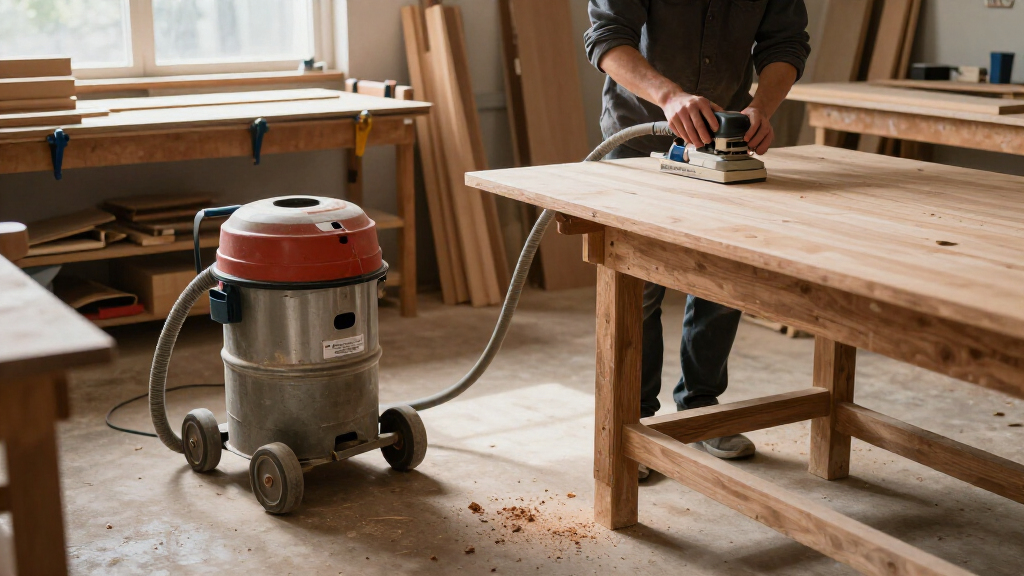
For most small and midsize shops, I’d start with the JET Vortex Cone DC-1100VX-CK, which pairs a 1.5 HP motor with a 2-micron canister filter for collecting dust at woodworking machines. The WEN DC1300 is a standout for buyers prioritizing higher stated airflow, while the WEN DC3401 suits smaller shops that need a rolling, compact collector. These machines do different jobs from hanging and room air-filtration units, so the main choice is whether you need to capture chips at a tool, filter airborne fine dust, or do both. Capacity, filtration, mobility, and installation needs all affect the fit. Read on for the full breakdown of all 12 woodworking dust collectors and how I’d match them to a shop.

Get tools and workshop supplies delivered free — and shop member deals
- Fast, free delivery on millions of items
- Access to Prime Big Deal Days deals on October 6–7
- Prime Video, Amazon Music and more included
Complete the kit

Key Takeaways
- The JET DC-1100VX-CK is my best overall machine collector: its vortex design and 2-micron canister filtration make it a balanced choice for connecting to woodworking equipment, though it needs more room than compact units.
- The WEN DC1300 prioritizes stated airflow: its 1,300 CFM rating sets it apart in this lineup, but buyers should compare duct layout and filter details rather than treating the number as a guarantee of real-world performance.
- Overhead air cleaners solve a different problem: the PuriCare, Purecare, and DecDust filtration systems circulate workshop air; they do not replace a collector connected to a saw or planer.
- Compact options trade capacity for flexibility: the WEN DC3401 and DC3474 are easier to place or move around a modest shop than larger collectors, but their collection volume and intended workload differ.
- Some product names obscure the key distinction: the Abestorm and ALORAIR 1350IG units focus on room air filtration, while the Abestorm 780S is a tabletop collector—match the unit to the dust source before comparing features.
| JET Vortex Cone Dust Collector with 2-Micron Canister Filter, 1.5 HP, 115/230V (DC-1100VX-CK) |  | Best Overall for Chip Collection | Motor power: 1.5 HP | Voltage: 115/230V, single phase | Filter: 2-micron canister | VIEW LATEST PRICE | See Our Full Breakdown |
| PURISYSTEMS PuriCare 500IG Air Filtration System with Remote and Ionizer |  | Best Compact Air Filtration Pick | Airflow: 350/450/500 CFM | Coverage area: Up to 500 sq. ft. | Filtration: Reusable two-stage; particle retention size listed as 1 micron | VIEW LATEST PRICE | See Our Full Breakdown |
| Purisystems PuriCare 1100 Hanging Air Filtration System |  | Best for Large-Shop Overhead Filtration | Coverage area: Up to 1,100 sq. ft. | Airflow: 1,100 CFM | Filtration: Two-stage mechanical; particle retention listed as 1 micron | VIEW LATEST PRICE | See Our Full Breakdown |
| Abestorm DecDust 1350IG 360° Workshop Air Filtration System with Ionizer |  | Best for Flexible, Wide-Area Air Filtration | Airflow: 1,050–1,350 CFM | Coverage area: Up to 1,700 sq. ft. | Filter type: MERV-11 | VIEW LATEST PRICE | See Our Full Breakdown |
| VEVOR 1.5 HP Vortex Cone Dust Collector, 1100 CFM, 2.5-Micron Filtration |  | Best for High-Capacity Bag Collection | Airflow: 1,100 CFM | Motor: 1.5 HP induction motor, 3,400 RPM | Filtration: 2.5 microns | VIEW LATEST PRICE | See Our Full Breakdown |
| ALORAIR Purecare 1350IG 360° Air Filtration System with Ionizer |  | Best for Large-Shop Air Cleaning | Airflow: 1,050/1,350 CFM | Coverage area: Up to 1,700 sq. ft. | Filter class: MERV-11 | VIEW LATEST PRICE | See Our Full Breakdown |
| Abestorm DecDust 780S Tabletop Dust Collector with Timer |  | Best Portable Bench-Top Air Cleaner | Airflow: 580/780 CFM | Filter: MERV-13; listed to last up to 6 months | Speed settings: 2 | VIEW LATEST PRICE | See Our Full Breakdown |
| WEN DC3401 12-Gallon Rolling Woodworking Dust Collector |  | Best Compact Machine-Connected Collector | Airflow: Up to 660 CFM | Motor: 5.7-amp brushed | Impeller: 6-inch nylon | VIEW LATEST PRICE | See Our Full Breakdown |
| WEN DC1300 1,300 CFM Woodworking Dust Collector |  | Best for Multiple Machines and High Airflow | Airflow: Up to 1,300 CFM | Motor: 14 amps | Impeller: 10-inch steel; up to 3,450 RPM | VIEW LATEST PRICE | See Our Full Breakdown |
| ALORAIR Purecare 780IG 2-Stage Woodworking Air Filtration System with Ionizer and Remote |  | Best Quieter Air Filtration for Smaller Shops | Airflow: 580/780 CFM | Intake: 270° | Filter class: MERV-11 (listed as MEVR 11) | VIEW LATEST PRICE | See Our Full Breakdown |
| POWERTEC 1 HP Dust Collector with 1-Micron Filtration and Mobile Base (DC1081) |  | Best for Finer Bag Filtration | Motor power: 1 HP | Airflow capacity: Up to 800 CFM | Filtration: 1 micron | VIEW LATEST PRICE | See Our Full Breakdown |
| WEN 15-Gallon Woodworking Dust Collector, 7.4-Amp Motor, Mobile Base and Optional Wall Mount (DC3474) |  | Best for Flexible Placement | Motor: 7.4-amp induction motor | Impeller: 9 inches | Airflow: Up to 600 CFM | VIEW LATEST PRICE | See Our Full Breakdown |
| woodworking dust collector | Airflow | Noise level | Weight |
|---|---|---|---|
| JET Vortex Cone Dust Collector | — | 80 dB | — |
| PURISYSTEMS PuriCare 500IG Air | 350/450/500 CFM | 61 dB | — |
| Purisystems PuriCare 1100 Hang | 1,100 CFM | 66 dB | 40.9 lb. |
| Abestorm DecDust 1350IG 360° W | 1,050–1,350 CFM | 60–69 dBA | — |
| VEVOR 1.5 HP Vortex Cone Dust | 1,100 CFM | Under 90 dB | 68.1 lb. |
| ALORAIR Purecare 1350IG 360° A | 1,050/1,350 CFM | 60–69 dB | — |
| Abestorm DecDust 780S Tabletop | 580/780 CFM | — | 19.96 lb |
| WEN DC3401 12-Gallon Rolling W | Up to 660 CFM | — | 17 lb |
| WEN DC1300 1,300 CFM Woodworki | Up to 1,300 CFM | — | — |
| ALORAIR Purecare 780IG 2-Stage | 580/780 CFM | Below 50 dBA | — |
| POWERTEC 1 HP Dust Collector w | — | — | 55 pounds |
| WEN 15-Gallon Woodworking Dust | Up to 600 CFM | — | 41.1 pounds |
More Details on Our Top Picks
JET Vortex Cone Dust Collector with 2-Micron Canister Filter, 1.5 HP, 115/230V (DC-1100VX-CK)
I’d put the JET Vortex Cone first for a shop that needs a dedicated collector for dust-producing machines, rather than a ceiling-mounted unit that filters air after dust escapes. Its vortex design separates chips before they reach the 2-micron canister filter, helping limit clogging and making this a stronger fit for repeated machine use than the Purisystems PuriCare 1100, which is designed to circulate and filter room air. The 1.5 HP motor is rated for continuous duty, and four casters make it easier to move between machines. The tradeoff is that this is a corded, floor-standing collector, not a complete solution for airborne fine dust. At 80 dB, it can also be intrusive in a small shared workspace.
Pros:- Vortex Cone separates chips before they reach the filter, helping reduce clogging.
- 2-micron canister filter is suited to fine woodworking dust.
- Four casters support movement between machines.
- Continuous-duty 1.5 HP motor is designed for sustained shop use.
Cons:- 80 dB noise can be disruptive in a small or shared workshop.
- Requires a corded electrical connection and floor space.
- Machine collection does not replace a separate system for filtering airborne room dust.
Best for: Woodworkers who want a mobile, machine-connected collector with chip separation and a canister filter for a one-person or small-shop setup.
Not ideal for: Buyers seeking quiet ambient air filtration, a ceiling-hung unit, or a cordless collector; the JET is a noisy, corded floor machine.
- Motor power:1.5 HP
- Voltage:115/230V, single phase
- Filter:2-micron canister
- Noise level:80 dB
- Mobility:Four casters
- Motor:Permanently lubricated, continuous-duty
- Warranty:5 years
- Power source:Corded electric
Our verdict“Choose the JET if you need a mobile, machine-side collector with chip separation; choose the PuriCare 1100 instead for overhead room-air filtration.”
PURISYSTEMS PuriCare 500IG Air Filtration System with Remote and Ionizer
The PuriCare 500IG is the compact room-air option in this group: its stated coverage is up to 500 square feet, well below the PuriCare 1100’s 1,100-square-foot rating. That smaller scale can suit a single-car garage or a defined work area without committing to a larger hanging unit. Three speeds reach 500 CFM, while reusable two-stage filters, a built-in ionizer, and a timer add flexibility for clearing airborne dust after cutting or sanding. The remote works from up to 26 feet, so you can adjust it without walking over to the unit. Unlike the JET Vortex Cone, though, this is an air filter, not a machine-connected collector; it will not capture chips at a saw’s dust port. Its 61 dB noise level and California shipping restriction are also real limits.
Pros:- Three airflow settings reach 500 CFM for adjusting filtration to the task.
- Reusable two-stage filters reduce the need for routine filter replacement.
- Remote control and a 1–6 hour timer support convenient operation.
- Ionizer is specified to retain particles as small as 1 micron.
Cons:- Coverage is limited to up to 500 square feet, less than the PuriCare 1100 or DecDust 1350IG ratings.
- Does not collect dust directly from machine ports.
- Cannot be shipped to California and produces 61 dB of noise.
Best for: Woodworkers in a smaller garage or dedicated work zone who want remote-operated ambient filtration and reusable filters.
Not ideal for: Buyers who need direct tool collection, coverage for a large open shop, or a unit that can be shipped to California.
- Airflow:350/450/500 CFM
- Coverage area:Up to 500 sq. ft.
- Filtration:Reusable two-stage; particle retention size listed as 1 micron
- Ionizer output:Up to 15 million negative ions/sec and 10 million positive ions/sec
- Timer:1–6 hours
- Remote range:Up to 26 ft.
- Noise level:61 dB
- Dimensions and weight:20.1 × 17 × 11 in.; 25.5 lb.
Our verdict“Pick the PuriCare 500IG for remote-controlled air filtration in a smaller shop, but choose the JET for dust capture at woodworking machines.”
Purisystems PuriCare 1100 Hanging Air Filtration System
For a larger shop where floor space matters, I’d favor the PuriCare 1100 over the smaller PuriCare 500IG: it is designed for areas up to 1,100 square feet and lists 1,100 CFM airflow. Its two-stage mechanical filtration is specified to retain particles as small as 1 micron, making it an overhead complement to a machine-side collector such as the JET Vortex Cone. That distinction matters: this unit circulates room air, while the JET is intended to capture debris at the source. The RF remote and timer make it practical to run without reaching the hanging unit. Its main costs in convenience are 40.9 pounds of hanging weight and 66 dB of noise; it is a less flexible choice if you regularly move filtration between rooms.
Pros:- Rated for up to 1,100 square feet, more coverage than the PuriCare 500IG.
- Listed 1,100 CFM airflow suits larger workshop air-filtration needs.
- Two-stage mechanical filtration is specified for particles down to 1 micron.
- RF remote and timer allow operation without direct access to the unit.
Cons:- At 40.9 lb., it is cumbersome to relocate once installed.
- The 66 dB noise level may interfere with quiet work.
- Filters room air rather than capturing dust at a machine port.
Best for: Woodworkers with a larger garage or fixed workshop who want overhead air filtration and can install a dedicated hanging unit.
Not ideal for: Small-shop owners, renters unable to mount equipment, or anyone who needs a portable collector connected to a machine.
- Coverage area:Up to 1,100 sq. ft.
- Airflow:1,100 CFM
- Filtration:Two-stage mechanical; particle retention listed as 1 micron
- Power:132 watts, corded electric
- Noise level:66 dB
- Dimensions:24.6 × 20.1 × 10.6 in.
- Weight:40.9 lb.
- Certification:cETL certified
Our verdict“Choose the PuriCare 1100 for fixed overhead filtration in a large shop, and pair it with a source collector such as the JET when tool-port capture is needed.”
Abestorm DecDust 1350IG 360° Workshop Air Filtration System with Ionizer
The DecDust 1350IG stands out for broad placement options: it can hang from the ceiling, mount directly to it, or sit on a workbench. Its 360-degree intake and coverage rating of up to 1,700 square feet make it a more flexible wide-area air-filtration choice than the PuriCare 1100, whose rated coverage is smaller. Airflow is listed at 1,050–1,350 CFM, and the package includes four replaceable MERV-11 filters plus a built-in ionizer. The touch panel and remote give you two ways to operate it. This is still an ambient filter, not a substitute for source collection like the JET Vortex Cone. I’d also factor in the ongoing filter changes: the stated interval is every 2–4 months, and California shipping is restricted.
Pros:- Coverage rating of up to 1,700 square feet exceeds the PuriCare 1100’s stated area.
- 360-degree intake supports air draw from multiple directions.
- Can be ceiling-hung, ceiling-mounted, or placed on a workbench.
- Includes four replaceable MERV-11 filters and remote control.
Cons:- Filters are recommended for replacement every 2–4 months.
- Cannot be shipped to California.
- Does not capture dust at the tool source, unlike the JET Vortex Cone.
Best for: Owners of a large workshop who want flexible ceiling or bench placement, broad intake, and remote-operated ambient filtration.
Not ideal for: California buyers, woodworkers who want reusable filters, or anyone needing direct extraction from saws and sanders.
- Airflow:1,050–1,350 CFM
- Coverage area:Up to 1,700 sq. ft.
- Filter type:MERV-11
- Included filters:Four replaceable filters
- Recommended replacement interval:Every 2–4 months
- Installation options:Ceiling hanging, direct ceiling mounting, or workbench placement
- Noise level:60–69 dBA
- Power requirements:115 V, 60 Hz, 1.5 A
- Weight and dimensions:27 lb.; 20.5 × 20.5 × 9.8 in.
Our verdict“Choose the DecDust 1350IG for flexible, wide-area room filtration if you can manage replacement filters and do not need direct machine collection.”
VEVOR 1.5 HP Vortex Cone Dust Collector, 1100 CFM, 2.5-Micron Filtration
The VEVOR pairs a 1.5 HP induction motor with listed airflow of 1,100 CFM and large collection bags, making it the direct machine-collection alternative to the JET Vortex Cone in this group. Its 35-gallon collection bag and 42-gallon filter bag mean less frequent emptying than a smaller-capacity setup may require, while clip-style access simplifies bag removal. Its 2.5-micron filtration is a coarser stated rating than the JET’s 2-micron canister, so I’d favor the JET when finer filtration and its canister design matter more than bag capacity. The VEVOR is a substantial floor unit at 68.1 pounds and nearly 76 inches tall. Noise is listed as under 90 dB, a broad ceiling rather than a quiet-operation claim, so it may not suit noise-sensitive shops.
Pros:- Listed 1,100 CFM airflow and a 1.5 HP motor target machine-side dust collection.
- 35-gallon collection bag reduces how often debris needs emptying.
- 42-gallon filter bag provides substantial bag capacity.
- Clip-style access is designed to simplify bag removal.
Cons:- 2.5-micron filtration is less fine than the JET’s 2-micron canister rating.
- At 68.1 lb. and 75.59 in. tall, it requires substantial floor space.
- Noise is listed as under 90 dB, which may be loud for a shared or noise-sensitive shop.
Best for: Woodworkers who prioritize large bag capacity and a 1.5 HP machine-side collector for handling sawdust and workshop debris.
Not ideal for: Buyers needing a compact or quiet collector, or those who prefer the JET’s finer 2-micron canister filtration.
- Airflow:1,100 CFM
- Motor:1.5 HP induction motor, 3,400 RPM
- Filtration:2.5 microns
- Collection bag capacity:35 gallons
- Filter bag capacity:42 gallons
- Noise level:Under 90 dB
- Voltage:120 V
- Weight:68.1 lb.
- Dimensions:36.22 × 29.13 × 75.59 in.
Our verdict“Choose the VEVOR if large bag capacity is your priority; choose the JET if you prefer a canister filter with a finer stated micron rating.”
ALORAIR Purecare 1350IG 360° Air Filtration System with Ionizer
I’d choose the Purecare 1350IG when a larger workshop needs ambient air filtration rather than a collector hooked directly to a machine. Its 360° intake and 1,050/1,350 CFM airflow are rated for spaces up to 1,700 sq. ft., giving it a broader stated coverage area than the Purecare 780IG. The MERV-11 filter is rated to capture 90% of 3–10 micron particles and 85% of 1-micron particles, while the remote and 1–9-hour timer make ceiling-mounted use easier to manage. This approach won’t replace the WEN DC1300’s tool-connected collection or its large chip-capacity bag. I’d also weigh the Purecare’s listed 60–69 dB noise level and 27-pound hanging weight against the convenience of overhead placement.
Pros:- 360° intake with stated coverage up to 1,700 sq. ft.
- MERV-11 filter with specified particle filtration rates
- Remote control and 1–9-hour timer
- Can be ceiling-hung or placed on a workbench
Cons:- Listed noise level of 60–69 dB may be intrusive in a small or shared shop.
- At 27 pounds, ceiling installation requires a suitable mounting point.
- Listing says it cannot be shipped to California.
Best for: Woodworkers with a larger shop who want overhead air circulation, remote operation, and filtration for fine airborne dust.
Not ideal for: Buyers seeking direct collection at a machine, a quieter listed operating range, or an option the listing permits shipping to California.
- Airflow:1,050/1,350 CFM
- Coverage area:Up to 1,700 sq. ft.
- Filter class:MERV-11
- Particle filtration:90% of 3–10 micron particles; 85% of 1-micron particles
- Fan speeds:2
- Controls:Remote control; 1–9-hour timer
- Noise level:60–69 dB
- Dimensions and weight:20.5 × 20.5 × 9.8 in; 27 lb
Our verdict“Choose the Purecare 1350IG for broad overhead air filtration in a large shop, but use a machine-connected collector for chips and source capture.”
Abestorm DecDust 780S Tabletop Dust Collector with Timer
The DecDust 780S is the portable, close-to-the-work option in this group: its metal housing, handle, and cord wrap make it easier to move between benches than either ceiling-oriented Purecare model. Its MERV-13 filter and two airflow settings, 580 and 780 CFM, suit localized air cleaning, while the timer can run for up to 120 minutes without requiring a separate reminder to switch it off. That makes it a different kind of tool from the WEN DC3401, which collects dust through a 4-inch hose and bag rather than filtering nearby air. The DecDust’s auxiliary outlet is limited to compatible Abestorm collectors, so I wouldn’t buy it expecting a universal expansion connection. Plan for periodic filter replacement, listed as lasting up to six months.
Pros:- MERV-13 filter for localized airborne-dust capture
- Portable metal housing with handle and cord wrap
- Two airflow settings and timer up to 120 minutes
- Circuit breaker and auxiliary outlet for compatible Abestorm collectors
Cons:- Filter may need replacement about every six months.
- Auxiliary outlet is intended for compatible Abestorm collectors only.
- Tabletop placement offers less overhead coverage than the Purecare 1350IG’s 360° system.
Best for: Woodworkers who want a movable tabletop air cleaner for one work area and value a higher-class filter and timed shutdown.
Not ideal for: Shops needing direct hose-connected dust collection, broad room coverage figures, or an auxiliary outlet for non-Abestorm equipment.
- Airflow:580/780 CFM
- Filter:MERV-13; listed to last up to 6 months
- Speed settings:2
- Timer:Up to 120 minutes
- Power:Corded electric; 115 V, 0.9 A, 100 W
- Dimensions:14.57 × 9.45 × 11.87 in
- Weight:19.96 lb
- Housing:Metal
Our verdict“Pick the DecDust 780S for portable, timed air cleaning near a bench, not as a substitute for a hose-connected collector.”
WEN DC3401 12-Gallon Rolling Woodworking Dust Collector
The WEN DC3401 is the practical choice for a small shop that needs dust pulled from a machine through a hose, not recirculated through a room. Its 4-inch port and 12-gallon bag give it a straightforward setup for a single compatible tool, while four lockable swivel casters make it easy to reposition as the work changes. At up to 660 CFM, it is more modest than the WEN DC1300’s 1,300 CFM and dual inlets, but the compact 17-pound body takes less space and is easier to move. The tradeoff is filtration: its included bag is rated at 5 microns, and the listing specifies a standard 4-inch dust hose. I’d favor it for basic source collection, not as the sole answer to fine airborne dust.
Pros:- Compact 17-pound design with carrying handle and four lockable swivel casters
- Moves up to 660 CFM through a 4-inch dust port
- 12-gallon collection bag keeps the footprint smaller than the WEN DC1300
- Optional wall mount and two-year warranty
Cons:- Requires a standard 4-inch dust hose.
- Included collection bag is rated at 5 microns.
- Single 4-inch port and 12-gallon capacity are less suited to multiple machines than the WEN DC1300.
Best for: Hobbyists with limited floor space who need a mobile collector for one 4-inch-port woodworking machine.
Not ideal for: Woodworkers connecting multiple tools at once or prioritizing finer filtration and a larger collection capacity.
- Airflow:Up to 660 CFM
- Motor:5.7-amp brushed
- Impeller:6-inch nylon
- Dust port:4 inches
- Collection bag:12 gallons; 5-micron zippered bag
- Dimensions:34.25 × 13 × 14.2 in
- Weight:17 lb
- Warranty:2 years
Our verdict“Choose the DC3401 for mobile, single-machine collection in a compact shop, and look to a larger collector for multiple tools or finer filtration.”
WEN DC1300 1,300 CFM Woodworking Dust Collector
For a shop that needs stronger machine-side collection, the WEN DC1300 brings the highest stated airflow among these five products: up to 1,300 CFM from a 14-amp motor and 10-inch steel impeller. Its dual 4-inch inlets allow connections to two tools, a useful step up from the single-port WEN DC3401 when a workshop has more than one collection point. The 50-gallon bag also means less frequent emptying than the DC3401’s 12-gallon bag, though it demands more room. Swivel casters aid repositioning, but they don’t make this a compact collector. I’d rank it for airflow and capacity, while noting that the supplied information gives no filtration-efficiency figure—buyers focused on fine dust should not infer performance from CFM alone.
Pros:- Up to 1,300 CFM of stated airflow
- Two 4-inch inlets allow connection to two tools
- 50-gallon collection bag reduces emptying frequency versus the WEN DC3401
- Mobile base with four swivel casters
Cons:- Large 50-gallon bag requires substantial workshop space.
- No filtration-efficiency details are provided.
- At 14 amps, it has a higher listed current draw than the WEN DC3401’s 5.7-amp motor.
Best for: Woodworkers with floor space for a large bag who want high airflow and connections for two 4-inch tools.
Not ideal for: Small-shop owners who need a compact collector or buyers who require stated filtration-efficiency data before choosing.
- Airflow:Up to 1,300 CFM
- Motor:14 amps
- Impeller:10-inch steel; up to 3,450 RPM
- Inlets:Two 4-inch air inlets
- Collection bag capacity:50 gallons
- Base:Mobile base with four swivel casters
- Color:Black
Our verdict“Choose the DC1300 for high-airflow, two-tool collection when you have room for its large bag and can accept unspecified filtration performance.”
ALORAIR Purecare 780IG 2-Stage Woodworking Air Filtration System with Ionizer and Remote
The Purecare 780IG suits a smaller workshop that wants overhead or bench-top air filtration without stepping up to the Purecare 1350IG’s larger stated coverage and higher airflow. Its 270° intake, two speeds, remote, and 1–9-hour timer make it convenient to run while working or after a session; the listed noise level is below 50 dBA, quieter on paper than the 1350IG’s 60–69 dB range. Its two-stage filtration is described as capturing 90% of 3–10 µm particles and 85% of 1 µm particles. I would pause over the conflicting coverage figures: the description says up to 800 sq. ft., while product information says 100 sq. ft. That uncertainty makes it harder to size confidently than the 1350IG.
Pros:- 270° intake with two airflow settings
- Listed noise level below 50 dBA
- Remote control and 1–9-hour timer
- Can be ceiling-hung or used on a bench
Cons:- Coverage information conflicts between 800 sq. ft. and 100 sq. ft.
- At up to 780 CFM, it has lower airflow than the Purecare 1350IG.
- Listing says it cannot be shipped to California.
Best for: Woodworkers in a smaller shop who want a remote-controlled air filtration unit and place a priority on its listed noise level.
Not ideal for: Buyers who need dependable coverage specifications for a larger space or direct dust collection at a machine.
- Airflow:580/780 CFM
- Intake:270°
- Filter class:MERV-11 (listed as MEVR 11)
- Particle filtration:90% of 3–10 µm particles; 85% of 1 µm particles
- Coverage:Conflicting listing figures: up to 800 sq. ft. in description; 100 sq. ft. in product information
- Noise level:Below 50 dBA
- Controls:Remote control; 1–9-hour timer
- Dimensions and power:18.35 × 18.35 × 8.82 in; 62 W; 115 V, 60 Hz, 0.6 A
Our verdict“Consider the Purecare 780IG for quieter, smaller-shop air filtration, but verify the intended coverage before relying on it for a defined area.”
POWERTEC 1 HP Dust Collector with 1-Micron Filtration and Mobile Base (DC1081)
The POWERTEC DC1081 stands out for buyers who want a portable machine collector with a 1-micron filter bag. Its stated 800 CFM capacity is higher than the WEN DC3474’s 600 CFM, giving the POWERTEC the stronger airflow claim of these two compact options. That can make it a better fit for connecting to a woodworking machine with a 4-inch port, though actual collection depends on the tool, hose, and setup. The four-wheel base and quick-release collection bag make it easier to reposition and empty than a fixed installation. The tradeoff is a 55-pound body that still needs assembly, and its indoor-use design limits where it belongs. Choose it over the WEN when finer listed filtration and greater stated airflow matter more than lower weight or wall mounting.
Pros:- 1-micron filter bag is the finer stated filtration of this pair.
- Up to 800 CFM airflow capacity is higher than the WEN DC3474’s stated 600 CFM.
- Four-wheel base makes it easier to move around a workshop.
- Quick-release clamps simplify collection-bag removal.
Cons:- At 55 pounds, it is heavier than the 41.1-pound WEN DC3474.
- Requires assembly before use.
- Designed for indoor use, limiting placement options.
Best for: Small-shop woodworkers who move a collector between 4-inch-port machines and prefer a 1-micron filter bag.
Not ideal for: Buyers seeking a fixed wall-mounted unit, outdoor dust collection, or a lighter machine to lift and carry.
- Motor power:1 HP
- Airflow capacity:Up to 800 CFM
- Filtration:1 micron
- Motor speed:3450 RPM
- Voltage:120/240 V
- Intake port:4 inches
- Weight:55 pounds
- Wheels:4
Our verdict“Choose the POWERTEC if you want a mobile machine collector with higher stated airflow and a finer filter bag than the WEN DC3474.”
WEN 15-Gallon Woodworking Dust Collector, 7.4-Amp Motor, Mobile Base and Optional Wall Mount (DC3474)
The WEN DC3474 is the more adaptable choice for a shop where floor space and storage matter: its mobile base can be replaced with an optional wall-mount setup. The 15-gallon collection bag gives it room for routine machine cleanup, while swivel casters and a carrying handle help when it needs to move. Its stated airflow reaches 600 CFM, below the POWERTEC DC1081’s 800 CFM, and its 5-micron bag filtration is coarser than the POWERTEC’s 1-micron bag. That makes the WEN a better match for buyers prioritizing flexible installation and a lighter unit over the finer listed filtration and higher airflow of its counterpart. It still needs a 4-inch connection to a woodworking tool, so it is not a whole-shop ambient air cleaner; those needing that function should look at dedicated filtration systems such as the PuriCare 1100.
Pros:- Optional wall-mount setup offers an alternative to occupying floor space.
- 15-gallon collection bag provides capacity for routine machine use.
- Swivel casters and carrying handle support repositioning.
- Two-year warranty is specified.
Cons:- Stated airflow of up to 600 CFM is lower than the POWERTEC DC1081’s 800 CFM.
- 5-micron bag filtration is coarser than the POWERTEC’s 1-micron bag.
- Requires a 4-inch connection to woodworking tools.
Best for: Home-shop woodworkers who need a 15-gallon collector that can roll between machines or be mounted to free floor space.
Not ideal for: Buyers whose priority is finer bag filtration or higher stated airflow than the POWERTEC DC1081, or those without 4-inch tool connections.
- Motor:7.4-amp induction motor
- Impeller:9 inches
- Airflow:Up to 600 CFM
- Dust port:4 inches
- Collection bag:15 gallons, 5-micron, zippered
- Dimensions:43.3 x 17.7 x 20.1 inches
- Weight:41.1 pounds
- Mounting:Mobile base with optional wall mount
- Warranty:2 years
Our verdict“Pick the WEN DC3474 if wall-mount flexibility and a 15-gallon bag matter more than the POWERTEC DC1081’s higher stated airflow and finer filtration.”

How We Picked
I ranked these products by the job they are designed to do, then compared buyer-relevant factors: stated airflow or filtration details, collection capacity, portability, mounting options, controls, and likely fit for a home or small workshop. For machine-connected collectors, I gave weight to practical connection and mobility considerations alongside motor and airflow claims. For air-filtration systems, the focus was room circulation, controls, and installation rather than chip collection. Product specifications can depend on setup and operating conditions, so I treat stated figures as comparison points, not a promise of performance at every tool.
The JET leads because it offers a balanced combination of machine-collection features and canister filtration. The WEN DC1300 ranks as an airflow-focused alternative, while smaller WEN collectors earn consideration for shops where footprint and mobility matter more than capacity. Hanging, 360-degree, and tabletop systems rank by their narrower roles: useful for airborne dust or localized capture, but not substitutes for a machine-connected collector. I also account for tradeoffs such as space, mounting, filter maintenance, and the need to pair some options with a separate collection system.
Factors to Consider When Choosing Woodworking Dust Collectors
Before choosing from this lineup, I’d separate source capture from air cleaning. A collector attached to a tool handles chips and dust as they leave the machine; an air-filtration unit circulates room air after fine particles become airborne. The right purchase depends on your tools, ducting, available space, and how much cleanup you are willing to do.
Choose Between Machine Collection and Room Filtration
Start by identifying where dust is escaping. A table saw, planer, or jointer with a dust port calls for a collector connected at the source; a hanging filtration unit is designed to recirculate workshop air. Buying an air cleaner alone for a machine with a dust port can leave chips and debris piling up at the tool. Conversely, a machine collector may not catch fine dust that escapes into the room, especially during sanding or when a tool has weak dust-port capture. Some shops benefit from both types, but I’d prioritize source capture before adding room filtration.
Treat Airflow Ratings as a Starting Point
Published CFM figures help compare models, but they do not tell the whole story once a collector is connected to hoses, fittings, filters, and ductwork. Narrow hoses, long runs, sharp bends, and leaks can reduce airflow at the tool. Check the dust-port size on your equipment and plan the shortest practical route before choosing a collector based on its headline rating. A higher stated airflow can be attractive for multiple machines, but a simple setup that matches one tool may work better than an undersized or poorly routed network. Avoid assuming that a single rating guarantees identical results in every shop.
Match Filtration to Your Dust and Work Habits
Filter ratings describe what a filter is designed to capture under specified conditions; they are not a complete measure of workshop air quality. Fine sanding dust and repeated sessions make filtration and maintenance more consequential than occasional rough cutting. Look at the stated particle size, filter type, and how the unit is cleaned or replaced, then follow the manufacturer’s maintenance guidance. A canister filter can offer a different filtration approach from a bag, while a room air cleaner depends on circulation and placement. For hazardous materials or strict exposure control, do not treat a consumer dust collector as a substitute for appropriate safety practices and respiratory protection.
Plan for Capacity, Emptying, and Filter Maintenance
Collection capacity affects how often work stops for emptying, but a larger bin also takes up more floor space and can be harder to handle when full. Estimate how much your tools produce and how long you typically work between cleanup breaks. Small containers can suit intermittent use or a compact shop, while frequent planing and routing can fill them quickly. Check how bags, bins, and filters are accessed, since awkward maintenance often leads to delayed emptying and reduced performance. Leave clearance around the collector for servicing rather than measuring only the unit’s footprint.
Check Mobility, Mounting, and Electrical Fit
A mobile base helps when one collector serves several tools, but a unit that moves easily still needs a safe, practical hose path at each station. Wall-mounted and hanging systems conserve floor area, though installation height, ceiling structure, controls, and access for cleaning all matter. Before buying, verify the available voltage and outlet, the machine’s electrical requirements, and whether your shop can support any mounting hardware. Remote controls and timers can make an overhead air cleaner easier to operate, but they do not compensate for poor placement. Choose the setup that fits your actual workflow, not just the one with the smallest footprint.
Spend More for a Clear Shop-Specific Benefit
A higher-capacity or more feature-rich unit makes sense when it solves a recurring problem: frequent emptying, limited floor space, difficult access, or a need to filter room air after source collection. Extra controls are useful only if they make regular operation more convenient, and a larger airflow claim matters only when your tools and duct layout can use it. For a beginner with one or two machines, a mobile collector that is easy to connect and maintain may be a better starting point than a complex duct network. If you expect to add machines, plan the layout and connection sizes before paying for capacity you may not be able to use. I’d put fit and consistent use ahead of feature count.
Frequently Asked Questions
Can an overhead air-filtration system replace a dust collector connected to my saw?
No. An overhead air cleaner circulates and filters air in the room, while a machine-connected collector captures dust and chips at a tool’s port. Relying on room filtration alone can leave larger debris at the machine and allow dust to spread before it reaches the filter. If your saw has a dust port, source collection is the more direct control. An air cleaner can complement it, particularly for fine airborne particles that escape collection.
Is the WEN DC1300’s 1,300 CFM rating enough reason to choose it over the JET?
Not by itself. The DC1300’s stated airflow makes it a strong candidate for shoppers comparing airflow-focused collectors, while the JET combines a vortex cone design with a 2-micron canister filter. Actual performance depends on the tool connection, hose or duct size, filter condition, and layout. Compare the specifications that matter to your machines and how you plan to route ducting. If you cannot use the extra stated airflow effectively, the JET’s overall feature balance may be the more useful fit.
Do I need a 360-degree air-filtration model for a small workshop?
Not automatically. A 360-degree intake can be useful when a unit is positioned to draw air from multiple directions, but placement and unobstructed circulation still shape how well it serves the room. In a compact shop, a smaller or differently mounted air cleaner may suit the layout better. First address dust capture at each machine, then decide whether airborne dust remains a problem. Choose based on room size, mounting position, and operating habits rather than the 360-degree label alone.
Should I choose a compact collector or a larger unit if I only have one machine?
A compact collector can be a practical match for one machine if its connection, capacity, and intended workload fit that tool. A larger unit may make more sense if the machine produces heavy chip loads, you work for long sessions, or you expect to add equipment. Small collection containers can require more frequent emptying, which interrupts work and adds maintenance. Check your tool’s dust-port requirements and the collector’s setup details before choosing by size alone. A larger footprint is worthwhile only when it brings a benefit your shop will use.
Should a beginner buy a dust collector or an air cleaner first?
If you are choosing between the two, I’d usually start with a collector that connects to the machine producing the most dust. Source capture prevents much of the debris from entering the room in the first place, while an air cleaner addresses particles that remain suspended. The right first machine depends on your tools: a compact rolling collector may be easier to place in a small shop, while a larger collector can suit heavier use. Make sure the hose and fittings match your equipment, since poor connections can undermine either choice. Add room filtration later if airborne dust remains a concern.
Conclusion
For a single recommendation that balances machine collection and filtration features, I’d choose the JET Vortex Cone DC-1100VX-CK as best overall. The WEN DC1300 is my airflow-focused alternative, while the WEN DC3401 is a practical value pick for buyers who want a compact rolling collector and can work within its smaller format. Beginners with limited space should compare the DC3401 and DC3474 against their tool connections and collection needs before moving to a larger system. For overhead air cleaning, look to the PuriCare, Purecare, or DecDust air-filtration models; for localized tabletop capture, consider the Abestorm DecDust 780S. My main rule is simple: buy a machine collector for dust at the tool, and add room filtration when airborne dust calls for it.
Fall yard work Picks
leaf blowers
As an affiliate, we earn on qualifying purchases.