For most buyers, I’d start with the DEWALT DWE575SB: its 7-1/4-inch blade, 57-degree bevel capacity, and included electric brake make it a well-rounded choice for general cutting. The CRAFTSMAN CMES510 is a strong value-minded alternative with a 15-amp motor, while the SKIL SPT70V-11 suits demanding work that calls for a much larger blade and worm-drive layout. The main tradeoffs are cutting capacity versus weight, plus whether extra power or bevel range matters more than easy handling. I’ve compared all 12 saws by performance, usability, construction, and intended workload. Read on for the full breakdown and a recommendation matched to your projects.

Get business pricing on tools and workshop supplies
- Business-only prices and quantity discounts
- Tax-exempt purchasing
- Multiple users, one account, clear invoices
Complete the kit


Key Takeaways
- The DEWALT DWE575SB leads as the all-around pick because its 57-degree bevel range and electric brake add useful control without moving to a heavier worm-drive saw.
- 15-amp sidewinders form the practical middle ground: the CRAFTSMAN CMES510, SKIL 5280-01, and several premium models offer familiar 7-1/4-inch capacity for common framing and sheet-cutting tasks.
- The SKIL SPT70V-11 is a different class of tool with a 16-5/16-inch blade; its added depth suits specialized heavy cuts, but it is more saw than many home projects need.
- Magnesium and worm-drive construction serve different priorities: the Makita 5007MG emphasizes a lighter magnesium build, while the SKILSAW worm-drive models favor torque and capacity over compact handling.
- Lower-power and value-oriented models make sense for lighter workloads, but buyers doing frequent thick-stock cuts may benefit more from a 15-amp motor and sturdier construction than from a laser guide or included blade alone.
| SKIL 5080-01 13-Amp 7-1/4-Inch Circular Saw |  | Best for Lightweight Home Projects | Motor: 13 A | Voltage: 120 V | Blade diameter: 7-1/4 in | VIEW LATEST PRICE | See Our Full Breakdown |
| DEKOPRO 1200W Circular Saw with 185mm 24-Tooth Blade | 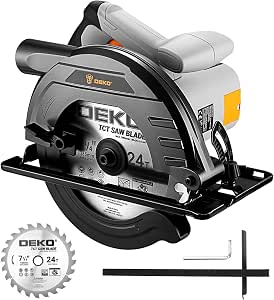 | Best for Guided Straight Cuts | Power: 1200W | No-load speed: 4800 RPM | Blade diameter: 185mm | VIEW LATEST PRICE | See Our Full Breakdown |
| CRAFTSMAN CMES510 7-1/4-Inch 15-Amp Corded Circular Saw |  | Best for Fast, Demanding Cuts | Motor: 15 A | Motor speed: 5,500 RPM | Blade diameter: 7-1/4 in | VIEW LATEST PRICE | See Our Full Breakdown |
| SKIL 5280-01 15-Amp 7-1/4-Inch Circular Saw with Laser Guide |  | Best for Visible Cut Alignment | Motor: 15 A | Speed: 5,300 RPM | Blade diameter: 7-1/4 in | VIEW LATEST PRICE | See Our Full Breakdown |
| DEWALT 7-1/4-Inch Corded Circular Saw with 57-Degree Bevel (DWE575SB) |  | Best for Bevel Range and Run-Down Control | Motor: 15 A | Speed: 5200 RPM | Blade diameter: 7-1/4 in | VIEW LATEST PRICE | See Our Full Breakdown |
| Bosch CS10 7-1/4-Inch Circular Saw |  | Best for Visibility and Handling | Motor: 15 A | Blade diameter: 7-1/4 in | Maximum cutting depth at 90°: 2-7/16 in | VIEW LATEST PRICE | See Our Full Breakdown |
| DEWALT DWE575 7-1/4-Inch Corded Circular Saw |  | Best Lightweight Standard Saw | Motor: 15 A | Blade diameter: 7-1/4 in | Cutting depth: 2-9/16 in | VIEW LATEST PRICE | See Our Full Breakdown |
| Makita 5007F 7-1/4-Inch Circular Saw |  | Best for Fast, Visible Framing Cuts | Motor: 15 A | Blade diameter: 7-1/4 in in title; conflicting 4 in specification | Speed: 5,800 rpm | VIEW LATEST PRICE | See Our Full Breakdown |
| SKILSAW SPT67WL-01 15-Amp 7-1/4-Inch Sidewinder Circular Saw |  | Best Lightweight Sidewinder Pick | Motor: 15 A | Voltage: 120 V | Wattage: 1,800 W | VIEW LATEST PRICE | See Our Full Breakdown |
| SKIL SPT70V-11 16-5/16-Inch Magnesium Worm Drive Circular Saw |  | Best for Extra-Thick Lumber | Saw type: Worm drive circular saw | Blade diameter: 16-5/16 in | Cutting capacity: 6-1/4 in | VIEW LATEST PRICE | See Our Full Breakdown |
| Makita 5007MG 7-1/4-Inch Magnesium Circular Saw |  | Best for Visibility and Bevel Flexibility | Model: 5007MG | Blade diameter: 7-1/4 inches | Motor: 15 amps | VIEW LATEST PRICE | See Our Full Breakdown |
| SKILSAW SPT77WML-01 15-Amp 7-1/4-Inch Magnesium Worm Drive Circular Saw |  | Best Magnesium Worm Drive | Model: SPT77WML-01 | Power source: Corded electric | Motor: 15 amps | VIEW LATEST PRICE | See Our Full Breakdown |
| corded circular saw | Blade diameter | Motor | Weight | Bevel capacity |
|---|---|---|---|---|
| SKIL 5080-01 13-Amp 7-1/4-Inch | 7-1/4 in | 13 A | 7 lb | — |
| DEKOPRO 1200W Circular Saw wit | 185mm | — | — | — |
| CRAFTSMAN CMES510 7-1/4-Inch 1 | 7-1/4 in | 15 A | 11.1 lb | 55 degrees |
| SKIL 5280-01 15-Amp 7-1/4-Inch | 7-1/4 in | 15 A | 8.7 lb | 51 degrees |
| DEWALT 7-1/4-Inch Corded Circu | 7-1/4 in | 15 A | 8.8 lb | — |
| Bosch CS10 7-1/4-Inch Circular | 7-1/4 in | 15 A | 10.2 lb | 56° |
| DEWALT DWE575 7-1/4-Inch Corde | 7-1/4 in | 15 A | — | Up to 57° |
| Makita 5007F 7-1/4-Inch Circul | 7-1/4 in in title; conflicting 4 in specification | 15 A | 6.17 kg | — |
| SKILSAW SPT67WL-01 15-Amp 7-1/ | 7-1/4 in in title; conflicting 4 in specification | 15 A | 8.6 lb | 56° |
| SKIL SPT70V-11 16-5/16-Inch Ma | 16-5/16 in | 15-amp Dual-Field | 27.3 lb | — |
| Makita 5007MG 7-1/4-Inch Magne | 7-1/4 inches | 15 amps | 10.1 or 10.6 pounds (source lists both) | — |
| SKILSAW SPT77WML-01 15-Amp 7-1 | 7-1/4 inches | 15 amps | 11.5 pounds | 53 degrees |
More Details on Our Top Picks
SKIL 5080-01 13-Amp 7-1/4-Inch Circular Saw
The SKIL 5080-01 is the lighter-duty pick here: its 13-amp motor and 7-pound weight suit common home workshop cuts without the heft of the CRAFTSMAN CMES510, which has a stronger 15-amp motor but weighs 11.1 pounds. The bevel adjusts to 51 degrees, with a positive stop at 45 degrees, giving DIYers room for routine angled cuts. A dust blower helps keep the cut line visible, and the spindle lock and included wrench make blade changes more straightforward. The tradeoff is a lower-power, entry-level design, so I would not choose it over the CRAFTSMAN for frequent aggressive cutting. Its cord also ties work to an outlet, as with every saw in this roundup.
Pros:- At 7 pounds, it is lighter than the CRAFTSMAN CMES510, which may make occasional handling less tiring.
- The 51-degree bevel range includes a positive stop at 45 degrees.
- A dust blower helps keep the cut line visible.
- Spindle lock and included blade wrench simplify blade changes.
Cons:- Its 13-amp motor is less powerful than the 15-amp motors in the CRAFTSMAN CMES510, SKIL 5280-01, and DEWALT DWE575SB.
- Entry-level positioning makes it a weaker fit for demanding, frequent cutting.
- The cord limits use to work areas with access to a power outlet.
Best for: Homeowners and occasional DIYers who want a relatively light corded saw for routine lumber cuts and basic bevel work.
Not ideal for: Frequent users or buyers making demanding, repeated cuts who would benefit from a stronger motor such as the CRAFTSMAN CMES510’s 15-amp unit.
- Motor:13 A
- Voltage:120 V
- Blade diameter:7-1/4 in
- Included blade:18-tooth carbide
- Maximum bevel angle:51 degrees
- Bevel stop:45 degrees
- Weight:7 lb
- Warranty:1-year limited
Our verdict“Choose this lighter SKIL for occasional home projects and skip it if your regular work calls for the stronger motor of the CRAFTSMAN CMES510.”
DEKOPRO 1200W Circular Saw with 185mm 24-Tooth Blade
The DEKOPRO DKPCCS0026 is the lineup’s guided-cut option, with a straight cutting guide included rather than relying on a separate accessory. Its steel base and depth adjustment—up to 65mm at 90 degrees and 43mm at 45 degrees—give buyers clear parameters for common sheet and board cuts. The 1200W motor runs at 4800 RPM, while a double protection switch and non-slip handle support controlled operation. Compared with the SKIL 5280-01, it gives up that saw’s 15-amp motor and laser guide, and its blade is 185mm rather than 7-1/4 inches. The 2m cord also calls for a nearby outlet. I see this as a practical choice for buyers who value the supplied guide over higher motor output or a laser.
Pros:- Includes a straight cutting guide for supported alignment.
- Cuts up to 65mm at 90 degrees and 43mm at 45 degrees.
- Steel base provides a sturdy platform for guided cuts.
- Double protection switch and non-slip handle support controlled operation.
Cons:- The 1200W motor has lower stated power than the 15-amp options in this roundup.
- Its 185mm blade differs from the 7-1/4-inch format used by the SKIL 5280-01 and several alternatives.
- The 2m power cord can restrict placement when the outlet is farther away.
Best for: DIYers making guided straight cuts in wood or PVC who want a saw supplied with a cutting guide and defined depth capacity.
Not ideal for: Buyers prioritizing higher motor output, a laser alignment aid, or the 7-1/4-inch blade format found on the SKIL 5280-01 and other models here.
- Power:1200W
- No-load speed:4800 RPM
- Blade diameter:185mm
- Blade teeth:24
- Maximum cut depth at 90 degrees:65mm
- Maximum cut depth at 45 degrees:43mm
- Base material:Steel
- Power cord length:2m
Our verdict“Pick the DEKOPRO if its included straight guide and stated cut depths matter more to you than the SKIL 5280-01’s higher motor rating and laser.”
CRAFTSMAN CMES510 7-1/4-Inch 15-Amp Corded Circular Saw
With a 15-amp motor rated at 5,500 RPM, the CRAFTSMAN CMES510 is the strongest speed-focused choice among these five. Its 55-degree bevel range and detents at 22.5 and 45 degrees make repeatable angled cuts easier to set than on the SKIL 5080-01, whose bevel tops out at 51 degrees. The magnesium shoe and metal guards point to a more durable build, while the contoured overmolded handle is intended to improve comfort. That capacity comes with a clear cost in handling: at 11.1 pounds, it is heavier than the DEWALT DWE575SB at 8.8 pounds and the SKIL 5280-01 at 8.7 pounds. I would favor it for robust workshop work, but not for buyers who value a lighter saw for frequent repositioning.
Pros:- The 15-amp motor runs at a stated 5,500 RPM for fast cutting.
- 55-degree bevel capacity includes 22.5- and 45-degree detents.
- Magnesium shoe and metal guards are built for durability.
- Contoured overmolded handle and spindle lock support handling and blade changes.
Cons:- At 11.1 pounds, it is heavier than the DEWALT DWE575SB and SKIL 5280-01.
- Its cord requires access to a power outlet, limiting work away from power.
- The included 18-tooth blade favors general cutting over finer tooth-count applications.
Best for: DIYers and workshop users who make frequent, fast cuts and want a durable-feeling shoe, metal guards, and useful bevel detents.
Not ideal for: Buyers who prioritize a lightweight saw for extended overhead work or frequent carrying; the DEWALT DWE575SB and SKIL 5280-01 weigh substantially less.
- Motor:15 A
- Motor speed:5,500 RPM
- Blade diameter:7-1/4 in
- Maximum cutting capacity:2-1/8 in
- Bevel capacity:55 degrees
- Bevel detents:22.5 and 45 degrees
- Shoe material:Magnesium
- Weight:11.1 lb
- Warranty:3-year limited
Our verdict“Choose the CRAFTSMAN for fast, demanding workshop cuts and bevel flexibility, but favor the lighter DEWALT DWE575SB if carrying weight matters more.”
SKIL 5280-01 15-Amp 7-1/4-Inch Circular Saw with Laser Guide
The SKIL 5280-01 pairs a 15-amp motor with a single-beam laser guide and dust blower, making cut alignment the main reason to choose it. At 8.7 pounds, it is also lighter than the CRAFTSMAN CMES510, though the DEWALT DWE575SB is nearly as light at 8.8 pounds and adds an electric brake. The SKIL offers a 51-degree bevel range with a positive stop at 45 degrees, which covers common angled work but falls short of the DEWALT’s 57-degree capacity. Its 5,300 RPM motor is rated below the CRAFTSMAN’s 5,500 RPM. The included 24-tooth blade is a general-purpose choice, not a promise of fine-finish results. I would pick it when the laser and cut-line visibility matter more than maximum bevel range or a brake.
Pros:- The laser guide and dust blower help with alignment and cut-line visibility.
- 15-amp motor runs at a stated 5,300 RPM.
- 51-degree bevel capacity includes a positive stop at 45 degrees.
- At 8.7 pounds, it is lighter than the CRAFTSMAN CMES510.
Cons:- Its 51-degree bevel capacity is narrower than the DEWALT DWE575SB’s 57 degrees.
- It has no listed electric brake, unlike the DEWALT DWE575SB.
- The included 24-tooth blade may not suit buyers seeking a finer-finish cut.
Best for: Home renovators and DIYers who want a laser alignment aid, dust blower, and moderate weight for everyday wood cutting.
Not ideal for: Buyers seeking the widest bevel range or an electric brake; the DEWALT DWE575SB offers 57-degree beveling and a brake.
- Motor:15 A
- Speed:5,300 RPM
- Blade diameter:7-1/4 in
- Included blade:24-tooth carbide-tipped
- Bevel capacity:51 degrees
- Bevel stop:45 degrees
- Weight:8.7 lb
- Included components:Circular saw, 24-tooth carbide blade, wrench, carry bag
Our verdict“Choose the SKIL 5280-01 for laser-assisted alignment and a lighter build, but choose the DEWALT DWE575SB for a wider bevel range and electric brake.”
DEWALT 7-1/4-Inch Corded Circular Saw with 57-Degree Bevel (DWE575SB)
The DEWALT DWE575SB stands out for combining a broad 57-degree bevel capacity with an electric brake that stops the blade after trigger release. That gives it a distinct edge over the SKIL 5280-01, whose bevel range is 51 degrees and which has no listed brake. It also weighs 8.8 pounds, far less than the CRAFTSMAN CMES510, while still offering a 15-amp motor and a maximum cutting depth of 2-9/16 inches. Stops at 22.5 and 45 degrees support familiar angles, and the integrated dust blower helps keep the cut line visible. The tradeoff is that it remains a corded saw and its stated depth is the limit for deeper stock. Buyers who need the SKIL’s laser guide may prefer that model instead.
Pros:- 57-degree bevel capacity exceeds the SKIL 5280-01’s 51-degree range.
- Electric brake stops the blade after the trigger is released.
- At 8.8 pounds, it is much lighter than the CRAFTSMAN CMES510.
- Integrated dust blower and ball-bearing lower guard support visibility and guard movement.
Cons:- The cord requires an outlet and can restrict work-area placement.
- Maximum cutting depth is 2-9/16 inches, which may not cover deeper stock.
- It lacks the laser guide included with the SKIL 5280-01.
Best for: Carpenters and serious DIYers who want broad bevel adjustment, common angle stops, an electric brake, and a relatively light 15-amp saw.
Not ideal for: Buyers who specifically want a laser guide for alignment or need cutting capacity beyond the stated 2-9/16-inch maximum depth.
- Motor:15 A
- Speed:5200 RPM
- Blade diameter:7-1/4 in
- Maximum bevel capacity:57 degrees
- Bevel stops:22.5 and 45 degrees
- Maximum cutting depth:2-9/16 in
- Weight:8.8 lb
- Special features:Electric brake, integrated dust blower, ball-bearing lower guard, cord protection system
Our verdict“Pick the DEWALT for its wide bevel range, electric brake, and manageable weight; choose the SKIL 5280-01 if laser alignment is your priority.”
Bosch CS10 7-1/4-Inch Circular Saw
The Bosch CS10 suits buyers who want a full-size corded saw that feels manageable without giving up a 15-amp motor. Its dust blower and clear sight lines help keep the cut path in view, while the soft-grip handle and 10.2-pound weight support steadier handling during repeated cuts. Compared with the lighter DEWALT DWE575, the Bosch is heavier and runs at a higher listed no-load speed, but offers a useful 56-degree bevel range and detents at common angles. Its composite footplate keeps the build light, though buyers who prefer an aluminum base may favor the DEWALT or Makita 5007F. The main limitations are the 10-foot cord, which can call for an extension, and a 2-7/16-inch depth at 90 degrees—less than the DWE575’s listed 2-9/16 inches.
Pros:- 15-amp motor and 5,600-rpm no-load speed suit demanding wood cuts.
- Dust blower and unobstructed sight lines help keep the blade path visible.
- 56-degree bevel capacity with detents at 22.5 and 46 degrees supports angled work.
- Soft-grip handle, saw hook, and included carrying bag add practical handling and storage features.
Cons:- Its 10-foot cord may require an extension cord on larger work areas.
- The 2-7/16-inch maximum depth at 90 degrees is below the DWE575’s listed capacity.
- At 10.2 pounds, it is heavier than the DWE575’s stated 8.8-pound product-description weight.
Best for: Framers and DIYers who value a visible cut line, comfortable grip, and useful bevel detents in a standard 7-1/4-inch saw.
Not ideal for: Buyers who need the deepest listed 90-degree cut or a longer cord for work far from outlets.
- Motor:15 A
- Blade diameter:7-1/4 in
- Maximum cutting depth at 90°:2-7/16 in
- Bevel capacity:56°
- No-load speed:5,600 rpm
- Weight:10.2 lb
- Cord length:10 ft
- Included accessories:24-tooth carbide-tipped blade, tool wrench, carrying bag
Our verdict“Choose the Bosch CS10 if cut-line visibility and bevel flexibility matter more than the lightest weight or greatest cutting depth.”
DEWALT DWE575 7-1/4-Inch Corded Circular Saw
The DEWALT DWE575 is the practical pick for buyers who want a standard 7-1/4-inch corded saw without carrying extra weight. Its 15-amp motor, aluminum base, and ball-bearing lower guard suit regular framing and sheet-goods work, while the dust blower helps keep the cut line visible. It also edges the Bosch CS10 on listed cutting depth, reaching 2-9/16 inches at 90 degrees, and its 57-degree bevel capacity is the widest in this group of conventional-size saws. The tradeoff is incomplete weight data: the listing gives both 8.8 pounds and 5.6 pounds, so I would not rely on either figure for a precise comparison. Unlike the larger SKIL SPT70V-11, this DEWALT is for routine lumber, not exceptionally thick stock; its cord also keeps it tied to an outlet.
Pros:- 15-amp motor is suited to demanding everyday cutting tasks.
- 2-9/16-inch listed depth at 90 degrees exceeds the Bosch CS10’s stated capacity.
- 57-degree bevel capacity accommodates a broad range of angled cuts.
- Aluminum base and ball-bearing lower guard support stable cuts and smooth guard movement.
Cons:- The product information lists conflicting weights of 8.8 pounds and 5.6 pounds.
- Corded operation limits mobility and requires access to a suitable outlet.
- Its 4,500-rpm listed speed is lower than the Bosch CS10 and Makita 5007F figures.
Best for: Home remodelers and framing crews who want a conventional 7-1/4-inch saw with a sturdy aluminum base and generous bevel range.
Not ideal for: Buyers who need verified weight information, cordless mobility, or the ability to cut very thick lumber in one pass.
- Motor:15 A
- Blade diameter:7-1/4 in
- Cutting depth:2-9/16 in
- Bevel capacity:Up to 57°
- Speed:4,500 rpm
- Base material:Aluminum
- Listed weight:Conflicting figures: 8.8 lb and 5.6 lb
- Included components:Carbide-tipped blade, blade wrench, instruction manual
Our verdict“Pick the DWE575 for a lightweight-oriented, full-size corded saw with strong bevel and depth figures, but treat its listed weight as uncertain.”
Makita 5007F 7-1/4-Inch Circular Saw
The Makita 5007F makes the most sense for buyers who prioritize a quick-running motor and a well-lit cut path. Its 5,800-rpm motor, two LED lights, and dust blower combine to support visibility and pace during framing cuts, while the heavy-gauge aluminum base and all-ball-bearing construction are aimed at durability. Against the Bosch CS10, the Makita lists a higher speed and a 2-3/8-inch depth at 90 degrees, but its bevel range stops at 45 degrees rather than Bosch’s 56. The product data also contains a serious inconsistency: the title names a 7-1/4-inch saw, while one specification says the blade is 4 inches; the listed “Hand Powered” source conflicts with its 15-amp motor. I would verify the exact configuration before buying. Its 6.17-kilogram listed weight is also substantial for frequent overhead work.
Pros:- 15-amp motor with a listed speed of 5,800 rpm.
- Two LED lights and a dust blower help illuminate and clear the cut line.
- Heavy-gauge aluminum base and all-ball-bearing construction are designed for durability.
- Shaft lock supports blade changes.
Cons:- Product data conflicts on blade size: the title says 7-1/4 inches, while a specification says 4 inches.
- The listed “Hand Powered” source conflicts with the 15-amp motor information.
- Its 45-degree maximum bevel is narrower than the Bosch CS10 and DEWALT DWE575 ranges.
Best for: Framing professionals and serious DIYers who want high listed blade speed, built-in work lights, and an aluminum-base saw.
Not ideal for: Buyers who need a wide bevel range, a lightweight tool, or product data that clearly confirms blade size and power source.
- Motor:15 A
- Blade diameter:7-1/4 in in title; conflicting 4 in specification
- Speed:5,800 rpm
- Cutting capacity at 90°:2-3/8 in
- Cutting capacity at 45°:1-3/4 in
- Maximum bevel capacity:0°–45°
- Base material:Heavy-gauge aluminum
- Weight:6.17 kg
Our verdict“Consider the Makita 5007F for speed and cut-line lighting, but confirm the blade and power details before choosing it over the better-documented Bosch CS10.”
SKILSAW SPT67WL-01 15-Amp 7-1/4-Inch Sidewinder Circular Saw
At a listed 8.6 pounds, the SKILSAW SPT67WL-01 is aimed at buyers who want a full-size corded sidewinder that is easier to carry between cuts than the 10.2-pound Bosch CS10. Its 15-amp motor and 5,300-rpm speed are suited to demanding woodwork, and the 56-degree bevel capacity gives it more angle range than the Makita 5007F’s 45 degrees. The Dual-Field motor is designed to dissipate heat, a useful design focus for repeated cutting sessions. However, the data lists a 4-inch blade despite identifying the saw as a 7-1/4-inch model, so I would confirm the supplied blade and compatibility details before purchase. The 10-foot cord is another limit on reach, and unlike the DEWALT DWE575 listing, this product data does not provide a clear maximum cutting depth.
Pros:- Listed 8.6-pound weight is lower than the Bosch CS10’s 10.2 pounds.
- 15-amp motor and 5,300-rpm speed suit demanding wood-cutting tasks.
- 56-degree bevel capacity provides more range than the Makita 5007F’s 45 degrees.
- Dual-Field motor is designed to dissipate heat during operation.
Cons:- Specifications list a 4-inch blade despite the 7-1/4-inch saw title.
- The 10-foot cord can limit reach around a large job site.
- No maximum cutting-depth figure is provided in the supplied specifications.
Best for: Carpenters and DIYers who want a lighter full-size sidewinder for repeated wood cuts and need a broad bevel range.
Not ideal for: Buyers who require an unambiguous blade specification, a documented cutting-depth figure, or freedom from a power cord.
- Motor:15 A
- Voltage:120 V
- Wattage:1,800 W
- Speed:5,300 rpm
- Blade diameter:7-1/4 in in title; conflicting 4 in specification
- Bevel capacity:56°
- Cord length:10 ft
- Weight:8.6 lb
Our verdict“Choose the SPT67WL-01 for its lower listed weight and wide bevel range only after confirming its blade specification.”
SKIL SPT70V-11 16-5/16-Inch Magnesium Worm Drive Circular Saw
The SKIL SPT70V-11 belongs in this roundup for a very different job from the standard 7-1/4-inch saws: it is built to cut stock up to 6-1/4 inches thick in one pass. That reach makes it suited to heavy timber and 6x material, where the Bosch CS10, DEWALT DWE575, and other conventional saws cannot match its capacity. A magnesium body and die-cast footplate support a durable, stable build, while brass worm-drive gearing and a 15-amp Dual-Field motor set it apart from the sidewinder designs. The tradeoff is size and weight: at 27.3 pounds, it is a specialized tool, not a comfortable choice for routine overhead or all-day carry work. Buyers who mostly cut framing lumber should choose a standard saw such as the DEWALT DWE575 instead.
Pros:- 6-1/4-inch cutting capacity handles thick lumber in one pass.
- Magnesium construction and die-cast magnesium footplate are designed for durability and stable cuts.
- Brass worm-drive gearing distinguishes it from the sidewinder saws in this group.
- Includes a 16-5/16-inch, 24-tooth blade.
Cons:- At 27.3 pounds, it is much heavier than standard saws such as the DEWALT DWE575.
- Its large blade and deep capacity are excessive for routine sheet goods and ordinary framing cuts.
- The specialized size is less suited to overhead work and frequent repositioning.
Best for: Timber framers and builders who regularly cut thick beams or 6x stock and need the capacity to do it in one pass.
Not ideal for: DIYers and carpenters who mostly cut standard boards, need a portable saw, or work overhead for extended periods.
- Saw type:Worm drive circular saw
- Blade diameter:16-5/16 in
- Cutting capacity:6-1/4 in
- Motor:15-amp Dual-Field
- Construction:Magnesium
- Footplate:Magnesium die-cast
- Gearing:Brass worm drive
- Weight:27.3 lb
Our verdict“Buy the SPT70V-11 only if you regularly cut exceptionally thick timber; for everyday lumber, a standard 7-1/4-inch saw is easier to handle.”
Makita 5007MG 7-1/4-Inch Magnesium Circular Saw
The Makita 5007MG pairs a 15-amp motor with a 5,800-RPM no-load speed, while its magnesium components are intended to keep the saw balanced without adding unnecessary weight. Its twin LED lights and dust blower help keep the cut line visible, a practical advantage when working in dim areas or through sawdust. Compared with the SKILSAW SPT77WML-01, it offers a slightly wider bevel range—56 degrees versus 53—plus positive stops at 22.5 and 45 degrees. The tradeoff is that the SKILSAW is a worm-drive design, while this Makita is better suited to buyers prioritizing visibility and bevel adjustment over that drive style. Its 2-1/2-inch depth at 90 degrees covers many framing cuts, but the listed weight varies between 10.1 and 10.6 pounds, so the exact figure is unclear.
Pros:- Magnesium components support a lightweight, balanced design.
- Twin LED lights and a dust blower help keep the cutting line visible.
- 56-degree bevel capacity with positive stops at 22.5 and 45 degrees.
- Includes an ultra-coated framing blade and attached blade wrench.
Cons:- Source data lists two different weights: 10.1 and 10.6 pounds.
- The 90-degree cutting capacity is limited to 2-1/2 inches.
- Its standard circular-saw design may not suit buyers specifically seeking a worm drive.
Best for: Framing and remodeling buyers who want useful cut-line lighting, a dust blower, and bevel flexibility for varied jobsite cuts.
Not ideal for: Buyers who need a worm-drive saw or consistently cut stock thicker than the stated 2-1/2-inch capacity at 90 degrees.
- Model:5007MG
- Blade diameter:7-1/4 inches
- Motor:15 amps
- No-load speed:5,800 RPM
- Weight:10.1 or 10.6 pounds (source lists both)
- Cutting capacity at 90 degrees:2-1/2 inches
- Maximum bevel capacity:56 degrees
- Positive bevel stops:22.5 and 45 degrees
- Lighting:Twin LED lights
Our verdict“Choose the Makita 5007MG if cut-line visibility and a broad bevel range matter more to you than a worm-drive layout.”
SKILSAW SPT77WML-01 15-Amp 7-1/4-Inch Magnesium Worm Drive Circular Saw
The SKILSAW SPT77WML-01 is the lineup’s magnesium worm-drive pick for buyers who want that drive style in a 7-1/4-inch corded saw. Its 15-amp motor is designed for lumber work, while the cut-ready depth system makes depth adjustments more direct. The 53-degree bevel capacity is broad enough for many angled cuts, though it falls three degrees short of the Makita 5007MG. The anti-snag lower guard is a useful distinction when the blade meets small cutoff pieces, but it does not replace careful handling. At 11.5 pounds, this saw is heavier than the Makita’s listed figures, and its cord limits where it can be used. The included 24-tooth blade is suited to general cutting, but buyers doing finish work may prefer to choose a blade with a tooth count tailored to that task.
Pros:- Magnesium housing keeps the worm-drive construction lighter than a heavier housing would be.
- 15-amp motor is designed for cutting lumber.
- 53-degree bevel capacity supports a wide range of angled cuts.
- Cut-ready depth system and anti-snag lower guard aid adjustment and cutting through small offcuts.
Cons:- At 11.5 pounds, it is heavier than the Makita 5007MG’s listed weight figures.
- The cord requires access to an electrical outlet and limits mobility.
- The included 24-tooth blade may not suit fine or task-specific cuts.
Best for: Framers and lumber-focused DIYers who specifically want a corded magnesium worm-drive saw with straightforward depth adjustments.
Not ideal for: Buyers prioritizing the lightest listed saw, cordless mobility, or a blade set up specifically for fine finish cuts.
- Model:SPT77WML-01
- Power source:Corded electric
- Motor:15 amps
- Voltage:120 V
- Wattage:1,800 W
- Blade diameter:7-1/4 inches
- Bevel capacity:53 degrees
- Weight:11.5 pounds
- Included blade:24-tooth carbide
Our verdict“Pick the SKILSAW SPT77WML-01 if you want a magnesium worm-drive saw for lumber work and can accept its weight and cord.”

How We Picked
I compared these corded circular saws on the factors that shape everyday cutting: motor power, blade size, depth and bevel capacity, handling, and build. I also looked at practical details such as blade visibility, safety features, weight-conscious materials, and whether a saw’s design suits repeated framing work or occasional home projects. A higher amp rating alone did not determine placement; the saw also needed a useful balance of control and capacity for its intended buyer.
The ranking favors versatility and usability for common jobs near the top, then gives specialized tools room to stand out for specific needs. That is why a capable 7-1/4-inch saw can rank ahead of a much larger worm-drive model for general use, even though the latter cuts deeper. Value-oriented and entry-level picks remain useful, but their lower power or simpler construction limits them for sustained demanding work. Since the right choice depends on workload, I call out who should choose each design—and who is better served by another saw in this lineup.
Factors to Consider When Choosing Corded Circular Saws
Before choosing among these corded circular saws, match the saw to the cuts you make most often—not the biggest cut you might make once. The right balance depends on stock thickness, bevel work, how long you handle the tool, and whether you need a general-purpose sidewinder or a specialized drive style.
Match Blade Size to the Material You Cut
A 7-1/4-inch blade is the familiar choice for many framing, plywood, and general repair tasks, with broad availability of replacement blades. Larger blades can cut deeper in one pass, but they also bring a larger, heavier tool and may be harder to control for routine work. Don’t choose a large saw solely because its maximum depth looks impressive; check whether your stock actually requires it. For repeated cuts through thick material, extra capacity can save repositioning and reduce the need for a second pass. For sheet goods and ordinary dimensional lumber, a standard blade size is often the more manageable fit.
Think About Motor Load, Not Just Amp Numbers
Amperage gives a rough indication of a corded saw’s electrical draw, but it does not tell the whole story about cutting speed or how the tool behaves in dense stock. Blade condition, tooth count, feed rate, and material all affect whether a cut feels smooth or bogs down. A sharp, suitable blade can matter more than a small difference in motor rating. Avoid forcing the saw through a cut to make up for a dull blade; that can strain the motor and reduce control. If your work involves frequent thick or hard material, prioritize a robust saw and pair it with the right blade rather than relying on the amp label alone.
Choose a Drive Style for Your Work and Handling
Sidewinders are the common choice for general-purpose cutting, while worm-drive designs appeal to buyers who need strong torque for demanding work. Drive style changes balance and handling, so a saw that feels capable on paper may be tiring during repeated overhead or ladder work. Heavier construction can bring durability or stiffness, but it asks more of the operator over a long day. If you work mostly at a bench or on framing, weight may matter less than sustained cutting performance. Try to match the saw’s balance and grip layout to your working position, not just its power.
Check Bevel Range and Cut Setup Needs
Bevel capacity matters when your projects include angled edges, roof work, or trim cuts; for repeated square cuts, it may matter far less. A wider bevel range is useful only if the saw’s markings and adjustment mechanism make it practical to set accurately. Look beyond the maximum angle and think about how often you’ll change settings. A laser guide can help indicate a cut path, but it does not replace a stable base, a clear sightline, or careful setup. Buyers who mostly rip sheet goods may get more benefit from a reliable edge guide than from extra angle features.
Plan for Blade Changes, Dust, and Cord Management
A corded saw avoids battery runtime limits, but the cord adds a real setup concern: it can snag on stock, cross the cut path, or restrict movement. Route it behind the saw and keep it away from the blade before starting each cut. Check whether the tool’s design gives you good access to the blade and clear visibility of the cut line, since frequent blade changes and adjustments are part of ownership. Dust can hide markings and make a work area harder to manage, so consider your extraction setup and cleanup habits. For portable work, add cord reach and extension-cord suitability to your planning rather than assuming every outlet will be close by.
Decide When Premium Construction Is Worth It
Paying for a more rugged saw can make sense when it will see frequent use, tough materials, or repeated jobsite handling. Magnesium components and heavier-duty drive designs may appeal to users seeking a durable work tool, but they do not automatically improve every cut. For occasional DIY repairs, a simpler saw may leave more room in the budget for quality blades, clamps, and a straightedge. Those accessories can improve cut quality and safety across many projects. Spend more when the added construction or capacity solves a regular problem—not just because the specification sounds more professional.
Frequently Asked Questions
Is a 15-amp corded circular saw necessary for home projects?
Not for every home project. A lower-power saw can handle occasional cuts in common lumber when the blade is sharp and the material is supported properly. A 15-amp model is a better fit for frequent cutting or tougher stock, where extra motor capacity can help the saw maintain pace. If you mostly cut thin boards and sheet goods, prioritize comfortable handling and good cut visibility over motor rating alone. Choose based on your regular workload rather than an occasional demanding task.
Should I choose a worm-drive saw or a sidewinder?
For general home use, a sidewinder is often the more straightforward choice because it covers common cuts in a familiar 7-1/4-inch format. A worm-drive model is worth considering when your work regularly demands stronger torque or specialized cutting capacity. The tradeoff is that worm-drive saws can be larger and less convenient to handle for routine, repeated cuts. Also think about where you work: weight and balance matter more when you carry the saw or make cuts in awkward positions. Let the material and frequency of your work decide, not the drive style’s reputation alone.
Will a 7-1/4-inch saw handle framing lumber?
A 7-1/4-inch saw is a standard choice for many framing cuts, but the exact capacity depends on the cut angle and the saw’s depth adjustment. Check the manufacturer’s stated cutting depth at 90 and 45 degrees before buying, especially if you work with thicker stock. Bevel cuts reduce available depth, so a saw that clears a board square may not cut through it at an angle in one pass. For occasional oversized material, a careful second pass may work, though it takes more setup and attention. If thick cuts are routine, consider a design with greater capacity.
Does a laser guide make a circular saw more accurate?
A laser can make the intended cut path easier to see, but it cannot correct a misaligned base, poor blade choice, or an unstable workpiece. Treat it as a visual aid rather than a substitute for measuring and setting up the cut. For long, straight cuts, a clamped guide or straightedge often gives more reliable support than following a projected line freehand. The laser may also be less helpful in bright conditions or when dust obscures the path. If accuracy matters, prioritize a stable setup and a clear blade-to-mark sightline.
Is a magnesium circular saw worth choosing over a standard model?
Magnesium construction can appeal to buyers who want a more durable-feeling tool without adding unnecessary bulk, particularly for frequent jobsite use. It does not guarantee better accuracy or make every saw easier to handle; overall balance, shoe stability, and controls still matter. Occasional DIY users may get greater practical value from a suitable blade and good work supports than from upgraded housing materials. Compare the saw’s full design and intended workload before treating magnesium as a deciding feature. For regular professional use, the construction may be easier to justify.
Conclusion
For a single corded saw that covers a broad range of work, I’d choose the DEWALT DWE575SB as best overall, with its bevel range and electric brake adding practical versatility. The SKIL 5080-01 is my best value-minded pick for lighter, occasional cutting, while the DEWALT DWE575 or Makita 5007MG suit buyers seeking a more substantial premium 7-1/4-inch option. Beginners who want a familiar format and straightforward general-use capacity should compare the CRAFTSMAN CMES510 and SKIL 5280-01, choosing based on whether they prefer a simple setup or a laser aid. For specialized heavy cuts, the SKIL SPT70V-11 offers the standout blade capacity; for demanding work in a worm-drive format, consider the SKILSAW SPT77WML-01. Match the saw to your routine cuts, and skip extra size or weight unless your projects can use it.