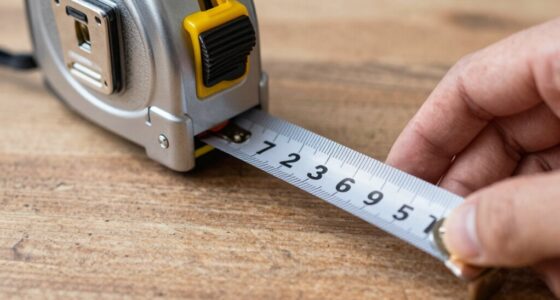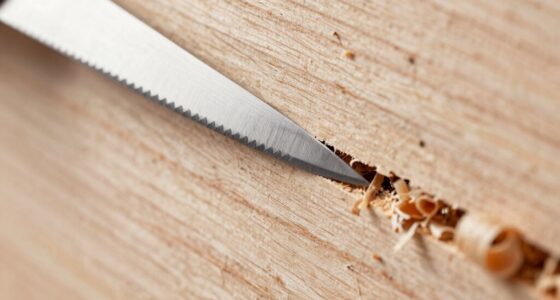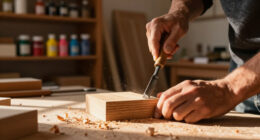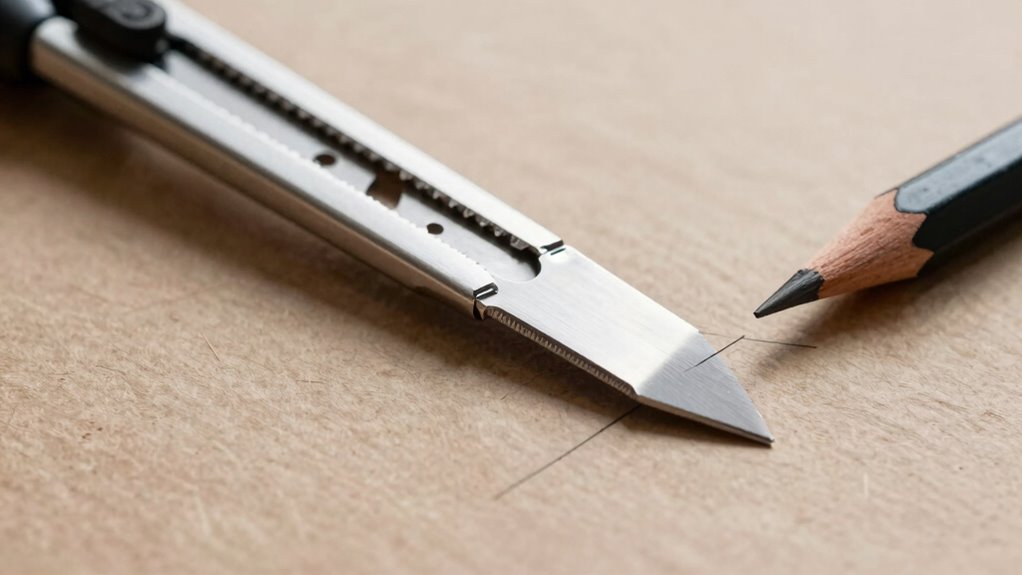

When choosing between a marking knife and a pencil for layout lines, consider your project’s precision needs. A marking knife provides cleaner, more accurate lines and is less prone to smudging, making it ideal for joinery and hardwoods. Pencils are easier to handle and better for quick, less critical marks. To get perfect lines every time, understanding their differences helps you select the right tool—more tips await as you explore deeper.

Get business pricing on tools and workshop supplies
- Business-only prices and quantity discounts
- Tax-exempt purchasing
- Multiple users, one account, clear invoices
Key Takeaways
- Marking knives produce cleaner, sharper lines ideal for precise cuts and joints, reducing errors in critical woodworking tasks.
- Pencils are quicker and easier to use but may smudge or fade, risking inaccurate layout lines over time.
- For dense hardwoods and fine detail, marking knives offer better control and permanence than pencils.
- Using a straightedge or guide with a marking knife enhances line straightness and accuracy.
- Maintaining sharp tools and applying consistent pressure ensures layout lines remain clear and reliable.
As an affiliate, we earn on qualifying purchases.
Why Accurate Layout Lines Are Critical in Woodworking
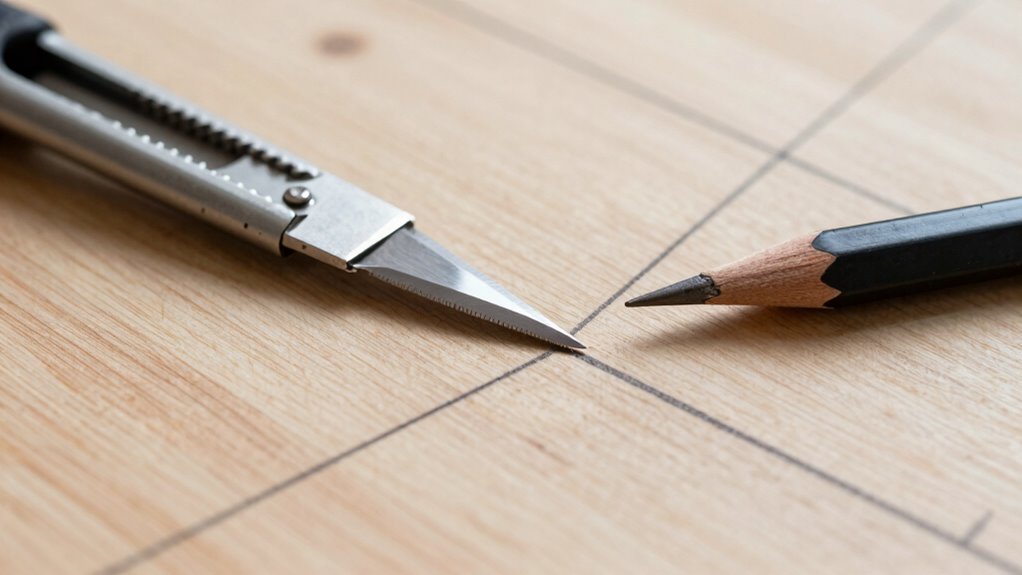
Accurate layout lines are essential in woodworking because they serve as the blueprint for every cut and joint. If your measurement accuracy slips, your entire project can be compromised, leading to gaps or misaligned parts. Choosing the right tools for marking lines directly impacts this precision. For example, a sharp marking knife provides cleaner, more precise lines than a dull pencil, reducing errors. Proper tool selection ensures you can transfer measurements reliably across surfaces. When your layout lines are precise, you minimize material waste and avoid costly mistakes. This attention to detail not only improves the quality of your work but also makes assembly smoother. Additionally, understanding measurement accuracy and how it influences your project is crucial for achieving professional results. The use of visual reference techniques can further improve marking accuracy by providing clear guides during layout. Recognizing the importance of proper tools in marking ensures consistency and accuracy in your work. In woodworking, precision tools are fundamental to ensuring your layout lines truly “don’t lie,” ultimately producing cleaner, more accurate results. Ultimately, reliable measurement accuracy and appropriate tool choices are foundational to producing professional, well-fitted woodworking projects.
As an affiliate, we earn on qualifying purchases.
What Is a Marking Knife? Benefits and Best Uses

A marking knife is a handheld tool designed specifically for creating fine, precise lines on woodworking surfaces. Historically, tools like the marking knife have been essential for craftsmen, serving as reliable, simple devices that produce accurate layout lines. Today, modern techniques continue to favor marking knives for their clean, crisp marks that don’t smudge or fade like pencil lines. The benefits include improved accuracy, especially on hardwoods or delicate surfaces, and the ability to make shallow, controlled cuts that guide saws and chisels. Modern European cloud servers emphasize energy efficiency and security, paralleling the precision needed for marking lines in woodworking. Additionally, using a marking knife can help reduce material waste by ensuring more accurate cuts from the start. Best uses involve marking joinery, cut lines, and reference points where precision is critical. Whether you’re restoring traditional techniques or working with contemporary methods, a marking knife remains a valuable tool for achieving exact, reliable layout lines.
As an affiliate, we earn on qualifying purchases.
Pros and Cons of Using a Pencil for Layout Lines

Using a pencil for layout lines offers convenience and familiarity, making it a popular choice among woodworkers. You can easily see your lines and make quick adjustments when needed. However, maintaining marking consistency can be tricky, especially over long distances or multiple passes. Pencils also present erasability challenges; marks can smudge or fade, risking accidental removal or misinterpretation. On the plus side, pencils are inexpensive, readily available, and allow for detailed, fine lines. They’re also useful for quick sketches or when you need to lightly mark surfaces. But, their tendency to smudge and the difficulty in ensuring consistent marking can reduce accuracy. Overall, pencils are versatile but may fall short when precision and permanence are critical. Marking techniques play a crucial role in achieving reliable layout lines in precise tasks. Additionally, understanding marking tools and their limitations can significantly improve your woodworking accuracy, especially when selecting the appropriate marking instrument for the job. Employing high-quality pencils designed for marking can help mitigate some of these issues and enhance marking visibility during your projects. Using the right pencil hardness can also make a difference in how well the marks hold up and how easily they can be erased after cutting or assembly.
As an affiliate, we earn on qualifying purchases.
Marking Knife vs. Pencil: Which Is Right for Your Project?

When choosing between a marking knife and a pencil for your project, understanding their strengths and limitations can help you make the best decision. Tool ergonomics plays a role—marking knives often require a firmer grip and proper technique, but they offer better control for precise lines. Pencils, on the other hand, are more comfortable to hold and easier to maneuver, especially for longer tasks. Material compatibility also matters: a marking knife works best on hardwoods and dense materials, leaving a fine, visible line without smudging. Pencils are versatile across many surfaces but can smudge or wear down, reducing line clarity over time. Consider your project’s material and your comfort with tool handling to determine which option will deliver the most accurate, efficient results.
Tips for Getting Precise Lines With Any Layout Tool

Achieving precise lines with any layout tool starts with proper technique and attention to detail. Your success depends on mastering effective layout techniques and choosing the right marking tools for the job. To improve accuracy:
Master proper technique and tools to ensure precise, consistent lines in your layout work.
- Keep your marking tools sharp and well-maintained.
- Use a straightedge or guide for straight, consistent lines.
- Apply consistent pressure to avoid wobbling or uneven marks.
- Clamp or secure your workpiece to prevent shifting.
- Practice slow, deliberate strokes to improve control.
- Additionally, understanding safe installation practices ensures your layout process aligns with overall safety considerations. Being familiar with proper surface preparation can also enhance the longevity and accuracy of your markings, and incorporating auditory feedback techniques can help you develop more consistent marking habits.
Frequently Asked Questions
Can Marking Knives Be Used on All Types of Wood?
Yes, you can use marking knives on most wood species, but be aware of some marking knife limitations. Hardwoods like oak or maple may require a sharper blade for clear lines, while softer woods like pine are easier to mark. Always test on a scrap first to avoid damaging delicate or resinous woods. Overall, marking knives are versatile, but understanding their limitations helps you get precise, clean marks without harming the wood.
How Do I Sharpen and Maintain a Marking Knife?
To sharpen and maintain your marking knife, use precision techniques like honing on a fine-grit stone or strop to keep the edge sharp. Regular maintenance tips include cleaning the blade after each use and storing it in a protective case. Keep the edge aligned and free of nicks by periodically checking with a magnifier. Proper sharpening guarantees precise lines, making your woodworking projects more accurate and professional.
Are There Safety Concerns When Using a Marking Knife?
While mastering the craft, safety precautions are essential when using a marking knife. You should handle it with care, always keeping your fingers clear of the blade’s path. Use proper handling techniques, like cutting away from your body and securing your workpiece firmly. By respecting the sharpness and maintaining awareness, you minimize the risk of injury, ensuring your work remains precise and your experience safe and enjoyable.
What Are Alternative Tools for Precise Layout Lines?
You can use alternative marking tools like a fine-tipped pen, mechanical pencil, or chalk for precise layout options. These tools provide clear, sharp lines that help you achieve accuracy in your work. For even more precision, consider a sash crayon or a marking wheel. Each offers different benefits, so choose based on the material you’re working with and the level of detail you need for your project.
How Do Weather Conditions Affect Pencil and Marking Knife Marks?
Did you know humidity effects can cause pencil marks to smudge or fade by up to 20%? Weather conditions considerably impact your marking tools. High humidity makes pencil lines softer and easier to smudge, while low humidity helps them stay sharp longer. Temperature impacts marking knives by causing metal expansion or contraction, which can alter precision. So, always consider weather, especially humidity and temperature impacts, to guarantee your layout lines stay accurate and clear.
Conclusion
Choosing between a marking knife and a pencil is like selecting the right brush for a painting—you need precision and confidence. A marking knife offers sharp, clear lines that won’t fade or smudge, ensuring your project stays true to your vision. While a pencil is versatile and easy to use, it may lack the accuracy you need for fine details. Ultimately, picking the right tool helps you craft a masterpiece where every line is a truth you can trust.
Fall yard work Picks
leaf blowers
As an affiliate, we earn on qualifying purchases.