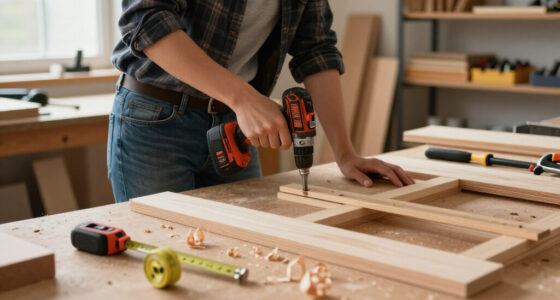
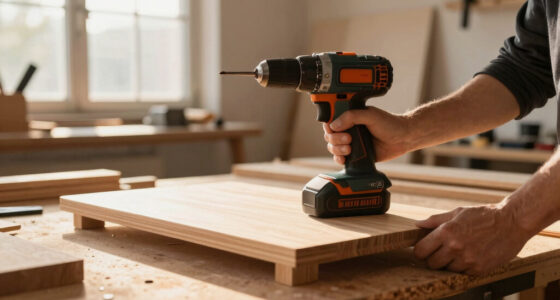
Choosing between a track saw and a table saw depends on how you work. If you need portability, quick setup, and precise cuts on large panels, a track saw might suit you better. For heavy-duty, repetitive tasks in a dedicated workspace, a table saw offers stability and long-term durability. Consider your project size, workspace, and safety needs. To make the best choice, explore how each saw matches your specific workflow and priorities.

Get business pricing on tools and workshop supplies
- Business-only prices and quantity discounts
- Tax-exempt purchasing
- Multiple users, one account, clear invoices
Key Takeaways
- Assess project scale and material size to determine if portability or stability is more critical for your workflow.
- Consider whether high precision on large sheets or repetitive cuts in a fixed workshop aligns with your needs.
- Evaluate workspace constraints; use a track saw for small spaces and a table saw for dedicated, larger setups.
- Match tool choice to material thickness and power requirements—track saw for portability and fine cuts, table saw for heavy-duty tasks.
- Prioritize safety features and maintenance ease to ensure smooth workflow and long-term tool performance.
As an affiliate, we earn on qualifying purchases.
What Are the Key Differences Between Track Saws and Table Saws?
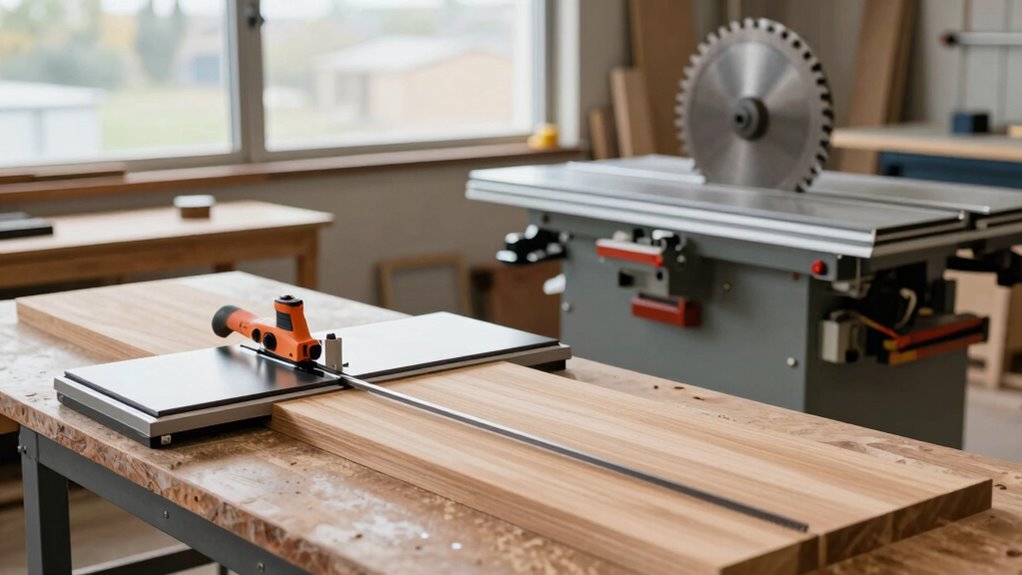
The primary difference between track saws and table saws lies in their design and how they cut material. Track saws feature a guided rail system, allowing you to make precise, straight cuts on large sheets. They typically have a smaller blade diameter, around 6-8 inches, which helps in controlled, accurate cuts. In contrast, table saws have a fixed blade mounted on a table, offering stability for repeated cuts. They usually boast higher motor power, often 1.5 to 3 HP, enabling them to handle tougher materials and larger projects. The blade diameter of table saws can be larger—up to 10 inches or more—providing deeper cuts. This fundamental difference impacts your workflow, depending on whether you prioritize portability, precision, or power. Additionally, power capacity plays a significant role in determining which saw is better suited for your specific needs. It’s also important to consider cutting versatility, as each type of saw has its unique advantages for different tasks. For example, adjustability in table saws allows for more complex cuts, which can be essential for certain projects. Moreover, understanding the material types each saw can handle effectively will help you choose the right tool for your projects. When choosing between the two, consider the cutting accuracy and the level of control you need for your projects.
As an affiliate, we earn on qualifying purchases.
How Does Your Workflow Determine Which Saw Is Best for You?
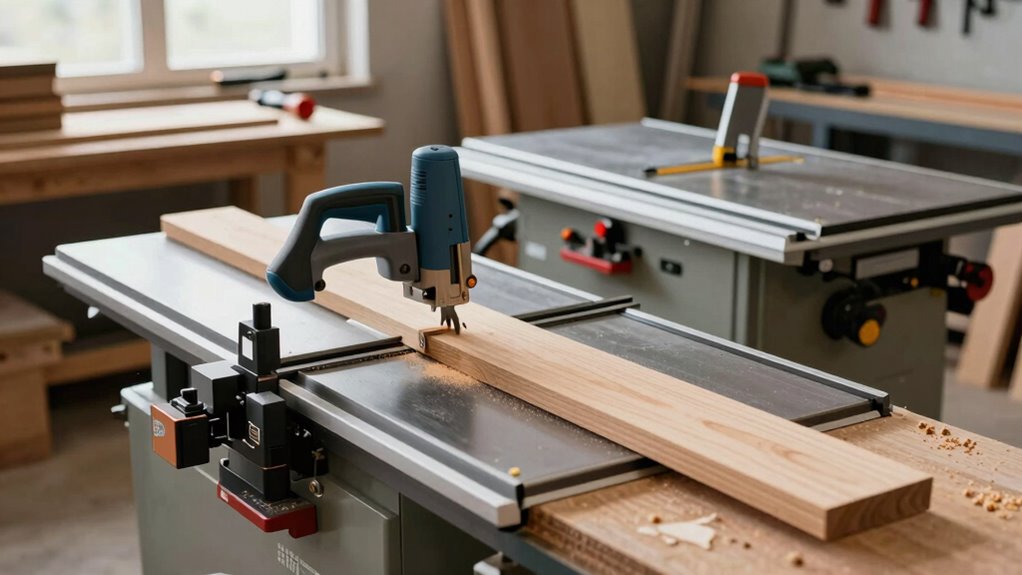
Your workflow plays a crucial role in choosing the right saw, as it determines whether portability, precision, or power matters most. If you often work on-site or need portability, a track saw offers ease of transport. For detailed projects requiring tight blade adjustment and dust collection, a table saw provides stability and control. Consider how you handle dust: if minimizing cleanup is key, look for saws with efficient dust collection systems. Think about your cutting pace—speed and safety depend on your capacity to adjust blades quickly and accurately. Visualize yourself moving around the workspace, making precise cuts or quick rough cuts, and how each saw supports your process. Your workflow guides your choice, impacting your efficiency and finished quality.
As an affiliate, we earn on qualifying purchases.
Which Saw Offers Better Precision, Speed, and Safety?
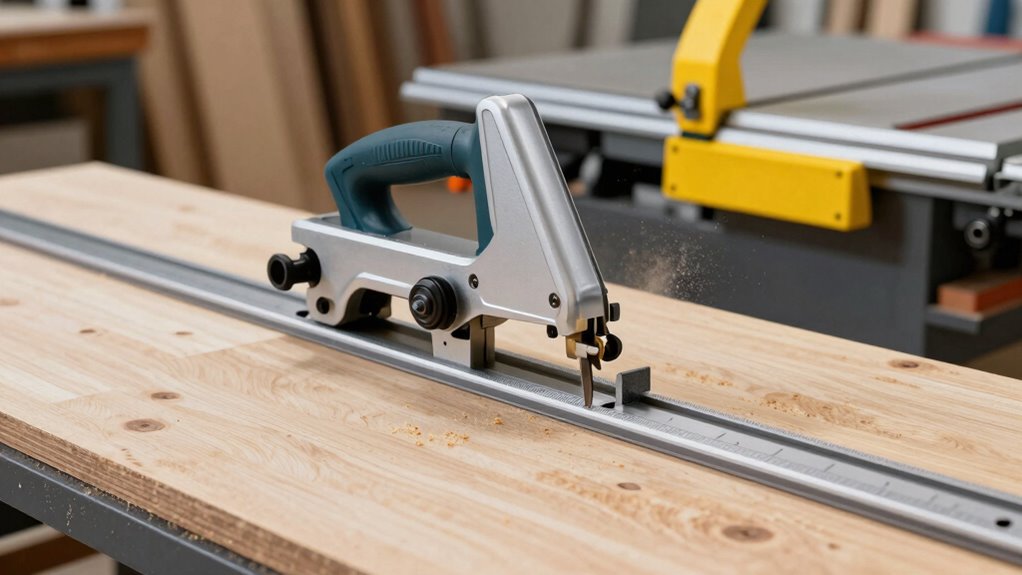
When it comes to precision, a track saw often delivers cleaner, more accurate cuts, especially on large panels. Speed varies depending on the task; a table saw can be faster for repetitive cuts, but safety features are essential for both. Consider how each tool’s safety mechanisms and control ease impact your workflow and overall safety. Additionally, understanding wireless networking and proper cable management can enhance safety and efficiency in your workspace.
Cutting Precision Differences
While both track saws and table saws are designed for precise cuts, their accuracy varies depending on the task. Track saws excel in cutting accuracy for straight, clean edges, especially on large panels. They offer smooth, splinter-free finishes, improving overall finish quality. Table saws, on the other hand, provide consistent precision for repetitive cuts and thicker materials.
Imagine:
- The track guiding your saw with laser-like precision along a marked line
- A clean, splinter-free edge on plywood
- A wide, stable work surface ensuring steady cuts
- Smooth, flawless finish on delicate veneers
- Repetitive cuts with identical accuracy
Both tools can deliver high cutting accuracy, but your choice depends on whether you prioritize finesse, speed, or versatility.
Speed of Operation
Which saw cuts through material faster and safer? Typically, a track saw offers quicker, cleaner cuts because it maintains consistent blade speed and depth, enhancing overall speed. Its blade durability allows for sustained cutting performance without frequent replacements, saving time. Dust collection systems in track saws are usually more efficient, reducing debris and keeping your workspace clear, which can speed up workflow. Additionally, the use of Free Floating technology in some saws can improve maneuverability and safety during operation. Table saws, on the other hand, excel in repetitive cuts and larger projects, but their blade may wear faster under heavy use, affecting speed and precision over time. While both saws can be safe when operated correctly, the track saw’s portability and efficient dust collection give it an edge in rapid, precise cuts. So, if speed and efficiency matter most, the track saw is often the better choice.
Safety Features Comparison
Both track saws and table saws prioritize safety features, but they approach safety differently to enhance user protection. In this safety features comparison, you’ll notice how each tool integrates safety technology to reduce risks. Track saws often include features like retractable blades, anti-kickback systems, and improved dust collection for safer operation. Table saws may offer blade guards, riving knives, and flesh detection technology. Imagine a saw with:
- Quick-release blade guards
- Anti-kickback pawls
- Riving knives for kickback prevention
- Electronic safety shut-offs
- Enhanced dust extraction systems
These safety technology integrations help minimize accidents and protect you during use. Additionally, some models incorporate ergonomic designs to improve handling and reduce user fatigue, further enhancing safety. Your choice depends on which safety features align best with your workflow, ensuring safer, more confident cuts.
As an affiliate, we earn on qualifying purchases.
Is a Track Saw or Table Saw Better for Large or Repetitive Jobs?
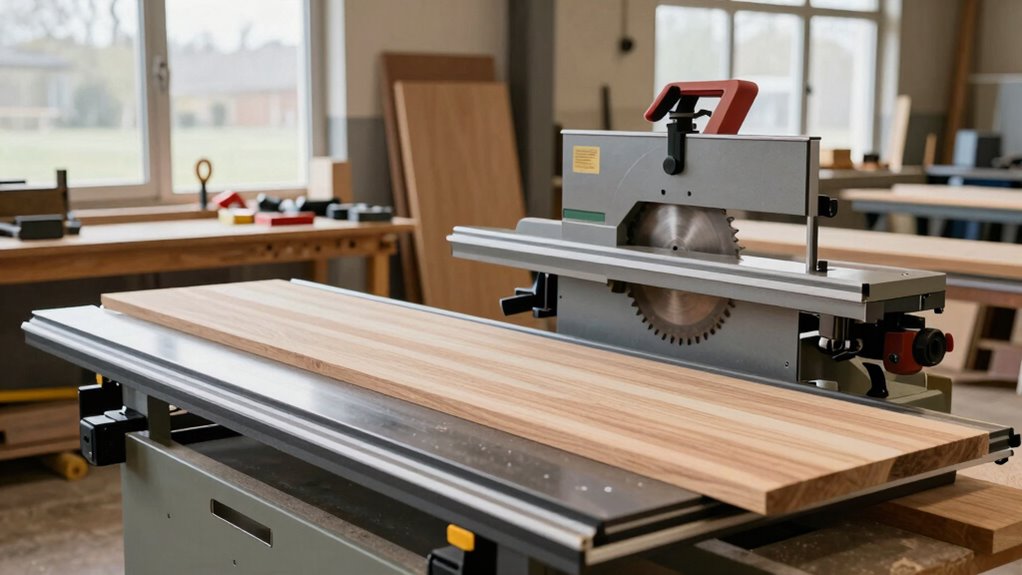
For large or repetitive jobs, choosing between a track saw and a table saw depends on your specific needs and workflow. If you prioritize long-term durability and consistent performance, a table saw often outlasts a track saw, especially under heavy use. However, noise levels are typically lower with a track saw, making it more suitable for environments requiring quieter operation. Imagine the decision like this:
| Feature | Track Saw | Table Saw |
|---|---|---|
| Durability | Moderate, depends on build | High, designed for long-term use |
| Noise Levels | Lower | Higher |
| Repetitive Cuts | Less efficient | More efficient |
Choosing the right tool also involves considering tool longevity, which can significantly impact your overall workflow and investment. Additionally, understanding cutting accuracy and how each tool maintains precision over time can help inform your decision. Regular maintenance and proper use can also enhance performance consistency, ensuring your tools operate at optimal levels over the years.
Will Portability or Workspace Size Influence Your Choice?
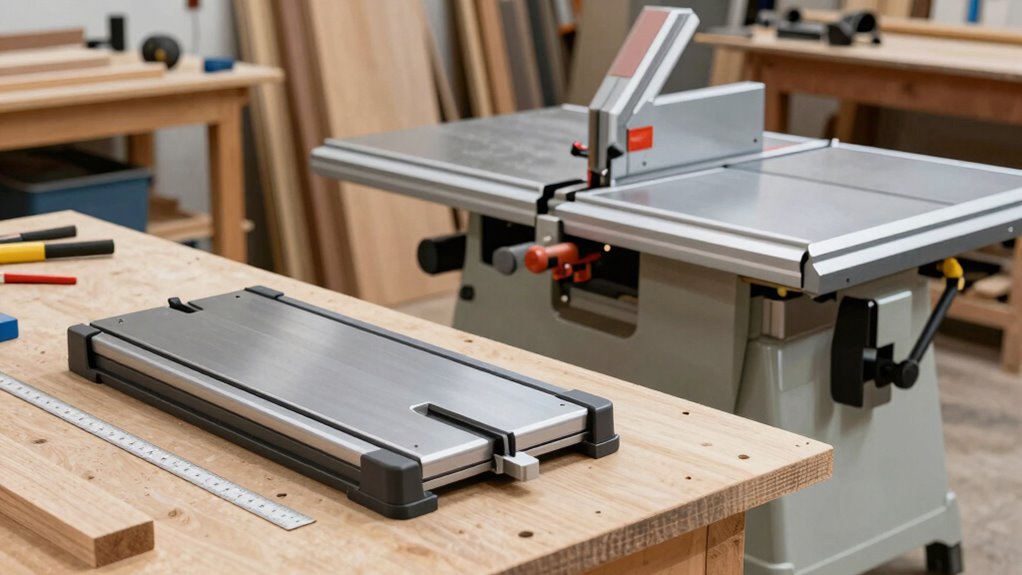
Your workspace size and need for portability can considerably impact your choice between a track saw and a table saw. If you frequently work on the go or have limited space, a portable option might suit you better. Consider how easy each tool is to store and set up to guarantee it fits into your workflow. Additionally, understanding the types of saws and their features can help you select equipment that aligns with your specific project needs and space constraints. Recognizing ergonomic design can also improve your comfort and efficiency during use, especially if you work in tight or mobile environments. Incorporating joyful and mindful practices into your workspace setup can further enhance your overall well-being and enjoyment during projects. For example, choosing tools with energy-efficient features can reduce operational fatigue and support sustainable practices.
Portability for On-the-Go Projects
When working on the go, portability becomes a essential factor in choosing between a track saw and a table saw. Your decision hinges on how easily you can transport and set up your tools for quick projects. A track saw offers portable convenience, fitting into a compact case and easily sliding into your vehicle. Imagine carrying it in a backpack or fitting it into a small toolbox, ready for any location. Picture setting it up on a sturdy surface outdoors, cutting precise angles without hassle. Consider how lightweight it is, enabling on-the go flexibility.
- Slim profile fits in tight spaces
- Lightweight design for easy carrying
- Compact storage options
- Quick setup on any work surface
- Minimal accessories needed
Workspace Space Requirements
Workspace size plays a fundamental role in deciding between a track saw and a table saw, as each tool requires different amounts of space to operate safely and efficiently. A table saw generally needs a dedicated, stable area with enough room for support and safety zones, especially when handling large panels. Dust extraction is essential here to keep your workspace clear and minimize airborne debris. Noise levels also matter; a table saw tends to be louder, so consider soundproofing or placement in a separate area if noise is a concern. Conversely, a track saw is more adaptable to smaller spaces, often used on portable workbenches or in tight spots. Its compact nature makes it ideal if your workspace is limited, but proper dust extraction remains vital to maintain a clean and safe environment.
Storage and Setup Ease
The ease of storage and setup can considerably influence your choice between a track saw and a table saw, especially considering portability and available space. A track saw often offers modular storage options, making it easy to transport and store in smaller spaces. Its setup complexity is minimal, allowing quick assembly and disassembly for on-the-go projects. Conversely, a table saw generally requires a dedicated workspace and more involved setup, with larger footprints and heavy components. Visualize:
- Compact, portable case for track saw parts
- Modular storage shelves for accessories
- Foldable stand for easy transport
- Fixed, built-in table for a permanent shop
- Simplified assembly with few tools required
Choosing based on storage and setup ease depends on whether you prioritize quick, mobile setups or a permanent, organized workspace.
What Are the Cost and Maintenance Factors to Consider?

Considering the cost and maintenance factors of a track saw versus a table saw helps you make a smarter investment. Cost considerations include the initial purchase price, which can vary markedly—track saws tend to be more affordable upfront, while high-quality table saws can be expensive. Maintenance requirements also differ; table saws often need regular blade alignment, motor checks, and dust collection maintenance, adding to ongoing costs. Track saws generally require less upkeep but may need occasional blade changes and track adjustments. Additionally, accessory costs like replacement blades or track accessories should factor into your budget. By evaluating both the upfront expenses and long-term upkeep, you can choose the saw that best fits your budget and workflow, avoiding surprises down the line. Furthermore, equipment longevity and durability play a crucial role in determining the overall value of your investment over time.
How to Pick the Right Saw Based on Your Projects and Needs
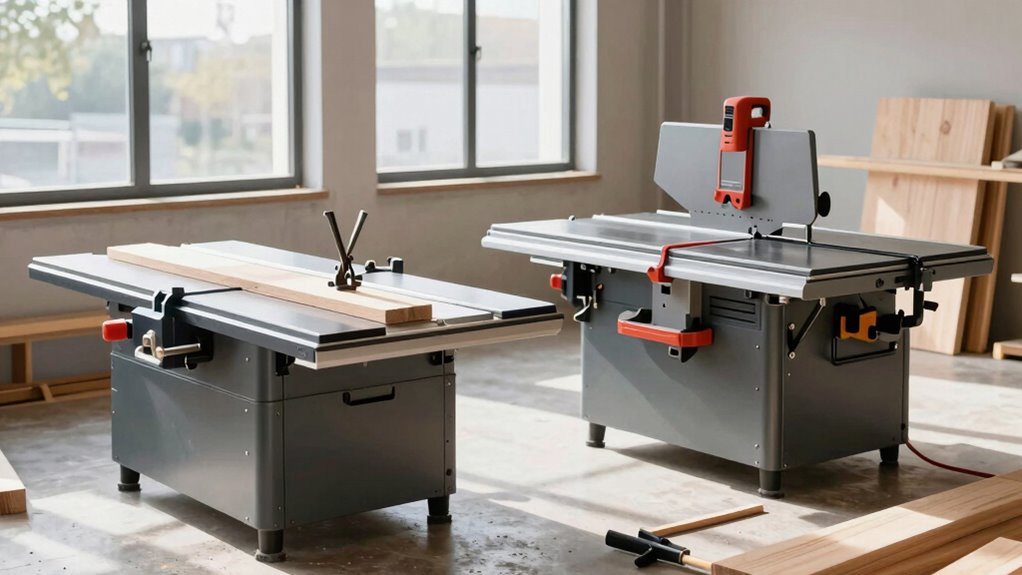
Choosing the right saw depends on matching its capabilities to your specific projects and needs. Consider the blade diameter, which affects cut depth and versatility, and motor power, influencing cutting strength and efficiency. Think about the types of materials you’ll work with most often.
Selecting the right saw requires matching blade size and power to your project needs for optimal results.
- Visualize a compact saw with a smaller blade for detailed work or fine finish cuts.
- Imagine a powerful motor driving a larger blade through thick hardwoods without strain.
- Picture easy portability for on-site projects versus a stationary setup for workshop precision.
- Envision adjusting blade height and angle to suit diverse cut angles and bevels.
- Think about safety features and ease of use for long, demanding projects.
Matching these features to your workflow guarantees you select a saw that boosts productivity and quality.
Frequently Asked Questions
Can a Track Saw Replace a Table Saw for All Projects?
A track saw can’t replace a table saw for all projects. While it offers portable convenience, power, and precision for ripping and crosscutting on-site or small projects, a table saw excels in handling large, repetitive cuts and thicker materials. For versatile, heavy-duty woodworking, a table saw remains essential. Use a track saw for quick, precise cuts when portability matters, but keep your table saw for more demanding tasks.
Which Saw Is More Suitable for Beginner Woodworkers?
As a beginner, a track saw is more suitable because over 60% of new woodworkers find it easier to handle. It offers budget options and simplifies cuts, making it less intimidating. Its ease of use helps you build confidence and develop skills without overwhelming complexity. Plus, its portability means you can practice in small spaces, making it an ideal starting point for learning woodworking basics.
How Does Dust Collection Compare Between Track and Table Saws?
Dust collection is generally more effective with table saws due to their built-in dust extraction ports and enclosed design, which help manage debris better. Track saws produce less dust overall, but their portability means debris can spread more easily unless you use an additional vacuum or dust management system. For cleaner workspaces and better debris management, a table saw offers superior dust extraction compared to a track saw.
Are There Specific Materials Each Saw Handles Better?
Think of a track saw as a nimble dancer, gracefully handling delicate materials like plywood and laminates with ease, thanks to its precise cutting ability. A table saw, like a steady workhorse, excels with thicker, denser woods such as hardwoods or large panels, offering robust material compatibility. For cutting precision, choose the tool that matches your material’s dance—track saws for finesse, table saws for strength.
What Safety Features Should I Prioritize When Choosing a Saw?
When choosing a saw, prioritize safety features like reliable safety gear and an emergency stop. Look for saws with blade guards, riving knives, and anti-kickback mechanisms to protect yourself during use. An easy-to-access emergency stop switch is vital for quick shutdowns if needed. Ensuring these features are present helps prevent accidents, keeps you safe, and makes your workflow more confident and efficient.
Conclusion
Choosing between a track saw and a table saw is like selecting the perfect tool for your woodworking adventure. Imagine sliding a sleek track saw along smooth, straight cuts across your material, or envision your table saw standing ready like a steadfast companion for larger projects. Consider your space, your pace, and your needs. With the right choice, you’ll craft with confidence, turning raw wood into art as seamlessly as a gentle breeze shapes the landscape.
Fall yard work Picks
leaf blowers
As an affiliate, we earn on qualifying purchases.