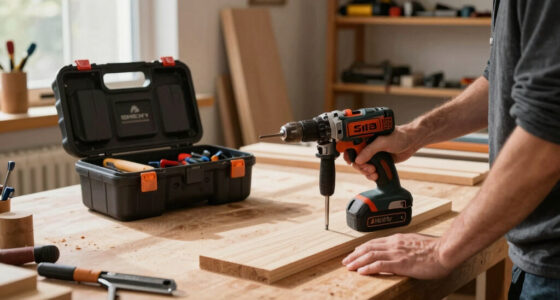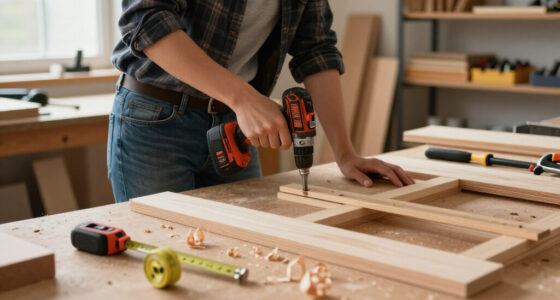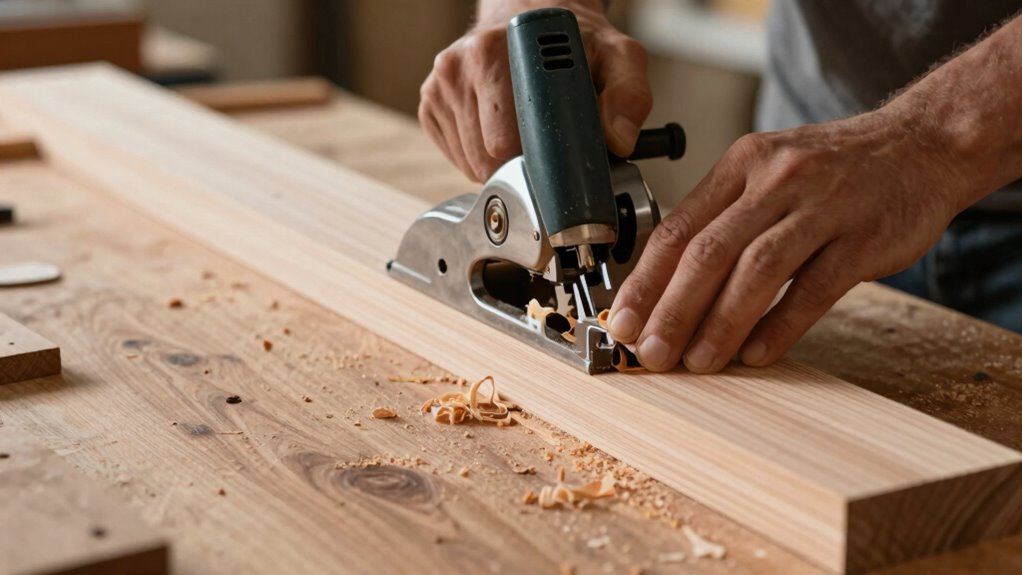

For narrow jointers, align the grain with the cutter’s rotation to minimize tear-out and make multiple shallow passes for safety and accuracy. Use featherboards and stabilize the board to control movement, and always check your setup for wobble and blade height. For wide boards, take shallow passes, use push sticks, and secure the material to reduce vibration. Proper tool maintenance and understanding wood properties boost results. Keep exploring these strategies for professional-quality results every time.

Get business pricing on tools and workshop supplies
- Business-only prices and quantity discounts
- Tax-exempt purchasing
- Multiple users, one account, clear invoices
Key Takeaways
- Align grain with cutter rotation for optimal surface quality and reduced tear-out on both narrow jointers and wide boards.
- Use multiple shallow passes and stabilization techniques to prevent damage and ensure accuracy for wide boards.
- Regularly inspect, sharpen, and calibrate tools to maintain precision and safety during milling.
- Adjust feed rate and cut depth based on grain direction and board width for optimal results.
- Employ proper setup, including calibration and tool maintenance, to minimize errors and improve milling consistency.
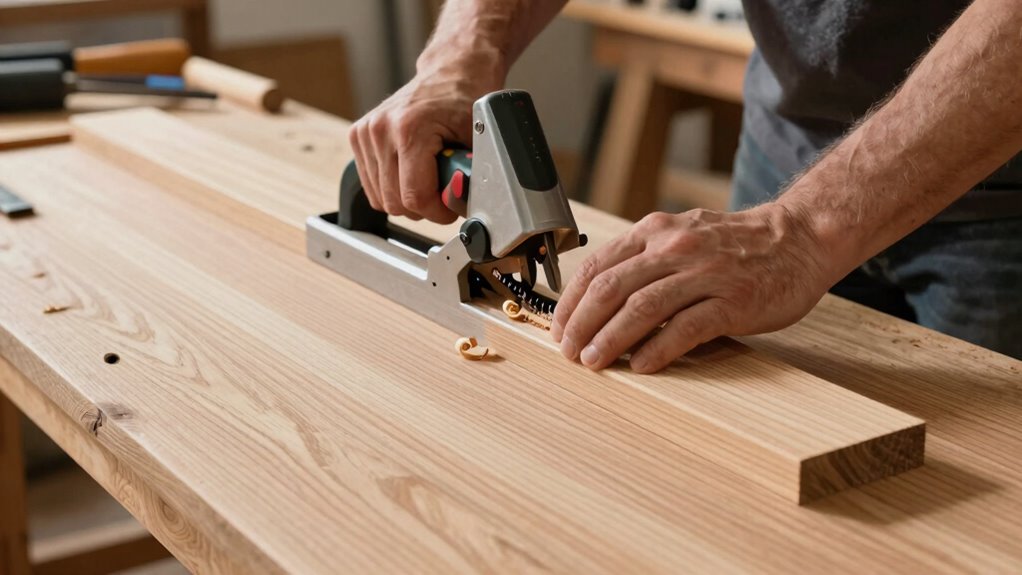
Have you ever struggled to mill narrow jointers or wide boards without sacrificing precision or safety? If so, you’re not alone. Working with different board widths requires adjusting your approach to ensure smooth, accurate cuts. One essential factor often overlooked is understanding grain orientation. Grain runs differently across a board’s width and length, and if you don’t account for it, you risk tear-out, rough surfaces, or even damaging your tools. Before starting, examine the grain direction carefully. For narrow jointers, align the grain so it’s running with the cutter’s rotation. For wider boards, consider making multiple passes, gradually removing material while paying attention to the grain’s behavior. When the grain runs against the cutter, it’s more likely to chip or splinter, so always adjust your feed rate accordingly. Proper grain orientation not only improves surface quality but also minimizes the risk of kickback or tool damage. Additionally, understanding grain orientation can help in selecting the right cutting techniques for different types of wood. Tool maintenance plays an equally critical role in achieving excellent results. Dull blades or poorly aligned cutters can cause uneven cuts, tear-out, and increased effort, especially on wide boards. Regularly inspect and sharpen your blades to ensure they’re performing at peak condition. Keep your tools clean and free of debris, which can interfere with smooth operation and compromise safety. When milling narrow jointers, fine-tuning your setup becomes even more essential because small misalignments can be magnified in tight spaces. It’s worth taking the time to calibrate your machine, check for any wobble, and ensure consistent blade height. Proper machine calibration can prevent many common milling issues and improve overall accuracy. For wider boards, consider using featherboards or push sticks to maintain control and keep your hands clear of the blades. These safety devices also help stabilize the board, reducing vibration and preventing uneven cuts. Adjust your feed rate and depth of cut based on the board’s width and grain orientation. For narrow jointers, slower feeds and lighter cuts help maintain control and minimize tear-out. With wider boards, multiple shallow passes are better than a single aggressive cut—this approach preserves the integrity of the wood and your blades. Throughout the milling process, pay close attention to the grain’s behavior and your machine’s response. Proper tool maintenance combined with a keen understanding of grain orientation and wood behavior allows you to achieve smooth, precise, and safe results every time. Additionally, using the correct cutting tools designed for specific wood types can further enhance your results. Ensuring you understand the properties of different woods can assist in choosing the most suitable milling approach. Ultimately, the key lies in preparation, patience, and ongoing care of your tools, ensuring your milling projects are both efficient and of high quality.
woodworking featherboard for table saw
As an affiliate, we earn on qualifying purchases.
As an affiliate, we earn on qualifying purchases.
Frequently Asked Questions
How Do I Prevent Tear-Out on Delicate Woods?
To prevent tear-out on delicate woods, always pay attention to grain direction. You should cut with the grain whenever possible, as cutting against it causes tear-out. Use sharp blades and take light passes to minimize stress on the wood. Employ proper cutting techniques by adjusting feed rate and blade depth, and consider using a sacrificial board or applying painter’s tape along the cut line to protect fragile surfaces.
What Safety Precautions Are Essential During Large Board Milling?
Milling large boards can feel like wrestling a beast, so safety’s vital. Always wear eye and ear protection, and make sure your dust extraction system’s working perfectly to keep your workspace clear. Before starting, sharpen your blades to prevent kickback and guarantee smooth cuts. Keep hands away from blades, and double-check that your machine’s guards are in place. Staying alert and maintaining safety protocols keeps you safe and your project on track.
How Do Humidity Levels Affect Board Milling Results?
Humidity levels considerably impact your board milling results because high humidity increases moisture content, making wood harder to cut and more prone to warping. Low humidity reduces moisture, causing cracks or splits. To manage this, you should use proper drying methods like air drying or kiln drying before milling. Maintaining consistent humidity levels helps guarantee smoother cuts, stable dimensions, and better overall quality of your finished project.
Can I Use a Router Instead of a Jointer for Wide Boards?
Yes, you can use a router as an alternative for wide board milling, but it requires careful setup and technique. For wide boards, routers can help flatten and straighten edges, especially with a router sled or jig. Keep in mind, router alternatives might not provide the same precision as a jointer, so double-check your work frequently. Proper clamping and patience guarantee good results in wide board milling with a router.
What Are the Best Edge Jointing Techniques for Uneven Boards?
Think of uneven boards as unruly dancers; you need precise choreography to bring harmony. To achieve perfect edge jointing, start with careful edge preparation, ensuring your tools are sharp and true. Use a straightedge or jig to maintain jointing accuracy, guiding your board steadily along the router or hand plane. Focus on smooth, consistent passes, and you’ll create seamless edges ready to be glued, transforming chaos into a symphony of craftsmanship.
As an affiliate, we earn on qualifying purchases.
Conclusion
By adapting your milling strategies to the width of your boards, you guarantee smoother, more precise results. While some believe that using the same approach for narrow and wide boards is sufficient, evidence suggests tailoring your technique actually enhances quality and minimizes warping. Embracing these nuanced strategies not only improves your workflow but also challenges the assumption that one method fits all. Ultimately, paying attention to board width can make a significant difference in your woodworking projects.
push sticks for woodworking safety
As an affiliate, we earn on qualifying purchases.
As an affiliate, we earn on qualifying purchases.
wood milling guide for wide boards
As an affiliate, we earn on qualifying purchases.
As an affiliate, we earn on qualifying purchases.
Evergreen bestsellers Picks
bestsellers
As an affiliate, we earn on qualifying purchases.