
Choosing between a cabinet saw and a contractor saw impacts your shop layout and workflow. A cabinet saw offers precise adjustments, higher power, and better dust control, making it ideal for accuracy-focused projects, but it’s less portable and takes up more space. A contractor saw is lighter, more adaptable, and easier to move, perfect for smaller workshops. Your choice shapes how you organize your space—if you stay tuned, you’ll discover which option best matches your woodworking needs.
Key Takeaways
- Cabinet saw offers higher precision, stability, and dust management, ideal for dedicated, accuracy-focused workshops.
- Contractor saw provides portability and lower cost, suitable for flexible or smaller shop layouts.
- Choose a cabinet saw for demanding, large-scale projects requiring consistent, detailed cuts.
- Opt for a contractor saw if space, budget, and mobility are primary considerations.
- Your shop layout and woodworking needs determine whether stability or versatility is the priority.
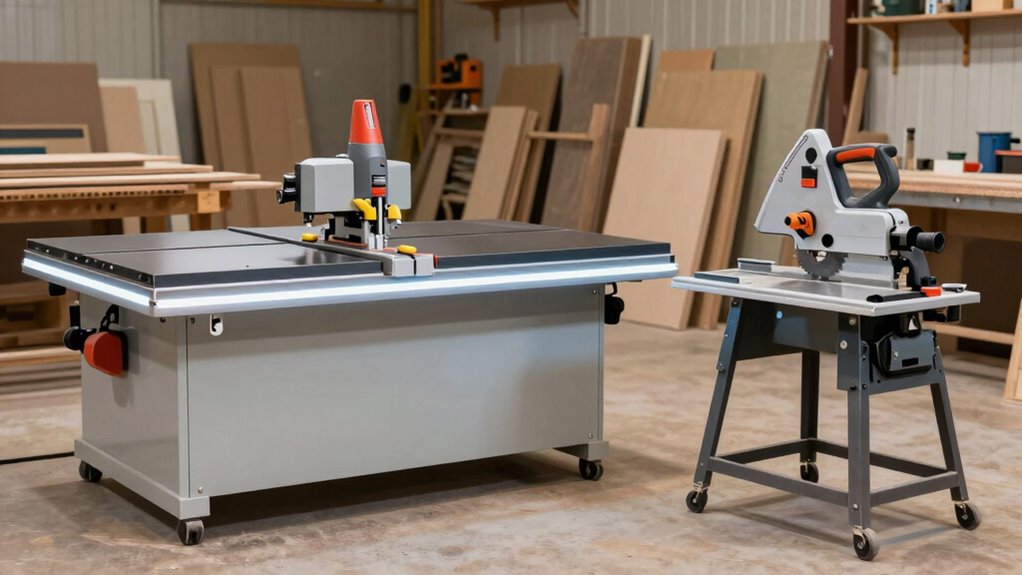
When choosing between a cabinet saw and a contractor saw, understanding their differences can help you make an informed decision for your woodworking needs. Both saws serve the purpose of ripping and crosscutting wood, but their design, power, and features set them apart. One of the first things to consider is how each saw’s blade height and dust collection system will fit into your workflow.
A cabinet saw typically features a fixed blade height, which you can precisely adjust for different cuts. This stability is essential for accurate, repetitive cuts, especially on large projects. With a professional-grade blade height system, you can lock the blade at a specific height, ensuring consistency over long sessions. Dust collection is another critical factor. Cabinet saws usually come equipped with a built-in dust collection port that connects directly to a shop vacuum or dust extractor. This system keeps your workspace cleaner and promotes better air quality, making it easier to maintain a safe environment. Additionally, dust management is crucial for maintaining a healthy and efficient work environment. Proper dust control not only improves safety but also extends the lifespan of your tools.
In contrast, contractor saws often have a more portable design, which means their blade height adjustment can be less robust. You might find that the blade height is adjusted via a less precise mechanism, requiring more effort to get it just right. Dust collection on contractor saws tends to be less thorough. They usually have a smaller port or none at all, which means dust and debris can accumulate more easily around the workspace and within the saw itself. That can make cleanup more time-consuming and reduce the air quality in your shop. Proper dust management is crucial for maintaining a healthy and efficient work environment. Additionally, many contractors opt for versatile saws that can be adapted with different blades or accessories, although this can sometimes compromise the stability and dust collection capabilities. Selecting the right saw also involves considering the cost versus benefit, especially for hobbyists or those with limited space.
The blade height on a cabinet saw is usually easier to fine-tune thanks to its stable, heavy-duty construction. If you frequently work on detailed, accurate projects, this feature becomes essential. A contractor saw’s portability often comes at the expense of fine adjustments; it might be more challenging to set the blade height exactly where you want it, especially during extended use. Dust collection is another area where cabinet saws outperform. Their design inherently supports better dust management, helping you maintain a cleaner environment and prolong the life of the saw. Additionally, the power capacity of cabinet saws generally surpasses that of contractor saws, making them better suited for demanding tasks. This increased power also enables smoother cuts on thicker or harder materials.
Ultimately, your choice depends on your priorities. If you value accuracy, power, and a cleaner workspace, a cabinet saw’s robust blade height adjustment and superior dust collection make it the better option. But if mobility and lower upfront cost matter more, a contractor saw could suit your needs better. Understanding these differences helps you decide which saw aligns with your shop layout and woodworking goals.

Miter Saw Dust Hood with Light, Chop Saw Collector Attachment with 4-Inch Dust Collection Port, Comes with Storage Bag, Bench Miter Saw Dust Collection Solution
Dust Prevention and Collection: When you start the miter saw, this miter saw dust hood will cover the…
As an affiliate, we earn on qualifying purchases.
As an affiliate, we earn on qualifying purchases.
Frequently Asked Questions
Which Saw Is Better for Beginner Woodworkers?
For beginner woodworkers, a contractor saw is better because it offers sufficient blade precision and motor power without overwhelming you. You’ll find it easier to handle, and its more compact size makes it more adaptable to smaller shop layouts. While cabinet saws provide higher precision and power, they can be more complex to operate. Starting with a contractor saw helps you learn the basics comfortably before upgrading later.
How Much Space Does Each Saw Require?
A cabinet saw typically requires more space due to its larger footprint, with blade dimensions often around 10 inches and a need for at least 24 square feet of workspace. It also demands higher power requirements, usually 3 to 5 horsepower. A contractor saw is more compact, with similar blade sizes but less power, needing about 12-16 square feet of space, making it suitable for smaller workshops.
Are There Significant Safety Differences Between Them?
Yes, there are safety differences. Cabinet saws often come with better blade guards and integrated dust collection systems, which help prevent accidents and keep your workspace cleaner. Contractor saws might lack some of these features or have less robust guards, making them slightly riskier. Always verify your saw has proper blade guards and dust collection to minimize injury risk and maintain a safer working environment.
What Is the Average Cost of Each Saw Type?
A cabinet saw typically costs between $2,000 and $5,000, offering larger blade sizes and more powerful motors, making it a beast in the shop. Contractor saws are more budget-friendly, ranging from $500 to $2,000, with smaller blades and less motor power. Your choice depends on your needs and budget, but either way, you’re investing in precision and performance that can transform your woodworking experience.
Can Both Saws Handle Professional-Grade Projects?
Yes, both saws can handle professional-grade projects, but your choice depends on blade precision and motor power. A cabinet saw offers superior blade precision and a more powerful motor, making it ideal for heavy-duty, accurate work. Contractor saws are versatile and portable, suitable for less demanding tasks. If you prioritize precision and power for professional projects, a cabinet saw is the better option.
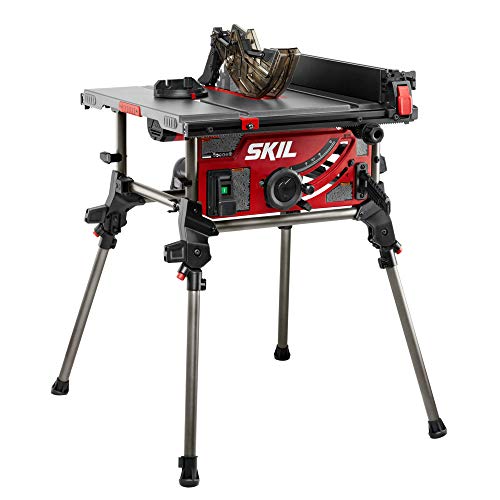
SKIL 15 Amp 10 Inch Portable Jobsite Table Saw with Folding Stand- TS6307-00
RACK AND PINION FENCE RAILS – Ensures fence stays parallel to blade for fast smooth, and accurate cuts
As an affiliate, we earn on qualifying purchases.
As an affiliate, we earn on qualifying purchases.
Conclusion
Choosing between a cabinet saw and a contractor saw is a decision that can make or break your workshop’s efficiency. Think carefully about your projects and budget — don’t put all your eggs in one basket. Remember, you get what you pay for, so invest where it counts. Ultimately, picking the right saw will help you stay ahead of the game and avoid biting off more than you can chew. Your perfect saw is just a decision away!

VEVOR Table Saw, 4500 RPM Portable Jobsite Table Saw with Sharp Edges & High Cutting Precision, Compact Table Saws with Dust Port For Woodworking, Fit for Raw Wood, Flooring & Cabinets
Outstanding Cutting Performance Equipped with a 15A high-efficiency motor, it can deliver up to 4500 RPM to easily…
As an affiliate, we earn on qualifying purchases.
As an affiliate, we earn on qualifying purchases.
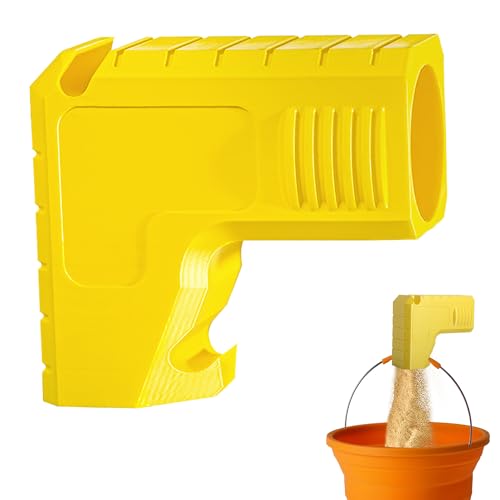
THOUSANDSUNNY Table Saw Dust Collector Adapter, D'ewalt Gravity Powered Dust Collection Attachment with Hook for Workshop Jobsite 2.05 Inch
Universal Dust Collection Adapter: Designed to fit most miter saw and table saw dust ports, this gravity-powered collector…
As an affiliate, we earn on qualifying purchases.
As an affiliate, we earn on qualifying purchases.