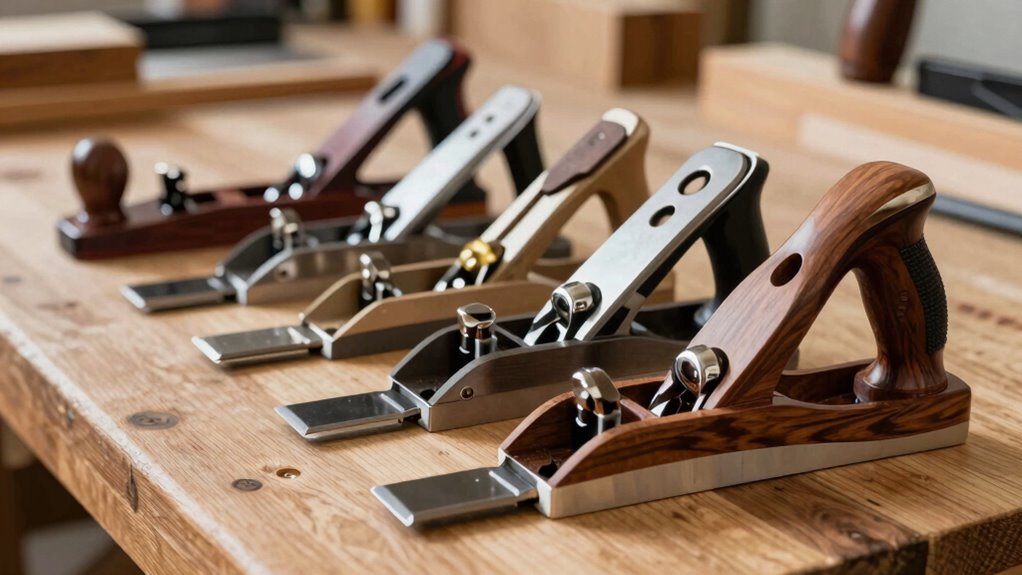

Properly setting up your hand plane is more vital than collecting many sizes because it directly impacts the quality of your work. When your plane is sharp, well-aligned, and comfortable to handle, you gain better control, smoother finishes, and less fatigue. Poor setup leads to rough surfaces and inconsistent results, no matter the size of the plane. If you want to improve your craftsmanship, understanding setup details is essential—keep exploring to learn how to get the most out of your tools.
Key Takeaways
- Proper setup ensures accurate, smooth cuts regardless of the plane’s size or type.
- Sharp blades and correct alignment are essential for effective planing and finish quality.
- Ergonomic handles improve control, reduce fatigue, and enhance precision during use.
- Regular maintenance and adjustments keep tools in optimal condition, maximizing performance.
- Focused setup skills often outweigh owning multiple planes for achieving better woodworking results.
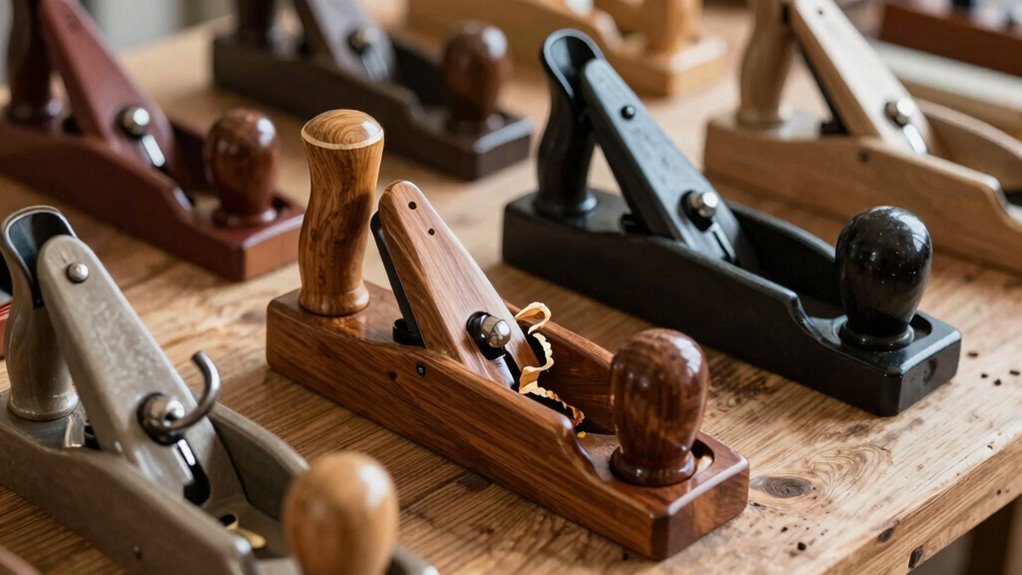
Many woodworkers believe that owning a variety of hand planes is enough to handle any project, but in reality, the key to effective planing lies in how well your tools are set up. No matter how many sizes you have, if your plane isn’t properly tuned, you’ll struggle to achieve smooth, accurate results. The two most critical aspects of setup are blade sharpness and wooden handle ergonomics. These factors directly influence how efficiently you work and the quality of your finish. Proper laboratory safety procedures and regular maintenance are essential to keep your tools in optimal condition. Blade sharpness is paramount. A dull blade tears at the wood fibers instead of slicing cleanly through them. This not only results in rough, uneven surfaces but also causes you to exert more force, leading to fatigue and potential safety hazards. Regular honing and sharpening keep your blade at its ideal cutting edge. When properly sharpened, your blade produces fine shavings, reduces the effort needed, and gives you a smoother, more controlled planing experience. Keep a sharpening stone or honing guide handy, and develop a routine to check and maintain your blade’s sharpness before each project. Equally important is the ergonomics of your wooden handle. A well-designed, comfortable handle allows you to maintain control and apply even pressure without strain. If your handle is uncomfortable or poorly shaped, you’ll find yourself gripping tightly, which leads to fatigue and inconsistent results. Look for handles that fit comfortably in your hand, with smooth edges and a shape that encourages a natural grip. Adjust or replace handles if they become loose or uncomfortable over time. Proper ergonomics help you work longer without discomfort, improve your precision, and make planing a more enjoyable task. Additionally, understanding wood properties can assist you in selecting the right tools and setup for different types of wood. Setting up your hand planes isn’t complicated, but it does require attention to detail. Start with ensuring the blade is sharp and correctly aligned. Make sure the blade protrudes just enough to take a thin shaving—too much, and you risk tear-out; too little, and the cut might be ineffective. Next, examine the handle for comfort and adjust if needed. Sometimes, adding a grip or reshaping a handle can make a significant difference. By focusing on these setup details, you’ll find that your hand planes become more responsive and capable, regardless of their size. In the end, collecting a range of hand planes isn’t as beneficial as making sure each one is properly set up. With a sharp blade and ergonomic handles, you gain better control, cleaner cuts, and a more satisfying woodworking experience. Proper setup transforms your tools into precise, reliable instruments—regardless of how many sizes you own.

Chisel Sharpening Jig, Wood Honing Guide for Chisels and Planes Width 0.1" to 2.8" with Sharpening Angle Fixture, Angle Gauge from 10° to 45°(With 2 Sharpening Stones)
- Accurate Honing Kit: Includes guide, stones, and angle tools
- Adjustable Clamping Jaws: Secure blades at correct bevel angles
- Angle Gauge & Fixture: Quickly set and measure bevel angles
As an affiliate, we earn on qualifying purchases.
As an affiliate, we earn on qualifying purchases.
Frequently Asked Questions
How Do I Know When My Hand Plane Is Properly Sharpened?
You’ll know your hand plane is properly sharpened when the blade angle is ideal for smooth cuts and the edge is keen and free of nicks. Check that the sole is flat, ensuring consistent contact with the wood surface. When you run the plane, it should glide effortlessly, leaving a clean, smooth surface. If it struggles or leaves uneven marks, re-sharpen the blade and verify the sole’s flatness.
What Are the Signs of an Incorrectly Set Hand Plane?
If your hand plane feels like it’s fighting you, it’s a sign something’s off. You might notice uneven shavings or tear-out, indicating poor blade alignment or a warped sole. When the blade isn’t aligned correctly or the sole isn’t flat, the plane skews or gouges, making your work uneven. Keep an eye on these signs, and verify your blade and sole are true to keep your projects smooth and flawless.
How Often Should I Adjust My Hand Plane’s Blade?
You should adjust your hand plane’s blade whenever you notice uneven shavings or increased effort. Regularly check the blade angle and shaving thickness—if shavings become too thick or thin, it’s time for a tweak. Typically, after every few projects or when switching tasks, revisit the blade setup. Keeping the blade sharp and properly aligned guarantees smooth cuts and better control, making your woodworking more precise and enjoyable.
Can Different Woods Require Different Plane Setups?
Did you know that different woods can change your plane’s setup by over 50%? Yes, you should adjust your plane for each type, considering the wood grain and cutting depth. For instance, a softer wood may need a shallower cut and a finer blade, while a hardwood might require a deeper cut for efficiency. Customizing your setup guarantees smoother, cleaner results every time, regardless of wood type.
What Tools Are Essential for Maintaining a Hand Plane?
You’ll need a sharpening stone or honing guide to keep the blade angles precise, guaranteeing ideal cutting performance. A small screwdriver helps you adjust the blade depth and alignment easily. Don’t forget handle ergonomics—choose a plane with a comfortable grip to reduce fatigue during extended use. Regularly checking and maintaining these tools guarantees your hand plane stays in top shape, making your woodworking smoother and more enjoyable.
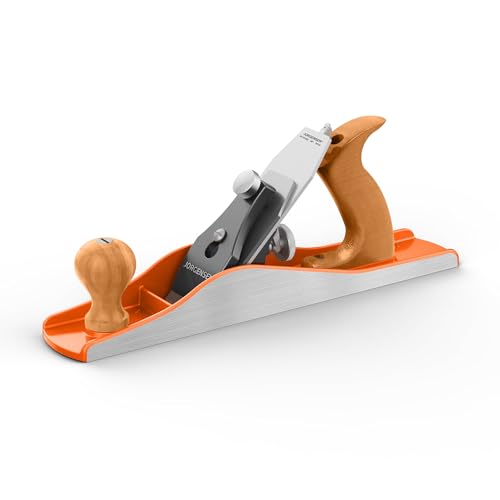
JORGENSEN No.5 Wood Planer, Professional Hand Planer for Woodworking
- Professional Blade Material: Made of durable O1 tool steel
- Heavy-Duty Body: Constructed from ductile iron for durability
- Drop-Tested Construction: Ensures rugged, reliable use
As an affiliate, we earn on qualifying purchases.
As an affiliate, we earn on qualifying purchases.
Conclusion
You might think collecting a variety of hand planes makes you a true woodworker, but the real difference comes down to how well you set them up. Proper setup reveals their full potential, transforming rough timber into smooth, flawless surfaces. It’s not about having many sizes; it’s about mastering each one. When you focus on setup, you’ll discover that your work improves dramatically — proving that precision and care truly matter more than quantity.

TOOLCOOL Router Plane Handheld Woodworking Tool Simple and Effective Plow Plane for Tuning Joinery Cutting Grooves Mortise (Wood Grip)
- Material Construction: 6061 Aluminum alloy with stainless steel blade shaft
- Adjustable Blade Depth: Precise control up to 1.2 inches
- High-Quality Blade: Razor-sharp high-speed steel blade
As an affiliate, we earn on qualifying purchases.
As an affiliate, we earn on qualifying purchases.
Chisel Sharpening Jig, Wood Honing Guide for Chisels and Planes Width 0.1" to 2.8" with Sharpening Angle Fixture, Angle Gauge from 10° to 45°(With 2 Sharpening Stones)
- Accurate Honing Kit: Includes guide, stones, and angle tools
- Adjustable Clamping Jaws: Secure blades at correct bevel angles
- Angle Gauge & Fixture: Quickly set and measure bevel angles
As an affiliate, we earn on qualifying purchases.
As an affiliate, we earn on qualifying purchases.




![How Blackwing Pencils Are Made [Video]](https://woodworkslibrary.com/wp-content/uploads/2026/08/how-blackwing-pencils-are-made-video-featured-260x140.jpg)