Proper rail clearance on your miter saw is essential for accurate cuts, safety, and smooth workflow. When space is cramped, it can cause misalignments, increase the risk of binding or kickback, and force you to make adjustments that waste time. Many buyers overlook how limited clearance impacts performance and safety. Ensuring adequate space makes operation easier and results more precise. If you want to learn what space issues could be holding back your projects, keep exploring.
Key Takeaways
- Adequate rail clearance ensures precise cuts and prevents blade veering caused by cramped setups.
- Insufficient space can lead to saw binding, kickback, and safety hazards during operation.
- Proper clearance allows smooth saw movement, improving control and workflow efficiency.
- Understanding space needs helps prevent misalignments and ensures accurate, consistent results.
- Considering space requirements during setup saves time, reduces adjustments, and enhances long-term safety and performance.

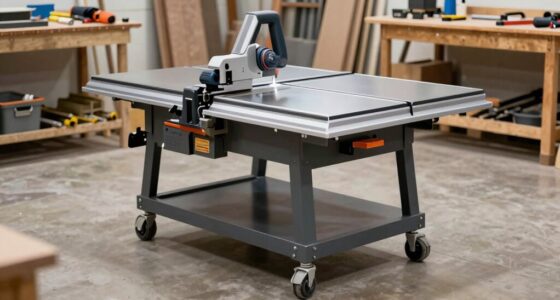
Understanding miter saw rail clearance is essential for achieving precise cuts and ensuring safety during your woodworking projects. When you’re setting up your saw, one often-overlooked aspect is the space available for the saw blade to move freely without obstruction. Rail clearance directly impacts blade accuracy because if the rails are too tight or cramped, your cuts might veer off course. It’s easy to focus on the saw’s features and blade quality, but without enough clearance, even the best blade can’t deliver the precision you need. You might find yourself making multiple adjustments just to compensate for limited space, which only increases the risk of errors and inconsistent results.
Proper rail clearance ensures accurate cuts and safe operation of your miter saw.
Safety precautions are also closely tied to rail clearance. If the clearance is insufficient, you might be tempted to force the saw or push materials in ways that compromise your safety. A cramped setup can cause the saw to bind or kick back unexpectedly, posing injury risks. When you’re working with limited space, you might not have enough room to handle the workpiece confidently, which increases the likelihood of slips or accidental contact with the blade. Ensuring proper rail clearance allows for smooth movement of the saw arm and better control, reducing hazards and giving you peace of mind while cutting. Additionally, proper saw setup and understanding of space requirements can significantly improve your overall cutting experience. Paying attention to these space considerations can prevent misalignments and improve your workflow.
Furthermore, considering space efficiency when choosing your saw can help prevent the common oversight of inadequate clearance, saving you time and effort in the long run.
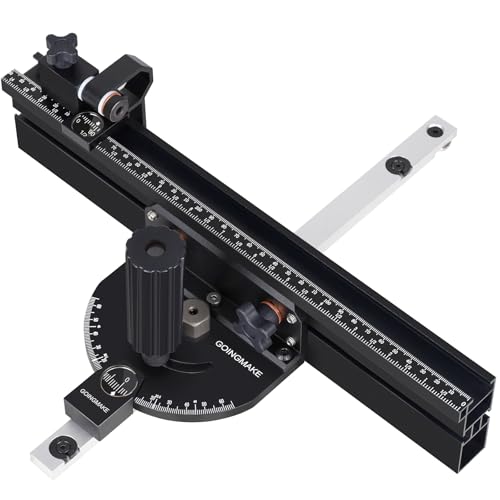
GOINGMAKE Compact Table Saw Miter Gauge with 360mm Fence and Multifunction Flip Stop and Positive Angle Stops, Miter Gauge for Table Saw Accessories, for Woodworking Cuts, Fits 3/4"x3/8" Slot
【Accurate Woodworking Crosscuts and Miter Cuts】GOINGMAKE miter gauge for table saw is perfect for repeat woodworking angle cuts…
As an affiliate, we earn on qualifying purchases.
As an affiliate, we earn on qualifying purchases.
Frequently Asked Questions
How Do I Measure Proper Rail Clearance for My Miter Saw?
To measure proper rail clearance for your miter saw, first check the manufacturer’s specifications for dust collection and material compatibility. Then, measure the distance from the saw’s blade to the fence when fully extended, ensuring enough space for larger materials and dust extraction components. Keep in mind that ample clearance improves dust collection and allows you to work with various material sizes comfortably, enhancing safety and efficiency.
Can Rail Clearance Affect Cutting Accuracy?
Yes, rail clearance can affect your cutting accuracy. If there’s insufficient clearance, you might struggle with blade wobble or experience difficulty in achieving precise cuts. Additionally, limited clearance hampers dust collection, which can obscure your view and lead to inaccuracies. Ensuring proper rail clearance allows the blade to move smoothly, reduces wobble, and improves dust extraction, ultimately enhancing your overall cutting precision and safety.
What Tools Are Best for Adjusting Rail Clearance?
You should use a combination of a square and a level to adjust rail clearance for proper blade alignment. These tools help guarantee the rails are perfectly aligned, which improves cutting accuracy. Additionally, check your dust collection system during adjustments, as dust buildup can interfere with smooth movement. Regularly inspecting and fine-tuning with these tools keeps your saw functioning at its best, preventing miscuts caused by improper rail clearance.
Is Rail Clearance Adjustable on All Miter Saw Models?
Surprisingly, not all miter saws let you adjust the rail clearance easily. While some models offer blade alignment and dust collection adjustments, many lack this feature altogether. You might think you’re set, but if your saw’s rail clearance isn’t adjustable, it’s like trying to fine-tune dust collection with a broken vacuum. Always check if your saw allows for adjustments—otherwise, you’re fighting an uphill battle with blade alignment and dust collection.
How Does Rail Clearance Influence Safety During Cuts?
Rail clearance directly impacts safety during cuts by ensuring proper blade alignment and preventing kickbacks. When clearance is insufficient, you risk misaligned blades, which can cause binding or kickouts. Additionally, good clearance helps dust collection, keeping your workspace clear and reducing slipping hazards. Always check that your saw’s rail clearance allows smooth, precise cuts, and regularly maintain blade alignment and dust collection systems for a safer, more efficient cutting experience.
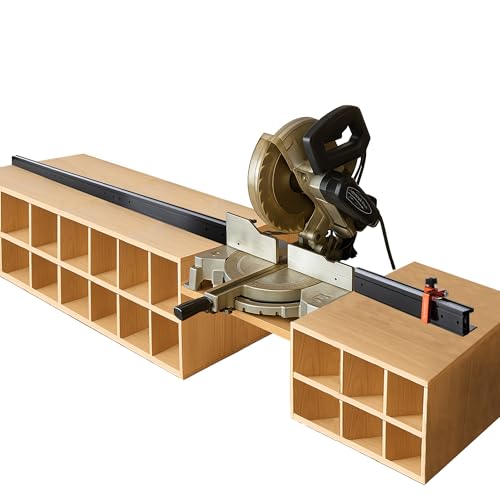
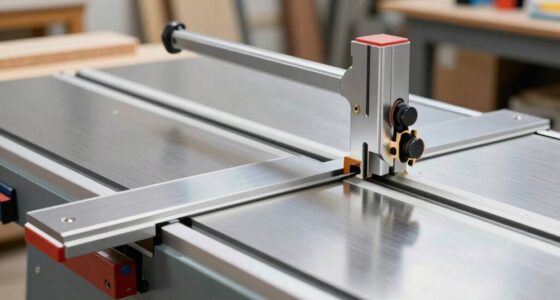
O'SKOOL Miter Saw Fence System with Adjustable Flip Stop – 68" Expandable Aluminum Track with Dual-Direction Measure Tape for Radial Arm Saws, Drill Presses, and Woodworking Stations, RTS024
Modular 68" expandable miter saw fence system: Each 17" aluminum rail connects seamlessly to create a 68" total…
As an affiliate, we earn on qualifying purchases.
As an affiliate, we earn on qualifying purchases.
Conclusion
Don’t overlook the importance of rail clearance when choosing your miter saw. It’s like the backstage pass to smooth, precise cuts—without enough space, your saw might as well be a boat stuck in a bottleneck. By paying attention to this often-forgotten detail, you’ll keep your workflow flowing as seamlessly as a well-oiled machine. Remember, the right clearance isn’t just a detail; it’s the foundation for perfect cuts and safer working days ahead.

Improved Dust Collection Port for DeWalt DWS779 & DWS780 Miter Saws – Virtually No Mess – Made in the USA
Compatible with DeWalt Miter Saws DWS779 & DWS780 (Double Bevel Sliding Miter Saw, 12-inch)
As an affiliate, we earn on qualifying purchases.
As an affiliate, we earn on qualifying purchases.
O'SKOOL Miter Saw Fence System with Adjustable Flip Stop – 68" Expandable Aluminum Track with Dual-Direction Measure Tape for Radial Arm Saws, Drill Presses, and Woodworking Stations, RTS024
Modular 68" expandable miter saw fence system: Each 17" aluminum rail connects seamlessly to create a 68" total…
As an affiliate, we earn on qualifying purchases.
As an affiliate, we earn on qualifying purchases.