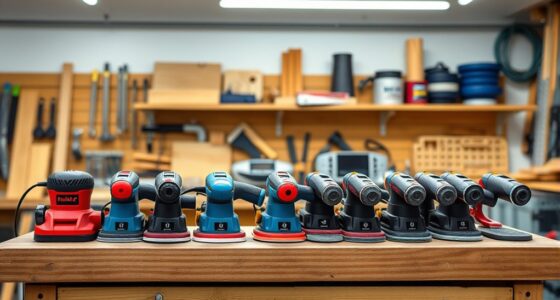
For most buyers, I’d start with the DEWALT DWE6423K: its variable speed makes it a versatile choice for moving between stock removal and finer finishing. The Makita BO5041K stands out for buyers who want added control, while the Bosch GET75-6N is the more powerful, larger-pad option for demanding work. The main tradeoffs are corded convenience versus cordless freedom, five-inch maneuverability versus six-inch coverage, and extra control versus simpler operation. Dust collection, pad compatibility, and how often you sand also affect the right choice. Read on for the full breakdown of all 15 random orbital sanders and the buyer type each one suits best.

Get tools and workshop supplies delivered free — and shop member deals
- Fast, free delivery on millions of items
- Access to Prime Big Deal Days deals on October 6–7
- Prime Video, Amazon Music and more included
Complete the kit


Key Takeaways
- The DEWALT DWE6423K is the strongest all-around fit for buyers who want a five-inch corded sander with variable speed and a kit format; the bare-tool DWE6423 offers similar core functionality without the same kit framing.
- Variable speed is the clearest separator among the corded five-inch picks. The DWE6421 and DWE6421K keep operation simpler, while the DWE6423 models, Bosch ROS20VSC, and several value options let users adjust sanding pace.
- The Makita BO5041K prioritizes handling choices compared with simpler body designs, while the BO5030K is a more straightforward alternative for buyers who do not need the same degree of control.
- The Bosch GET75-6N is in a different class of use from compact five-inch sanders: its six-inch pad and dual-mode design suit larger or tougher jobs, but bring more tool than many occasional DIY users need.
- Format matters as much as advertised power. The DCW210B provides cordless mobility but requires a compatible battery, while corded models avoid battery planning; bundled discs, cases, and dust boxes also vary in usefulness.


| random orbital sander | Power source | Motor | Weight | Warranty |
|---|---|---|---|---|
| DEWALT 5-Inch Variable-Speed R | Corded electric, 120 volts | 3 amps | — | — |
| DEWALT DWE6421K 5-Inch Random | Corded electric, 120 volts | 3 amps | — | 3-year limited warranty |
| Makita BO5041K 5-Inch Random O | Corded electric | 3 amps | — | 1 year |
| Bosch ROS20VSC 5-Inch Variable | Corded electric, 120 volts | 2.5 amps | 3.5 pounds | — |
| DEWALT DWE6421 5-Inch Single-S | Corded electric, 120 volts | 3 amps | 3.4 pounds | 3-year limited warranty |
| Makita BO5030K 5-Inch Random O | Corded electric | 3 A | 1,300 g | 1-year limited |
| SKIL 5-Inch Random Orbital San | Corded electric | — | 3.4 lb | 1-year limited warranty |
| HYCHIKA 5-Inch Random Orbital | Corded electric | — | — | — |
| DEKOPRO 5-Inch Random Orbital | — | — | — | — |
| DEWALT 5-Inch Variable-Speed R | Corded electric | 3 amp | 3.4 pounds | — |
| Dong Cheng 5-Inch Random Orbit | — | — | 3.3 lb | 3 years |
| WORKPRO 5-Inch Variable-Speed | Corded electric | 2.5 A | 2.7 lb | — |
| DEWALT 20V MAX Brushless 5-Inc | Battery powered; lithium-ion | Brushless | 2.5 lb | 3-year limited warranty; 1-year free service; 90-day money-back guarantee |
| BLACK+DECKER 5-Inch Random Orb | Corded electric | 2.0 A | 3.2 lb | 2-year limited manufacturer warranty |
| Bosch GET75-6N Dual-Mode Rando | — | 7.5 A | 5.7 lb | — |
More Details on Our Top Picks
DEWALT 5-Inch Variable-Speed Random Orbital Sander Kit (DWE6423K)
The DWE6423K is the most adaptable DEWALT option here: its speed dial spans 8,000–12,000 OPM, letting me slow down for delicate finishing or raise the pace for routine stock removal. Its 3-amp motor matches the fixed-speed DWE6421K, but the variable control makes this kit a better fit when one sander has to handle varied projects. A counterweight and rubber overmold address comfort during longer sessions, and the locking dust bag is ready for use without a separate collector.
The tradeoff is corded mobility, shared by the other DEWALT models in this group. Dust collection also depends on compatible connections; other vacuum setups may need an extra connector. I’d choose the Makita BO5041K instead if an adjustable front handle and a lower minimum speed matter more than the DEWALT kit’s focused setup.
Pros:- Variable 8,000–12,000 OPM speed supports different materials and finish stages.
- Counterweight design and rubber overmold help reduce vibration and hand fatigue.
- Locking dust bag is included for straightforward dust collection.
- Compatible with specified DEWALT dust collectors.
Cons:- The power cord limits reach and portability.
- Connecting some non-DEWALT vacuum systems may require a separate connector.
Best for: Woodworkers who want one corded 5-inch sander for both faster material removal and controlled finishing, with a dust bag included.
Not ideal for: People sanding far from outlets or switching among vacuum systems without wanting to source a compatible connector.
- Model:DWE6423K
- Pad size:5 inches
- Motor:3 amps
- Speed:8,000–12,000 OPM
- Power source:Corded electric, 120 volts
- Dust collection:Locking dust bag; compatible with DWV010 and DWV012 dust collectors
- Dimensions:10.38 × 7.25 × 6.2 inches
Our verdict“Choose the DWE6423K if you want a versatile corded sander with speed control and a ready-to-use dust bag.”
DEWALT DWE6421K 5-Inch Random Orbit Sander Kit
The DWE6421K keeps the setup uncomplicated: its 3-amp motor runs at a fixed 12,000 OPM, so there’s no speed dial to adjust between passes. That suits repeat work on familiar materials, while the low-profile body helps keep the pad close to the surface for controlled sanding. Like the variable-speed DWE6423K, it has a counterweight and rubber overmold to make extended handling more comfortable.
The kit adds a dust bag and carrying bag, giving it an advantage over the DWE6421, which includes a dust bag but not a carrying bag. The clear compromise is flexibility: the Makita BO5041K and DWE6423K can both slow down for more delicate work, while this DEWALT cannot. I’d pick this kit for straightforward jobs, not for a workshop where one tool must cover a wide range of finishes.
Pros:- Fixed 12,000 OPM provides a consistent pace for routine sanding.
- Low-profile body helps keep the sander close to the work surface.
- Counterweight and rubber overmold support more comfortable handling.
- Includes a dust bag and carrying bag.
Cons:- Single-speed operation offers less control than the DWE6423K or Makita BO5041K.
- Corded power restricts movement away from outlets.
Best for: DIYers and small-shop owners who mainly sand at a consistent pace and want a carry bag with their sander.
Not ideal for: Buyers who work with heat-sensitive finishes or varied materials that call for adjustable sanding speed.
- Model:DWE6421K
- Pad diameter:5 inches
- Motor:3 amps
- Speed:12,000 OPM
- Power source:Corded electric, 120 volts
- Included components:Sander, dust bag, carrying bag
- Dimensions:10.08 × 7.23 × 6.24 inches
- Warranty:3-year limited warranty
Our verdict“Pick the DWE6421K if repeatable 12,000-OPM sanding and the included carry bag matter more than variable speed.”
Makita BO5041K 5-Inch Random Orbit Sander
The Makita BO5041K stands out for control rather than a higher stated motor rating: its speed adjusts from 4,000 to 12,000 OPM, a wider working range than the DEWALT DWE6423K’s 8,000–12,000 OPM. That lower floor can help when I want a gentler pace, while the adjustable front handle gives another hand position for corners and confined areas. Its rubberized grips and 1/8-inch orbit support a controlled approach across varied sanding tasks.
Makita includes a case, abrasive disc, dust bag, and vacuum-port adapter, making this a more accessory-ready package than the DEWALT DWE6421K kit, though that model includes a carrying bag too. Dust collection can help limit mess but won’t capture everything, and the cord limits movement. Choose the DWE6423K if its simpler DEWALT dust-bag setup is a better match; choose Makita for the handle and lower speed range.
Pros:- 4,000–12,000 OPM range allows a slower pace than the DEWALT DWE6423K.
- Adjustable front handle supports control in corners and confined spaces.
- Rubberized grips provide additional handling support.
- Includes a tool case, abrasive disc, dust bag, and vacuum-port adapter.
Cons:- Corded operation limits reach and portability.
- Dust collection reduces mess but does not eliminate sanding dust.
Best for: Woodworkers who sand corners, confined areas, or varied materials and want an adjustable handle plus a broad speed range.
Not ideal for: Buyers who need cordless freedom or expect the dust bag and vacuum port to keep the workspace dust-free.
- Motor:3 amps
- Speed:4,000–12,000 OPM
- Orbit diameter:1/8 inch
- Sanding disc:5 inches, 8-hole hook-and-loop
- Power source:Corded electric
- Included accessories:Abrasive disc, dust bag, tool case
- Warranty:1 year
Our verdict“Choose the BO5041K if adjustable handling and a low-speed option matter more than cordless convenience.”
Bosch ROS20VSC 5-Inch Variable-Speed Random Orbital Sander
The Bosch ROS20VSC is the finish-focused choice in this group. Its variable-speed 2.5-amp motor covers 7,500–12,000 OPM, and the pad-dampening system is designed to help limit swirl marks—useful when the final surface matters as much as sanding speed. The microfilter dust canister and included vacuum adapter offer more collection options than the basic dust-bag setup on the DEWALT DWE6421.
At 3.5 pounds, it is also a defined, manageable package, with a carrying bag and sanding accessories included. Its lower motor amperage than the 3-amp DEWALT and Makita models is a spec difference, but the supplied information does not establish a direct performance comparison from amperage alone. The main limitation is that it remains corded, and the included disc’s grit is unspecified. For a wider speed range and adjustable front handle, the Makita BO5041K is the alternative I’d compare before choosing.
Pros:- Variable 7,500–12,000 OPM speed accommodates different sanding tasks.
- Pad-dampening system is designed to help minimize swirl marks.
- Microfilter dust canister and vacuum adapter give two dust-collection options.
- Includes a carrying bag and hook-and-loop sanding pad.
Cons:- Corded power requires access to an outlet.
- Included sanding disc grit is not specified in the supplied product data.
Best for: Finish-minded DIYers who want variable speed, a dust canister with a vacuum adapter, and features aimed at reducing swirl marks.
Not ideal for: Buyers who need cordless operation or want the included sanding disc’s grit specified before purchase.
- Model:ROS20VSC
- Disc diameter:5 inches
- Motor:2.5 amps
- No-load speed:7,500–12,000 OPM
- Power source:Corded electric, 120 volts
- Weight:3.5 pounds
- Dust collection:Microfilter system with detachable dust canister
- Included accessories:Sanding pad, sanding disc, dampening ring, dust canister, vacuum adapter, carrying bag
Our verdict“Choose the ROS20VSC if a swirl-mark-conscious finish and flexible dust collection take priority over cordless reach.”
DEWALT DWE6421 5-Inch Single-Speed Random Orbital Sander
The DWE6421 is the no-frills pick for buyers who want a familiar 5-inch format and a fixed 12,000 OPM sanding pace. Its low-profile design keeps the sander close to the work surface, while a counterweight and rubber overmold help with control and comfort. Compared with the DWE6421K, it skips the carrying bag and includes just the sander and dust bag, which suits buyers who don’t need a travel case.
This model shares the main limitation of the DWE6421K: there is no variable speed. The DWE6423K costs this choice in flexibility, offering speed adjustment for gentler finishing, while the Makita BO5041K adds both variable speed and an adjustable front handle. The DWE6421 makes sense when the work is routine and the simpler package fits; its cord still restricts movement, and compatible dust collectors may be preferable to the included bag for longer jobs.
Pros:- 12,000 OPM provides a consistent pace for everyday sanding.
- Low-profile design helps keep the pad close to the work surface.
- Counterweight and rubber overmold support more comfortable handling.
- Includes a dust bag and is compatible with select dust collectors.
Cons:- Single-speed operation is less adaptable than the DWE6423K or Makita BO5041K.
- Corded power limits mobility, and no carrying bag is listed among included components.
Best for: Home users doing routine sanding at a consistent pace who want a basic corded tool without a carrying bag.
Not ideal for: Woodworkers who need speed adjustment, cordless reach, or an included case for storage and transport.
- Model:DWE6421
- Pad diameter:5 inches
- Motor:3 amps
- Speed:12,000 OPM
- Power source:Corded electric, 120 volts
- Weight:3.4 pounds
- Included components:Sander, dust bag
- Warranty:3-year limited warranty
Our verdict“Choose the DWE6421 for routine 12,000-OPM sanding when you want a simple DEWALT tool and do not need variable speed or a case.”
Makita BO5030K 5-Inch Random Orbit Sander with Tool Case
The Makita BO5030K favors straightforward, steady sanding over the extra speed control offered by the SKIL SR211601 and DEWALT DWE6423. Its 3-amp motor and 12,000 OPM give it a fixed, brisk pace suited to smoothing larger wood surfaces without asking you to manage multiple settings. Controlled startup helps keep the pad more manageable as sanding begins, while the rubberized grip supports a firmer hold during longer sessions. Through-the-pad dust collection and an included tool case also make it a tidy, easy-to-store corded setup. The tradeoff is limited flexibility: unlike the variable-speed models in this lineup, it cannot slow down for delicate finishing or material-specific work. It also needs an outlet, so it is less convenient away from a workbench.
Pros:- 3-amp motor runs at a consistent 12,000 OPM for brisk sanding
- Controlled startup helps manage the pad as the tool powers on
- Rubberized grip supports comfort and control
- Through-the-pad dust collection and included case support cleaner storage and work
Cons:- Single-speed operation offers less control than the SKIL SR211601 and DEWALT DWE6423
- Corded power limits movement around large or remote workpieces
Best for: Woodworkers who want a corded 5-inch sander with a steady sanding rate, comfortable grip, and included storage case
Not ideal for: Buyers who need variable speed for delicate finishing or want to sand far from a power outlet
- Disc diameter:5 inches
- Motor:3 A
- Maximum speed:12,000 OPM
- Orbit diameter:1/8 inch
- Power source:Corded electric
- Weight:1,300 g
- Included components:Sander, dust bag, dust bag nozzle, plastic tool case
- Warranty:1-year limited
Our verdict“Choose the Makita BO5030K for steady, fast corded sanding and a useful case, but pick a variable-speed model if you need finer control.”
SKIL 5-Inch Random Orbital Sander with Cyclonic Dust Box and 3 Sanding Sheets
The SKIL SR211601 is a practical pick for jobs that move between materials or sanding stages. Its 7,000–13,000 OPM variable-speed range lets you reduce the pace for more controlled work or turn it up for faster sanding, giving it more range than the fixed-speed Makita BO5030K. The cyclonic dust box is another point of difference: it collects debris in a removable container instead of relying only on a loose dust bag, which can make quick cleanup simpler. A compact body and vibration-reducing grip help keep the tool manageable. It is still a corded sander, and the included sheets cover only one specified grit type, so buyers planning a full coarse-to-fine workflow will need to source additional abrasives.
Pros:- Variable 7,000–13,000 OPM speed range suits different materials and tasks
- Cyclonic dust box is removable and easy to empty
- Compact design and vibration-reducing grip support controlled handling
- Suitable for sanding wood, metal, and plastic
Cons:- Corded design restricts movement away from an outlet
- Only one grit type is specified for the included three sanding sheets
Best for: DIYers who sand wood, metal, and plastic and want variable speed with a removable dust container
Not ideal for: Buyers who need cordless mobility or want a supplied assortment of grits for multiple sanding stages
- Model:SR211601
- Disc diameter:128 mm
- Amperage:2.8 A
- Speed:7,000–13,000 OPM
- Power source:Corded electric
- Weight:3.4 lb
- Included components:Random orbital sander, dust box, 3 sanding sheets
- Warranty:1-year limited warranty
Our verdict“Choose the SKIL SR211601 if adjustable speed and an easy-to-empty dust box matter more than cordless convenience or a varied abrasive set.”
HYCHIKA 5-Inch Random Orbital Sander with 6 Speeds
The HYCHIKA FL117 makes a strong case for first-time buyers who want abrasives ready for more than one stage of a project. Its package includes 12 discs in 80, 120, and 240 grit, giving it a more useful starting assortment than the SKIL SR211601, whose supplied sheets are listed without a range of grits. Six speed settings provide a way to tailor sanding for rougher preparation, smoother finishing, or other light tasks, while the hook-and-loop pad speeds up disc changes. The 300 W motor and dust bag make this a self-contained corded option, though the bag still needs regular emptying. Compared with the DEKOPRO DKOS30XL125, the HYCHIKA’s included abrasives cover fewer grit grades, but its stated speed and power details are more internally consistent.
Pros:- Six speed settings offer control across sanding and preparation tasks
- Includes 12 discs in 80, 120, and 240 grit
- Hook-and-loop pad makes abrasive changes quick
- Dust bag and eight-hole collection design are included
Cons:- Corded operation requires access to an outlet
- Dust bag needs emptying during dusty work
- Supplied grit assortment does not extend beyond 240 grit
Best for: New DIY users who want a variable-speed corded sander and a basic coarse-to-fine disc assortment in the box
Not ideal for: Buyers who need cordless freedom, extensive grit coverage, or dust extraction without stopping to empty a bag
- Sanding pad size:5 inches
- Motor power:300 W
- Maximum speed:13,000 rpm
- Speed settings:6
- Power source:Corded electric
- Dust collection:Dust bag with 8 vacuum holes
- Included sanding discs:12: four each of 80, 120, and 240 grit
- Dimensions:9.17 × 6.61 × 5.61 inches
Our verdict“Pick the HYCHIKA FL117 as a ready-to-start option for basic sanding stages, but look elsewhere for finer grit coverage or a cord-free setup.”
DEKOPRO 5-Inch Random Orbital Sander with Dust Collection and 16 Sanding Discs
The DEKOPRO DKOS30XL125 stands out for the breadth of abrasives supplied: 16 discs across six listed grits, from coarse 60 grit through very fine 1,000 grit. That range gives it more finishing options out of the box than the HYCHIKA FL117, whose included discs stop at 240 grit. Six speed settings and a detachable dust bag add useful flexibility for wood or metal projects, while the balanced-grip design is intended to reduce fatigue. There is one specification caveat: the data lists a maximum of 13,000 rpm but the description says up to 14,000 RPM, so I would not choose it based on peak speed. Its corded format also limits where it can work, and the voltage listing should be checked against the buyer’s power supply.
Pros:- Includes 16 sanding discs across six listed grit grades
- Six speed settings allow adjustment for different tasks
- Detachable dust bag supports debris collection and cleanup
- Ergonomic grip and balanced design are intended to limit vibration and fatigue
Cons:- Maximum speed is inconsistent between the specifications and product description
- Corded design limits mobility
- Listed 240-volt supply may not suit every buyer’s power system
Best for: DIYers who want a wide range of included abrasives, including fine grits for finishing and polishing work
Not ideal for: Buyers who require clear, consistent speed specifications, cordless mobility, or a voltage listing that matches their supply without verification
- Disc diameter:5 inches
- Model number:DKOS30XL125
- Amperage:2.5 A
- Maximum rotational speed:13,000 rpm in specs; description states up to 14,000 RPM
- Speed settings:6
- Power source and voltage:Corded electric; 240 volts listed
- Included sanding discs:16; listed grits: 60, 80, 120, 240, 400, 1,000
- Item weight:1.64 kg
Our verdict“Choose the DEKOPRO for its unusually broad included grit selection, but verify the voltage and treat its maximum-speed figure with caution.”
DEWALT 5-Inch Variable-Speed Random Orbit Sander (DWE6423)
The DEWALT DWE6423 is the control-focused choice in this group. Its 8,000–12,000 OPM variable speed gives it a more restrained range than the SKIL SR211601’s 13,000 OPM ceiling, while the counterweight and rubber overmold grip are aimed at reducing vibration and improving handling. The low-profile body also helps bring the sanding pad closer to the work surface, which can be useful when smoothing broad panels or working near edges. A locking dust bag is included, and the tool can connect to a dust collector, though a separate connector is needed for other vacuum systems with 1-1/4-inch hoses. Unlike the Makita BO5030K, it offers speed adjustment, but it remains corded and the listed 20-volt specification sits awkwardly beside its corded power-source description.
Pros:- Variable 8,000–12,000 OPM range supports different sanding tasks
- Counterweight design is intended to reduce vibration
- Low-profile body helps keep the pad close to the work surface
- Includes a locking dust bag and supports dust-collector connection
Cons:- Corded design limits mobility
- A separate connector is needed for vacuum systems with 1-1/4-inch hoses
- Listed 20-volt specification conflicts with the corded power-source description
Best for: Woodworkers who prioritize controlled handling, lower vibration, and variable speed for finish work on larger surfaces
Not ideal for: Buyers who need cordless operation, a broad high-speed range, or a clearly matched voltage specification
- Model:DWE6423
- Pad size:5 inches
- Motor:3 amp
- Speed:8,000–12,000 OPM
- Power source:Corded electric
- Voltage listed:20 volts
- Weight:3.4 pounds
- Included components:Sander and dust bag
Our verdict“Choose the DWE6423 for vibration-conscious, variable-speed sanding and a low-profile body, but confirm the power details and vacuum connection needs first.”
Dong Cheng 5-Inch Random Orbital Sander, 380W, 6 Speeds
The Dong Cheng is a corded 5-inch option for buyers who want speed control and supplies in the box. Its six settings span 8,000–12,800 OPM, giving more room to adjust for a careful finish or faster stock removal than the fixed-speed BLACK+DECKER BDERO100. The package also includes 20 sanding discs, a tool bag, and spare carbon brushes, so it is ready for a range of jobs without assembling those basics separately. A detachable dust box can connect to a vacuum, though it may not match the collection capacity of a dedicated vacuum setup. At 3.3 pounds, it is heavier than the 2.7-pound WORKPRO, and its cord limits reach around large pieces or outdoor work. I’d choose it for a stationary shop where the included accessories and adjustable speed earn their keep.
Pros:- Six speed settings support both sanding and polishing tasks.
- Includes 20 discs, a tool bag, and spare carbon brushes.
- Hook-and-loop pad makes abrasive changes quick.
- Dust box can connect to a 32 mm vacuum connection.
Cons:- Corded operation restricts movement around large workpieces.
- At 3.3 pounds, it may cause more fatigue during extended or overhead sanding.
Best for: Woodworkers who want a corded 5-inch sander with several speed choices and a useful starter set of abrasives.
Not ideal for: Anyone sanding overhead or moving around a large worksite who wants a lighter tool without a trailing cord.
- Motor power:380 W
- Voltage:120 V AC
- Speed range:8,000–12,800 OPM
- Speed settings:6
- Pad size:5 inches (125 mm)
- Weight:3.3 lb
- Dust collection:Detachable dust box; compatible with 32 mm vacuum connection
- Included accessories:20 sanding discs, nylon tool bag, pair of carbon brushes, dust box
- Warranty:3 years
Our verdict“Choose the Dong Cheng if you want an adjustable corded sander with a generous set of included accessories and can work comfortably near an outlet.”
WORKPRO 5-Inch Variable-Speed Random Orbit Sander
At 2.7 pounds, the WORKPRO is the lightest of these corded 5-inch picks, a meaningful advantage for longer sessions and work on vertical surfaces. Its six speed settings and 7,000–14,000 rpm range give it broader adjustment than the single-speed BLACK+DECKER BDERO100, while the hook-and-loop base keeps disc swaps straightforward. The included 15 sandpapers cover several grits, making it a practical starting point for wood, iron, and plastic when paired with the right abrasive. The tradeoff is a corded 120 V setup, so it is less convenient away from an outlet than the battery-powered DEWALT DCW210B. It also has a dust bag rather than the Dong Cheng’s vacuum-connectable dust box. I’d put it on the shortlist for everyday home projects where low weight and variable speed matter more than cordless freedom.
Pros:- Light 2.7-pound body can be easier to control through longer sanding sessions.
- Six speed settings offer more control than a fixed-speed sander.
- Includes 15 sheets across multiple grits.
- Hook-and-loop base speeds up sandpaper changes.
Cons:- Corded power requires access to a 120 V outlet and limits movement.
- Included dust bag does not provide the stated vacuum connection offered by the Dong Cheng.
Best for: DIYers who want a light corded sander for furniture, trim, and occasional mixed-material projects.
Not ideal for: People who need cordless mobility or want a dust collection setup that readily connects to a shop vacuum.
- Motor:2.5 A
- Voltage:120 V AC
- Speed range:7,000–14,000 rpm
- Speed settings:6
- Pad size:5 inches
- Weight:2.7 lb
- Power source:Corded electric
- Included abrasives:15 sandpapers: 60, 80, 120, 180, and 240 grit
- Dust collection:Dust bag
Our verdict“Pick the WORKPRO for a lightweight, adjustable corded sander with a useful abrasive starter set, but choose the DEWALT DCW210B for cordless work.”
DEWALT 20V MAX Brushless 5-Inch Random Orbital Sander (DCW210B), Tool Only
The DEWALT DCW210B is the lineup’s choice for sanding where a cord gets in the way. Its 20V battery platform and brushless motor suit mobile work, while the 2.5-pound weight is lower than the corded Dong Cheng’s 3.3 pounds. Variable speed from 8,000 to 12,000 OPM helps adapt the sander to different surfaces, and its low-profile shape supports closer control on flat work. Dust collection is available through the included bag or a compatible collector, although adapters may be needed. This convenience comes with a clear catch: the battery and charger are sold separately, so it makes most sense for buyers who already own compatible DEWALT batteries. Compared with the lighter WORKPRO, it trades outlet dependence for battery cost and runtime limits. It is a focused choice for portable sanding, not the most complete out-of-box package.
Pros:- Cordless design allows work away from 120 V outlets.
- Brushless motor is designed for efficient battery operation.
- Variable speed from 8,000 to 12,000 OPM suits varied sanding tasks.
- Low-profile body and rubber overmold grip support controlled handling.
Cons:- Battery and charger are not included.
- Runtime depends on battery capacity and access to charged spares.
- Some dust-port adapters and replacement pads are sold separately.
Best for: DEWALT 20V tool owners who need a portable 5-inch sander for repairs, installations, or work away from outlets.
Not ideal for: First-time cordless-tool buyers who lack a compatible battery and charger or need uninterrupted long sessions.
- Motor:Brushless
- Voltage:20 V
- Power source:Battery powered; lithium-ion
- Speed range:8,000–12,000 OPM
- Pad size:5 inches
- Weight:2.5 lb
- Included components:Sander and dust bag
- Warranty:3-year limited warranty; 1-year free service; 90-day money-back guarantee
Our verdict“Choose the DCW210B for mobile sanding if you already own DEWALT 20V batteries; otherwise, the WORKPRO offers a lighter corded setup with abrasives included.”
BLACK+DECKER 5-Inch Random Orbit Sander, 2.0 Amp, 12,000 OPM, Corded (BDERO100)
The BDERO100 keeps the setup uncomplicated: a fixed 12,000 OPM speed, 5-inch pad, dust bag, and hook-and-loop paper changes. That simplicity can suit basic home sanding when variable control is not a priority. Unlike the six-speed Dong Cheng and WORKPRO, it offers no speed adjustment, so buyers cannot slow it down for delicate work or tune it to a particular abrasive. The included single sanding sheet also means most projects call for a separate supply of paper. Its 2.0-amp motor and 3.2-pound weight make it a corded general-purpose option, but not the strongest fit for extended work or jobs that benefit from a wider speed range. Compared with the cordless DEWALT DCW210B, it avoids battery compatibility decisions but stays tethered to an outlet. This is a straightforward pick for occasional, uncomplicated sanding.
Pros:- Fixed 12,000 OPM operation keeps controls simple.
- Hook-and-loop paper system makes sheet changes quick.
- Dust bag helps capture debris during basic jobs.
- Comfort grip supports routine hand-held sanding.
Cons:- No variable speed for delicate finishes or different material needs.
- Only one sanding sheet is included.
- Corded design limits mobility around large or distant workpieces.
Best for: Homeowners who need a basic corded sander for occasional wood, metal, or plastic preparation and do not need speed adjustment.
Not ideal for: Frequent users who need to tune sanding speed, work far from outlets, or start with a broad selection of abrasives.
- Motor:2.0 A
- Voltage:120 V
- Speed:12,000 OPM
- Pad size:5 inches
- Weight:3.2 lb
- Power source:Corded electric
- Dust collection:Dust bag
- Included components:Sander, sanding sheet, dust bag
- Warranty:2-year limited manufacturer warranty
Our verdict“Choose the BDERO100 for occasional sanding with minimal controls, but step up to the WORKPRO or Dong Cheng if adjustable speed is important.”
Bosch GET75-6N Dual-Mode Random Orbit Sander, 7.5 Amp, 6-Inch
The Bosch GET75-6N stands apart from the 5-inch sanders here through its 6-inch pad and dual-mode design. Standard random-orbit mode suits controlled finishing; turbo mode is intended for more aggressive material removal, a capability none of the Dong Cheng, WORKPRO, or BLACK+DECKER models claims. Its 7.5-amp motor and variable speed widen its role for larger or tougher jobs, while the multi-hole backing pad supports a range of compatible abrasives. The added capacity brings tradeoffs: at 5.7 pounds, it is substantially heavier than the DEWALT DCW210B, and the larger pad may feel cumbersome on narrow parts. Dust collection also depends on a vacuum and hose, with some compatible hoses sold separately. I’d select it for substantial surface work where removal rate matters more than compact handling or a self-contained dust bag.
Pros:- Standard and turbo modes cover finishing and more aggressive removal.
- Six-inch pad covers larger surfaces than the 5-inch models.
- Variable speed supports adjustment across sanding tasks.
- Multi-hole backing pad accepts a range of 6-inch abrasive discs.
Cons:- At 5.7 pounds, it is heavier than the other sanders in this batch.
- Dust collection requires a vacuum and hose rather than relying on an included dust bag.
- Some compatible vacuum hoses are sold separately.
Best for: Experienced woodworkers tackling large surfaces or heavier stock-removal jobs who can connect the sander to a vacuum.
Not ideal for: Beginners, users sanding small or narrow parts, and anyone seeking a lightweight tool with a self-contained dust bag.
- Motor:7.5 A
- Voltage:120 V
- Modes:Standard random-orbit and turbo
- No-load rotational speed:290–640 rpm
- No-load orbit speed:3,300–7,300 OPM
- Disc diameter:6 inches
- Weight:5.7 lb
- Dust collection:Vacuum-assisted; two vacuum hose adapters included
- Included accessories:Medium backing pad, hex pad wrench, sanding disc, removable front handle
Our verdict“Choose the Bosch for large or demanding sanding jobs that benefit from turbo mode, and choose a lighter 5-inch model for detail work or easier handling.”

How We Picked
I compared these random orbital sanders by the choices that change how they work on real projects: pad size, speed control, power source, handling, dust collection, and included accessories. I gave more weight to versatility and everyday manageability for the overall ranking than to headline power alone, since many readers need one sander for furniture, repairs, and general woodworking. I also separated compact five-inch tools from the larger six-inch Bosch, which is better judged by coverage and heavier-duty capability than by portability.
The order reflects use-case breadth, control, and ownership tradeoffs, not brand name or a single specification. Variable-speed corded models rank well for adaptable use; simpler single-speed tools make more sense when ease and basic sanding matter more than fine adjustment. Cordless freedom, included accessories, and specialized power each earn a place, but I account for battery requirements, added size, or a narrower audience. Since exact performance can depend on abrasive choice, material, and dust extraction setup, I focus on design and fit rather than promising identical results for every project.
| random orbital sander | Power source |
|---|---|
| DEWALT 5-Inch Variable-Speed R | Corded electric, 120 volts |
| DEWALT DWE6421K 5-Inch Random | Corded electric, 120 volts |
| Makita BO5041K 5-Inch Random O | Corded electric |
| Bosch ROS20VSC 5-Inch Variable | Corded electric, 120 volts |
| DEWALT DWE6421 5-Inch Single-S | Corded electric, 120 volts |
| Makita BO5030K 5-Inch Random O | Corded electric |
| SKIL 5-Inch Random Orbital San | Corded electric |
| HYCHIKA 5-Inch Random Orbital | Corded electric |
| DEKOPRO 5-Inch Random Orbital | — |
| DEWALT 5-Inch Variable-Speed R | Corded electric |
| Dong Cheng 5-Inch Random Orbit | — |
| WORKPRO 5-Inch Variable-Speed | Corded electric |
| DEWALT 20V MAX Brushless 5-Inc | Battery powered; lithium-ion |
| BLACK+DECKER 5-Inch Random Orb | Corded electric |
| Bosch GET75-6N Dual-Mode Rando | — |
Factors to Consider When Choosing Random Orbital Sanders
Choosing among these sanders is less about finding the biggest motor and more about matching the tool to your work rhythm. I’d start with where and how long you sand, then weigh control, pad size, dust handling, and the cost of keeping the tool supplied.
Choose a speed range that fits your materials
Variable speed helps when one tool must handle different jobs. Lower settings can give you more control near edges, on delicate finishes, or when working with heat-sensitive materials; higher settings can speed up broad, routine sanding. A single-speed model may be easier to operate and perfectly suitable for occasional work on familiar materials. A common mistake is buying adjustable speed without a real need, then paying for a feature that rarely gets used. Conversely, if your projects vary, fixed speed can make it harder to balance fast removal with careful finishing. Match speed control to the range of tasks you actually expect to do.
Pick pad size based on coverage and control
Five-inch pads suit general-purpose work because they can reach smaller panels and are easier to manage on many household projects. A six-inch pad covers more area per pass, which can reduce time on large surfaces, but it may feel bulky around narrow sections and edges. Do not choose a larger pad based on coverage alone: the sander, compatible abrasives, and your extraction setup all need to support that format. Also check whether your preferred sanding discs are readily available in the right hole pattern. For mixed furniture and repair work, maneuverability can matter more than covering the most surface each minute.
Compare corded and cordless around your work area
Corded sanders make sense for long sessions near an outlet because they avoid battery changes and charging interruptions. A cordless model is easier to move around a jobsite, work outdoors, or use where a cable would snag on the workpiece. Its real ownership cost depends on whether you already have compatible batteries and a charger; a tool-only listing does not supply that power source. Cord management is a practical safety issue, too, since a cable can mark a freshly sanded surface or limit movement around large panels. Think about your usual workspace before treating cordless freedom as an automatic upgrade.
Treat dust collection as a system, not a box
A dust box is convenient, but it does not remove the need for dust management. Its usefulness depends on how well the sander captures dust, how often the box needs emptying, and whether the tool can connect to an extractor you already own. Fine sanding dust can spread widely, so plan for suitable respiratory protection and cleanup even when a collection feature is included. Check the abrasive disc hole pattern against the pad and dust ports; mismatched discs can weaken collection. Buyers often focus on the included container and overlook replacement bags, adapters, or the value of connecting to a workshop vacuum. Base the decision on your whole setup, not the accessory name.
Look beyond the starter accessories
Included discs and a case are useful only if they fit your ongoing work. Starter abrasives can help you begin, but they may not cover the grit range or quantity needed for a full project. Before choosing a bundle, check disc diameter, attachment style, dust-hole layout, and the availability of replacements. A case helps protect and store a tool, yet it should not outweigh handling or speed control if those will affect every sanding session. Consider the tool’s serviceability as well: a worn pad or damaged dust component can determine whether the sander remains practical to keep. Compare the long-term consumables, not just what comes in the box.
Pay for power and size only when the work calls for them
More power is most useful when the work is large, frequent, or demanding. A larger, more capable sander can improve productivity on broad surfaces, but it can also be tiring or unwieldy for short household jobs. For occasional refinishing, balanced handling and approachable controls may matter more than a heavy-duty mode. If you sand regularly, compare how the tool handles sustained work and whether its pad size and dust setup fit your shop. Avoid using a random orbital sander as a substitute for a tool designed for aggressive leveling or for detail work in tight corners. The best upgrade is the one that removes a real bottleneck in your projects.
Frequently Asked Questions
Should I choose a variable-speed sander if I’m new to sanding?
Variable speed can give a beginner more room to adapt, but it does not replace careful technique. It lets you start conservatively and adjust to the material, abrasive, and finish you want. A single-speed sander can still be a sensible first tool if your projects are simple and you prefer fewer controls. More important than the dial is keeping the pad flat, moving steadily, and testing on scrap before working on a visible surface. Choose adjustable speed for the variety of work you plan to do, not because it guarantees a better finish.
Can a five-inch sander handle large tabletops or floors?
A five-inch model can sand large flat surfaces, but it takes more passes than a wider-pad machine. For a tabletop or occasional panel, maneuverability and control may make the smaller format worthwhile. For repeated work across broad surfaces, a six-inch option can cover area faster, though it is less nimble and may feel oversized on smaller pieces. Floor refinishing is a separate case: a handheld random orbital sander is generally suited to edges or localized work, not replacing dedicated floor equipment. Match the tool to the scale and frequency of the job.
Does a sander’s dust box mean I can skip a vacuum or respirator?
No—built-in collection should be treated as one layer of dust control. Capture varies with the sander, abrasive holes, material, and how full or clean the collector is. A compatible shop vacuum or extractor may be preferable for longer sessions or dusty materials, but check connection fit before relying on it. Use suitable respiratory protection and clean the work area, especially when sanding finishes or materials that produce fine dust. Do not assume that a full-looking dust box means the air and surrounding surfaces are clear.
Is a cordless random orbital sander worth choosing over a corded one?
Choose cordless when mobility removes a real obstacle, such as working outside, moving around a jobsite, or avoiding a cable across a large workpiece. If you already own compatible batteries, the DCW210B tool-only format may fit into your existing system. If you do not, account for the battery and charger before comparing it with a corded tool. Corded sanders are a practical match for stationary shop use and long sessions without battery planning. Neither format is universally better; the best choice depends on access to power and how you move around the work.
When does a six-inch or dual-mode sander make sense?
A six-inch, dual-mode machine is most useful for frequent work on large surfaces or jobs that call for a more forceful sanding mode. The larger pad can cover more area, while the added mode broadens what the tool can do. Those advantages come with more size and capability than many small repairs or occasional furniture projects require. Before choosing one, consider whether your abrasives, extraction equipment, and workspace can accommodate its format. If most tasks involve modest pieces or careful finishing, a manageable five-inch sander may be the better fit.
Conclusion
For the best overall balance, I recommend the DEWALT DWE6423K to buyers who want a versatile, variable-speed five-inch corded kit. The best value depends on the setup you already own: the DEWALT DWE6421 is a straightforward choice for basic sanding, while the SKIL or other accessory-rich options may appeal to buyers seeking a ready-to-start package. For a best premium, heavier-duty pick, the Bosch GET75-6N suits large surfaces and demanding work better than compact models. Beginners who want a simple corded tool can look at the single-speed DEWALT DWE6421; those who expect varied projects may prefer a variable-speed model instead. Choose the Makita BO5041K for added handling control, or the DEWALT DCW210B when cordless mobility and compatible batteries are priorities. The right sander is the one whose pad size, power source, and control match the work you do most often.
Fall yard work Picks
leaf blowers
As an affiliate, we earn on qualifying purchases.