When you sharpen a blade, feeling for a burr is key to confirming you’ve achieved a sharp edge. Gently run your fingertip perpendicular to the edge with light pressure; you’ll sense a tiny, thin ridge or roughness, which shows you’ve moved enough metal to the side. Recognizing this burr helps you know when to switch sides or finish. If you want to master this essential step, understanding how to detect and refine burrs will make your sharpening more effective.
Key Takeaways
- The essential thing to feel is a thin, wire-like projection along the edge, indicating a proper burr formation.
- Gently run your finger perpendicular to the edge to detect the burr’s slight roughness or thin wire.
- A proper burr should feel consistent and easily detectable with light pressure.
- The presence of a burr confirms that metal has been moved to the edge, signaling successful sharpening.
- Ensuring the burr feels uniform helps verify an even, razor-sharp edge before finishing.

Intelitopia Complete Knife Sharpening Stone Set – Dual Grit Whetstone 400/1000 3000/8000 Knife Sharpener with Leather Strop, Flattening Stone, Bamboo Base, 3 Non-slip Rubber Bases & Angle Guide
- Complete Knife Sharpening Kit: Includes all necessary sharpening tools
- Dual Grit Whetstone: 400/1000 and 3000/8000 grit options
- High-Quality Corundum Stone: Durable aluminum oxide abrasive
As an affiliate, we earn on qualifying purchases.
As an affiliate, we earn on qualifying purchases.
What Are Burrs and How Do They Help in Sharpening?
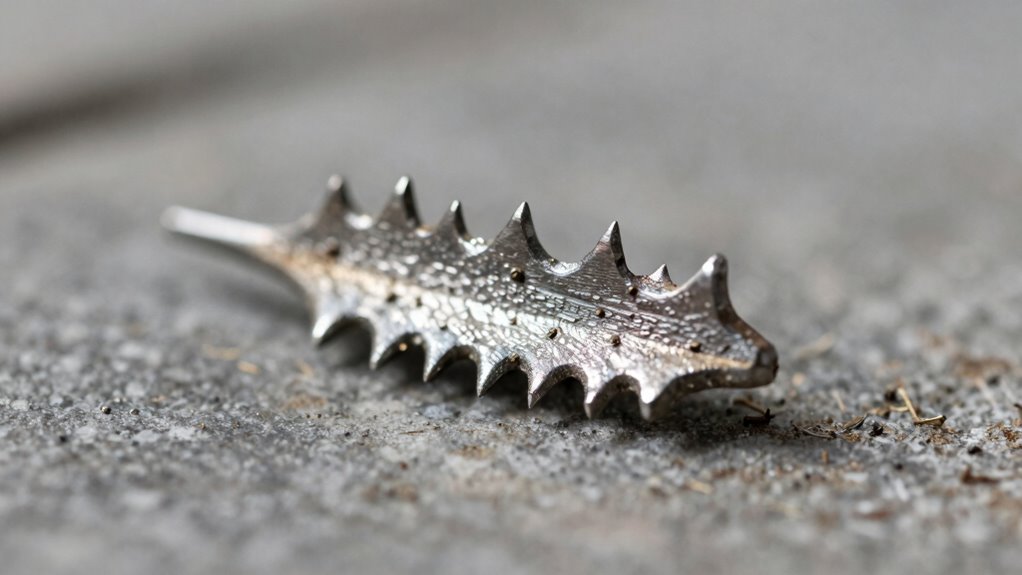
Have you ever wondered what burrs are and how they play a role in sharpening tools? Burrs are tiny, raised ridges that form along the edge of a metal when you grind or hone it. They are essential for edge refinement because they indicate that material removal has occurred, shaping the edge into a sharper, more effective form. When you sharpen, you’re not just polishing; you’re removing small amounts of material to improve the edge’s geometry. The burr acts as a sign that you’ve successfully altered the edge’s structure, creating a finer, more precise cutting surface. Recognizing and managing burrs during sharpening ensures you achieve a clean, sharp edge with ideal performance. They’re a natural part of the sharpening process that helps you get the best results. Understanding burrs can also help you develop more efficient sharpening techniques.
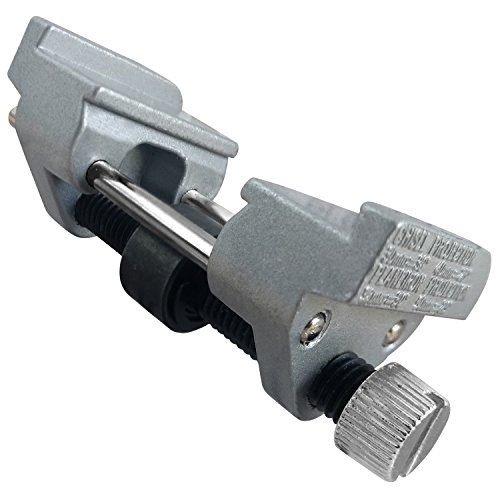
ATLIN Honing Guide – Sharpening Jig for Chisels 1/8” to 1-7/8”, Planer Blades 1-3/8” to 3-1/8”
- Adjustable sharpening angles: Choose precise angles for sharpening
- Includes instructions: Easy to follow setup guide
- Universal compatibility: Fits chisels and planer blades
As an affiliate, we earn on qualifying purchases.
As an affiliate, we earn on qualifying purchases.
How to Feel for Burrs: A Beginner’s Step-by-Step Guide
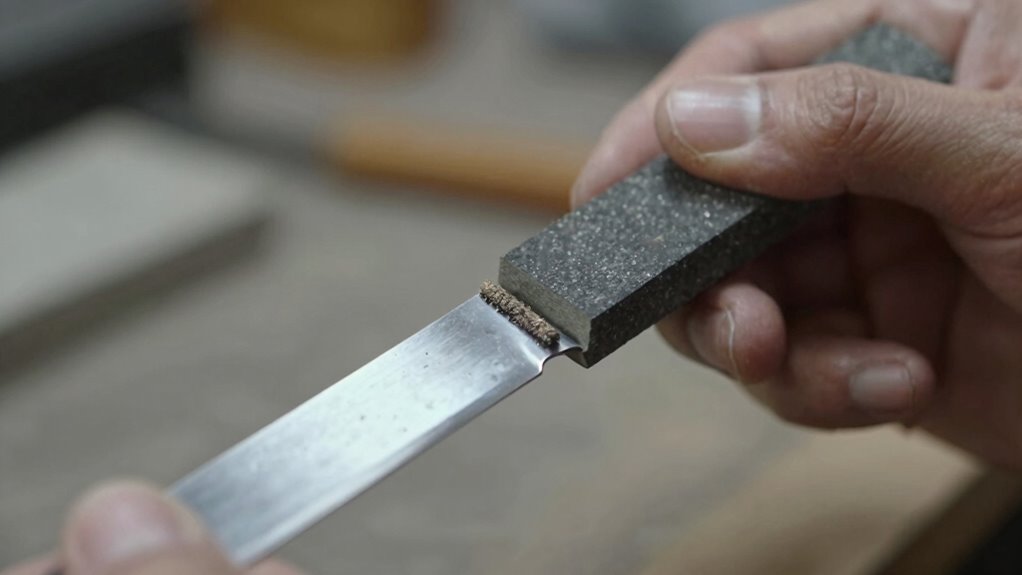
Once you’ve completed a sharpening pass, it’s important to check for the presence of a burr to see if the edge is properly refined. To feel for a burr, gently run your finger perpendicular to the edge, but do this carefully to avoid cuts. Use light pressure and move slowly along the blade, ensuring your touch is consistent. Proper grinding techniques help create a small, barely visible burr, which you should be able to detect with your fingertip. Always follow safety precautions—wear gloves if needed and handle the blade carefully. Remember, feeling for burrs takes practice, but it’s essential for confirming your sharpening progress and avoiding over-sharpening. Developing a good sense of touch sensitivity can significantly improve your sharpening accuracy. Stay attentive, and prioritize safety while developing this tactile skill.

AFA Tooling – Deburring Tool Micro-Polished & Anodized Handle with 11 High-Speed Steel M2 Blades, Deburring Tool 3D Printing, Reamer Tool for Metal, PVC, Copper Pipe, Plastic, Resin & 3D Printed Edges
- Includes 11 M2 HSS Blades: Industrial-grade wear resistance blades
- Long-lasting Sharp Edges: Maintains sharpness up to 80% longer
- CNC Anodized Aluminum Handle: Lightweight, durable, non-slip grip
As an affiliate, we earn on qualifying purchases.
As an affiliate, we earn on qualifying purchases.
How to Recognize a Proper Burr and What It Means
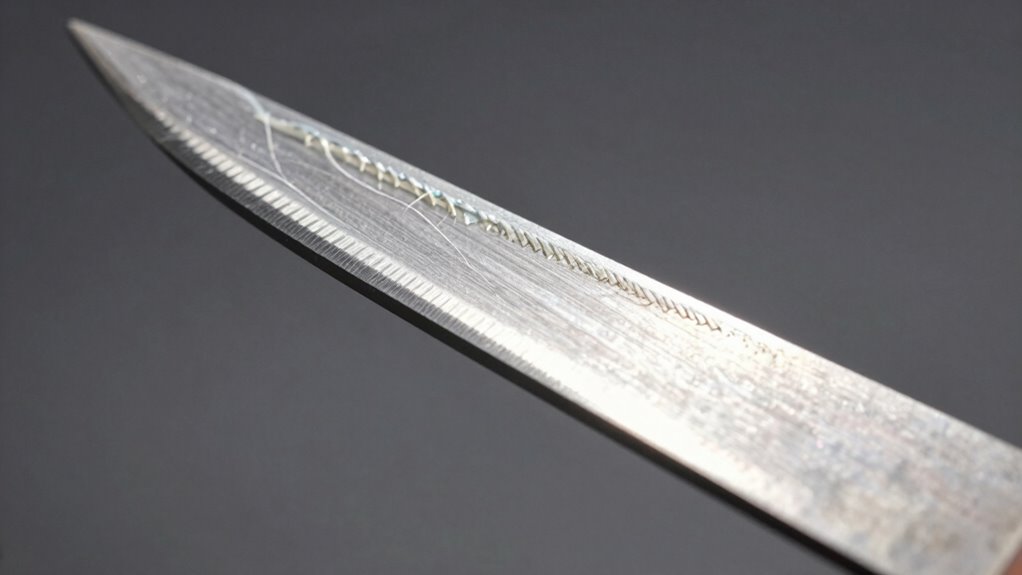
Recognizing a proper burr is essential because it indicates that your sharpening process has effectively refined the edge. During burr formation, you’ll feel a slight roughness or a thin wire-like projection along the blade’s edge. A proper burr feels consistent and can be felt with light pressure, confirming that you’ve sharpened enough on that side. When you see or feel the burr, it means the metal has been moved to the edge, creating the necessary fold. Burr removal techniques, such as light stroking or flipping the blade, help eliminate excess metal without dulling the edge. Once the burr is uniform and easily felt, you know you’ve achieved a properly sharpened edge, and it’s time to move on or refine further. Recognizing this step ensures your sharpening is effective and safe. Additionally, understanding sound design techniques can help you develop a more intuitive sense of tactile feedback during sharpening.
Intelitopia Complete Knife Sharpening Stone Set – Dual Grit Whetstone 400/1000 3000/8000 Knife Sharpener with Leather Strop, Flattening Stone, Bamboo Base, 3 Non-slip Rubber Bases & Angle Guide
- Complete Knife Sharpening Kit: Includes all necessary sharpening tools
- Dual Grit Whetstone: 400/1000 and 3000/8000 grit options
- High-Quality Corundum Stone: Durable aluminum oxide abrasive
As an affiliate, we earn on qualifying purchases.
As an affiliate, we earn on qualifying purchases.
How to Troubleshoot Burrs: Preventing Over- and Under-Sharpening
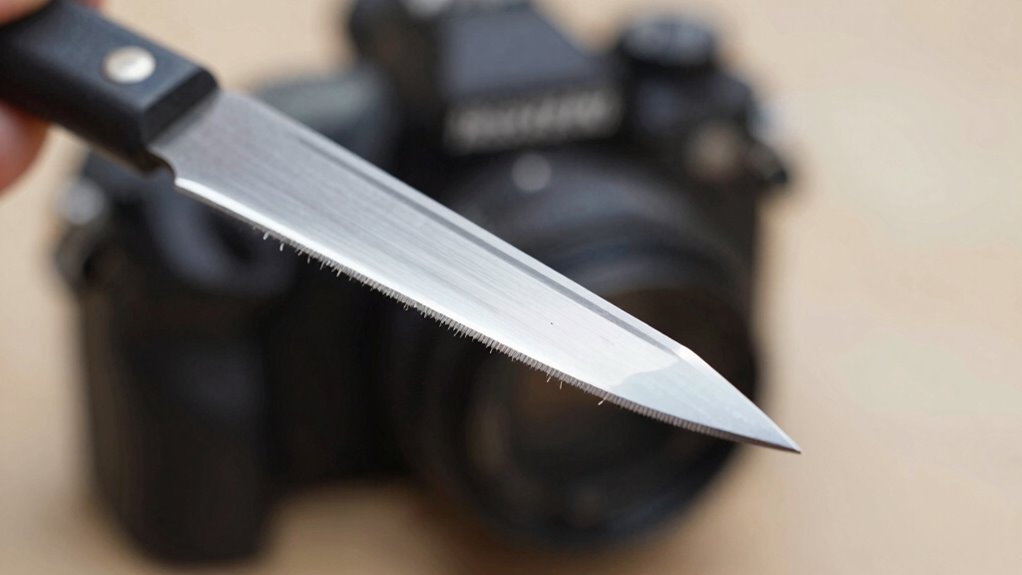
To prevent over- and under-sharpening, it’s crucial to understand how to troubleshoot burrs during your sharpening process. Proper blade alignment and consistent sharpening angles are key. If the burr isn’t forming correctly, follow these steps:
Ensure proper blade alignment and consistent angles to avoid sharpening issues.
- Check blade alignment to ensure the edge is centered and stable.
- Adjust your sharpening angle if the burr forms unevenly or feels inconsistent.
- Use light, even strokes to avoid over-sharpening or under-sharpening the edge.
- Pause frequently to evaluate the burr’s size and feel, ensuring it’s neither too thick nor too thin.
Using Burrs to Achieve a Razor-Sharp Edge: Tips for Perfect Results
Using burrs effectively can help you achieve a razor-sharp edge with minimal effort. Focus on proper edge alignment, ensuring your blade or tool is positioned correctly during sharpening. This alignment helps the burr form evenly, which is key to a smooth, consistent edge. When honing, use deliberate, controlled strokes to maintain the burr’s formation without overdoing it. Pay attention to how the burr feels; a slight, consistent feedback indicates you’re on the right track. Incorporate honing techniques that include light, even pressure and proper angle control to refine the edge. Remember, patience is essential—rushing can cause uneven burrs or damage. With careful edge alignment and refined honing techniques, you’ll produce a perfectly sharp, durable edge every time.
Frequently Asked Questions
Can Burrs Be Safely Removed After Sharpening?
Yes, burrs can be safely eliminated after sharpening. Use burr removal techniques like gentle filing, honing, or a fine abrasive stone to eliminate the burrs. Always follow safety precautions, such as wearing gloves and eye protection, to avoid injury. Take your time and work carefully to prevent damaging the blade. Proper burr removal ensures a cleaner, sharper edge and safer use of your tools.
How Do Different Materials Affect Burr Formation?
Think of sharpening like baking—each material affects the dough differently. Material effects influence burr formation, with harder metals like high-carbon steel producing smaller, more controlled burrs, while softer materials like aluminum tend to create larger, more delicate burrs. These burr characteristics impact how smoothly your edge sharpens and how much finishing you need. Knowing this helps you adjust your technique accordingly, ensuring a cleaner, more precise edge with every pass.
Is There a Risk of Damaging the Blade With Burrs?
Yes, there’s a risk of damaging your blade if you don’t perform proper blade inspection and use the right sharpening techniques. If you force the blade or ignore burr formation, you might create chips or uneven edges. Always inspect your blade before sharpening, and focus on gentle, controlled strokes. Proper technique helps remove burrs safely, preserving your blade’s integrity and ensuring a sharp, durable edge.
How Long Does It Take to Develop a Proper Burr?
Creating a proper burr is like planting a seed; it takes just moments to start forming, usually around a few strokes per side, depending on your honing techniques. The time varies based on blade dullness and steel type, but typically, you’ll see a burr develop within 10-20 strokes. Developing a good burr guarantees better edge retention and a sharper finish. Keep a steady hand, and patience will reward your sharpening efforts.
Can Burrs Indicate the Quality of the Sharpening Process?
Yes, burrs can indicate the quality of your sharpening process. When you feel a consistent burr, it shows you’ve achieved proper edge retention and blade smoothness. A well-formed burr means you’ve sharpened evenly and effectively, leading to a sharper, longer-lasting edge. If the burr is uneven or feels loose, it suggests your process isn’t complete or needs adjustment. Pay attention to burr formation to guarantee your sharpening results are ideal.
Conclusion
Mastering burrs is like tuning a finely crafted instrument—you’ll feel the difference in every slice. When you understand how to recognize and control burrs, you’re wielding the sharpness of a master. Keep practicing, and soon, your edges will cut through anything like a hot knife through butter. Remember, the key is feeling that subtle, satisfying tug—it’s your signal that your blade is perfectly honed and ready for action.