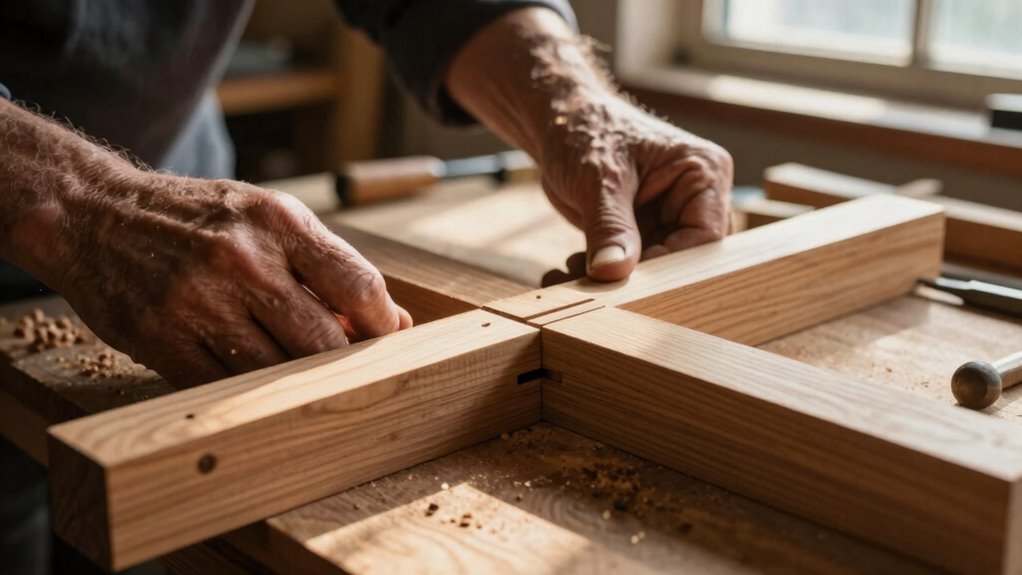
To fit through dovetails perfectly on the first try, you need precise measurements and accurate cuts. Choose dense hardwoods like oak or maple for strength, and guarantee your tools are sharp and well-maintained. Focus on grain orientation, and always dry-fit before gluing to make last-minute adjustments. Clamping should be firm but not over-tightened. With practice, you’ll master these techniques. Stick around to discover more tips that can elevate your craftsmanship even further.
Key Takeaways
- Select dense hardwoods like oak or maple for strength and durability in dovetail joints.
- Ensure accurate measurements and cuts for a tight fit; use a reliable square and marking knife.
- Practice steady cutting techniques, slightly staying off the line for adjustments and precision.
- Always dry-fit joints before gluing to make last-minute adjustments for a perfect fit.
- Maintain sharp tools and proper clamping pressure to enhance joint strength and appearance.

Creating through dovetails that close on the first try can be a game changer in your woodworking projects. When you nail those perfect joints, you not only boost your confidence but also elevate the overall quality of your work. Mastering this skill takes practice, but with focused attention on some key woodworking techniques, you can make it happen.
First, understanding the fundamentals of joinery is essential. You need to start by selecting the right wood. Dense hardwoods like oak or maple offer durability and a pleasing aesthetic, which is fundamental for those flawless dovetails. Once you’ve chosen your material, it’s time to focus on precision. Accurate measurements and cuts are critical. If your angles are even slightly off, your joints won’t fit together tightly, leading to frustration. Invest in a reliable square and a good marking knife to guarantee your lines are crisp and clear. Paying attention to grain orientation can also significantly impact the strength and appearance of your joints. Additionally, understanding the importance of material properties can help you select the best wood type for your specific project.
Understanding joinery fundamentals begins with selecting the right hardwoods and ensuring precision in your measurements for flawless dovetails.
Next, let’s talk about your tools. You can’t achieve perfect joints without the right equipment. A chisel set, a fine-toothed saw, and a mallet are your best friends when it comes to creating dovetails. Confirm your tools are sharp; dull tools will only hinder your craftsmanship skills and affect the quality of your joints. Regularly honing your blades will pay off in the long run, making it easier to achieve those tight-fitting joints you desire. Also, understanding tool maintenance can ensure your equipment remains in optimal condition for precise work. Keep your tools clean and properly stored to prevent damage and ensure consistent performance.
When cutting, focus on technique. Use a steady hand and take your time. Rushing through will only lead to mistakes. Remember the joinery tips: cut a little less than your line, then pare down to the exact fit. This method allows for adjustments, guaranteeing you have a snug joint that closes seamlessly. Practicing with precise measurements and consistent technique will improve your accuracy over time.
After cutting, it’s time to assemble. Dry-fit your joints before applying any glue. This step is essential because it allows you to make any last-minute adjustments. If everything looks good, apply wood glue and clamp the joint firmly, but don’t over-tighten, as this can cause your wood to warp. Ensuring proper clamping pressure can make a significant difference in the final fit and strength of your dovetails.
Finally, once your joints are set and dried, finish your piece with sanding and staining to highlight your craftsmanship. Achieving through dovetails that close on the first try isn’t just about skill; it’s about applying the right techniques and maintaining the right mindset. With practice, you’ll find that these perfect joints become second nature, transforming your woodworking into a true art form.

SUIZAN Dozuki Dovetail Saw 7" Rip Cross Angle Cut – Professional Japanese Pullsaw Handsaw Woodworking Tools
JAPANESE STYLE PULL SAW: This product is a “Pull Saw.” Most people are used to European saws, called…
As an affiliate, we earn on qualifying purchases.
As an affiliate, we earn on qualifying purchases.
Frequently Asked Questions
What Tools Do I Need for Making Dovetails?
To make dovetails, you’ll need a few essential tools. Start with a good quality saw, like a dovetail saw, for precise cuts. A chisel set helps refine the joints. Consider jig options for consistent results—jigs can simplify the process considerably. Don’t forget wood selection; choose a hardwood like oak or maple for durability and aesthetics. With these tools, you’re ready to create beautiful dovetail joints in your projects!
How Long Does It Take to Master Dovetail Joints?
Mastering dovetail joints can take anywhere from a few weeks to several months, depending on your dedication. As you practice, each failure can feel like a sting, but those moments foster growth. By honing your dovetail techniques, you’ll gradually achieve the joint precision you desire. Embrace the learning curve; it’s a journey worth taking. Remember, every skilled woodworker started right where you are, with a desire to improve and create.
Can I Use Softwood for Dovetails?
Yes, you can use softwood for dovetails. Softwood has advantages like being easier to cut and shape, which speeds up your project. It’s also generally more affordable. However, softwood can be less durable and may not hold up as well under stress compared to hardwood. If you’re looking for strength and longevity, consider these disadvantages. Ultimately, it depends on your project’s needs and how you plan to use the finished piece.
What Are Common Mistakes in Dovetail Joinery?
You’ll often run into common mistakes like dovetail alignment issues and joint spacing errors. If you don’t measure and mark accurately, your joints might end up uneven, compromising strength and aesthetics. It’s easy to overlook the importance of proper spacing—you might think it’s minor, but it can lead to gaps that weaken your project. Paying attention to these details now will save you headaches later, ensuring your dovetails fit perfectly every time.
Are There Different Styles of Dovetail Joints?
Yes, there are different styles of dovetail joints. You’ve got hand cut techniques, which offer unique character and craftsmanship, and machine-made options that provide precision and speed. Aesthetic considerations often influence your choice—some prefer the traditional look of through dovetails, while others might opt for half-blind dovetails for a cleaner appearance. Remember, the joint strength also varies; hand-cut joints can be incredibly strong if done right, while machine options guarantee consistent durability.
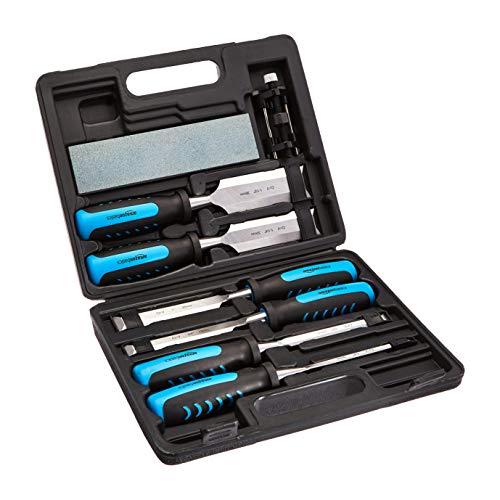
Amazon Basics 8-Piece Wood Chisel Set for Woodworking, with Honing Guide, Sharpening Stone and Storage Case, 1/4" – 1-1/2"
8-piece wood carving chisel set includes 6x chisels 1/4 inch (6mm), 1/2 inch (13mm), 3/4 inch (19mm), 1…
As an affiliate, we earn on qualifying purchases.
As an affiliate, we earn on qualifying purchases.
Conclusion
In the end, it’s the little things that count—the smooth glide of your tool, the satisfying snap of a perfect joint, the joy of creation. It’s the patience you nurture, the attention you give, and the pride you feel when everything aligns. Embrace the process, celebrate the small victories, and remember: it’s not just about the finished piece, but the journey you take to get there. Each dovetail is a reflection of your craft, your passion, your growth.

Marking Knife Woodworking Heavy Duty Scribing Gauge Knife Leather Sheath Carbon Steel Double Beveled Blade Striking Knife Wooden Handle Scribe Carving Tool Fathers Day Mens Woodworking Birthday Gift
【Double Beveled Blade】Double-sided blade for left-handed or right-handed. Woodworking marking, scribing, whittling chipping, carving both softwoods and hardwoods.
As an affiliate, we earn on qualifying purchases.
As an affiliate, we earn on qualifying purchases.

HORUSDY 8-Pack Bar Clamps for Woodworking, 12" and 6" Bar Clamps, Wood Working Clamp Sets, Quick Clamps F Clamp with 150 LBS Load Limit (8-Pack Wood Clamps)
1. The complete set includes 4pcs 6" bar clamps,2pcs 12" bar clamps and 2pcs 6" spring clamps, which…
As an affiliate, we earn on qualifying purchases.
As an affiliate, we earn on qualifying purchases.