TL;DR
A guide published by Hunker describes cutting through pallet nails with a reciprocating saw as a way to free boards while reducing the risk of splitting them. It also outlines safety precautions and alternatives, including a pallet buster or careful use of a pry bar and hammer.
A DIY guide published by Hunker recommends cutting through pallet nails with a reciprocating saw to remove boards with less risk of splitting them. The approach offers a practical option for people reusing pallet lumber, while the guide also outlines safety steps and slower alternatives for those without a saw.

Get business pricing on tools and workshop supplies
- Business-only prices and quantity discounts
- Tax-exempt purchasing
- Multiple users, one account, clear invoices
Hunker’s guide explains that pallets are built to carry heavy loads and that their fasteners can be difficult to pull out. When a board is pried upward at one end while nails at the other end remain fixed, the force can split the wood. The guide recommends cutting the nails to release the board without requiring it to bend as much against the fasteners.
The guide calls for a reciprocating saw fitted with a demolition blade designed for nail-embedded wood, along with safety glasses and work gloves. It advises securing the pallet so it cannot shift, locating the seam between a top board and the thicker support below it, then sliding the blade into the gap from the side so it can reach the nails without cutting into the board.
According to Hunker, users should keep the saw’s shoe supported against the workpiece and avoid applying excessive pressure as the blade cuts through the fasteners. The guide says to free the boards on one face, turn the pallet over and repeat the process on the other side. It identifies bi-metal and carbide-tipped blades as possible options, noting that carbide-tipped blades may be more durable when cutting metal screws. It also says blade length can affect how easily fasteners farther from an edge are reached.
Dismantle pallets with boards intact
Cutting through pallet nails can reduce the bending force that splits boards. Hunker’s guide also covers safer setup and careful manual alternatives.
Why boards split
Prying one end while nails still hold the other can stress the wood until it cracks.
- Board bends against fixed nails
- More risk of splitting
- Releases the board at its joint
- Can leave more usable lumber
Choose a removal method
Match the tool to the pallet and the boards your project needs.
Cut through fasteners
Use a reciprocating saw with a demolition blade made for nail-embedded wood.
Lift with care
A pallet buster or careful pry bar and hammer can work, with more effort and patience.
Set up and cut safely
Work along the seams between each board and its support.
Wear safety glasses and work gloves, and keep the pallet from shifting.
Slide the suitable blade into the joint from the side without cutting into the board.
Support the saw shoe, avoid excess pressure, turn the pallet over, then check boards for metal and cracks.
More Usable Wood From Each Pallet
Hunker’s guide says keeping boards intact can make reclaimed pallets more useful for projects that need longer or wider pieces of lumber. It points to possible uses including indoor storage and outdoor screens for concealing trash cans. More generally, fewer split boards may leave more material suitable for a planned build.
The guide’s method replaces leverage used to pull nails from thick supports with cuts through the fasteners at the joint. That can reduce the bending force placed on each board, but does not guarantee that every board will come off undamaged. Pallets vary in condition, construction and fasteners, so results depend on the wood and the care taken during removal.
For readers choosing between tools, the trade-off is time and effort versus access to a saw and a suitable blade. Hunker presents a reciprocating saw as a direct way to cut the fasteners, while also describing manual approaches that require careful, patient work. The guide provides no comparative test results or measured success rate, so its recommendation is practical advice, not a guarantee.
Products Worth Considering

Philips Hue Festavia Permanent Outdoor String Lights, 80 Lights, 150 ft

Shark AV2501AE AI Robot Vacuum with XL HEPA Self-Empty Base

Dyson V15 Detect Origin Cordless Vacuum
As an affiliate, we earn on qualifying purchases.
Why Pallet Boards Split
Hunker’s guide attributes splitting to the stress on a board when some of its nails are still holding it down. A crowbar can lift one end, putting force on the wood around the remaining fasteners. If the board cannot flex without breaking, it may split before the nails release. The guide’s central recommendation is to remove that resistance by cutting through the nails at the board-support joint.
The guide says some people leave old nail heads in place for a rustic look. For a cleaner finish, it suggests using a nail punch and hammer to drive leftover metal through the board, then pulling any exposed pieces out with pliers. Metal should be handled carefully, and the board should be checked before reuse.
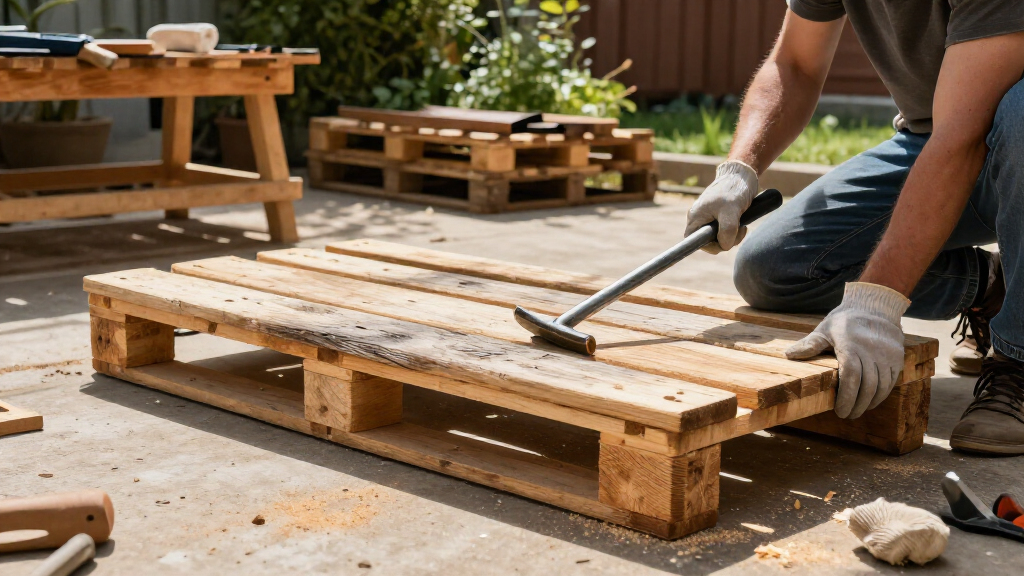
Hunker also describes alternatives to a reciprocating saw. A pallet buster has a forked head that fits around the support under a board and spreads lifting force more evenly than a crowbar. A pry bar and hammer can also work if force is applied carefully near each nail instead of lifting hard from one end. The guide notes that both manual methods can take more physical effort and patience.
Results Depend on Pallet Condition
Hunker’s guide does not say how often the cutting method preserves boards, how long disassembly typically takes, or which blade works best across different pallet designs. It also does not provide guidance for identifying the wood’s prior use or deciding whether a particular pallet is suitable for a specific project. Readers should inspect each pallet and its fasteners rather than assume all reclaimed boards are alike.
The guide notes that cutting can leave nail fragments in the wood and does not claim the method removes every piece of metal automatically. The type and condition of the fasteners may affect how easily they can be cut. It is also unclear whether every joint leaves enough room to position a blade safely; if the saw cannot be placed in the gap without contacting the board, forcing it is not a sound workaround.
Although the guide emphasizes protective equipment and a stable workpiece, it does not provide a full safety assessment for every tool or work setting. Users should follow the saw and blade manufacturers’ instructions, keep hands away from the cutting path, and stop if the pallet shifts or the blade binds.
Choose a Method Before Cutting
Hunker advises deciding whether the project needs clean, intact boards or can use pieces with visible nail heads. Before starting, set the pallet on a stable surface, secure it against movement, and wear safety glasses and work gloves. If using a reciprocating saw, check that the blade is intended for nail-embedded wood and can reach the fasteners through the joint.
The guide recommends working along the board-support seams and letting the blade cut through the nails without forcing it into the lumber. Turn the pallet over to address the other face, then inspect each freed board for remaining metal, cracks and damage before using it. Hunker suggests a nail punch, hammer and pliers for dealing with exposed remnants; boards with sharp or embedded metal need careful handling.
If a saw is unavailable, Hunker lists a pallet buster or a carefully applied pry bar and hammer as alternatives. Move gradually around the fasteners rather than trying to lift a board all at once. After disassembly, assess which boards are sound and suited to the intended project; the guide offers no guarantee that every pallet will yield reusable full-length lumber.
Source: Hunker
Key Questions
What is the recommended way to remove pallet boards without splitting them?
Hunker’s guide recommends using a reciprocating saw with a demolition blade for nail-embedded wood. Insert the blade into the gap between a board and its support to cut the nails rather than levering the board against fasteners that are still holding it.
What safety steps should I take before cutting a pallet?
The guide advises wearing safety glasses and work gloves and securing the pallet so it cannot move. Keep the saw’s shoe supported, avoid excessive pressure, follow the tool and blade instructions, and keep hands clear of the blade path.
Can I dismantle a pallet without a reciprocating saw?
Yes. Hunker’s guide lists a pallet buster, whose forked head spreads lifting force around a support, and a pry bar with a hammer. Manual methods require careful work near each nail and may take more physical effort and patience.
What should I do with nails left in the boards?
Hunker’s guide says nail heads can be left in place if they suit the project’s appearance. For a cleaner finish, it suggests driving leftover metal through with a nail punch and hammer, then removing exposed pieces with pliers. Inspect boards carefully before reuse.
Source: hunker.com