TL;DR

Get business pricing on tools and workshop supplies
- Business-only prices and quantity discounts
- Tax-exempt purchasing
- Multiple users, one account, clear invoices
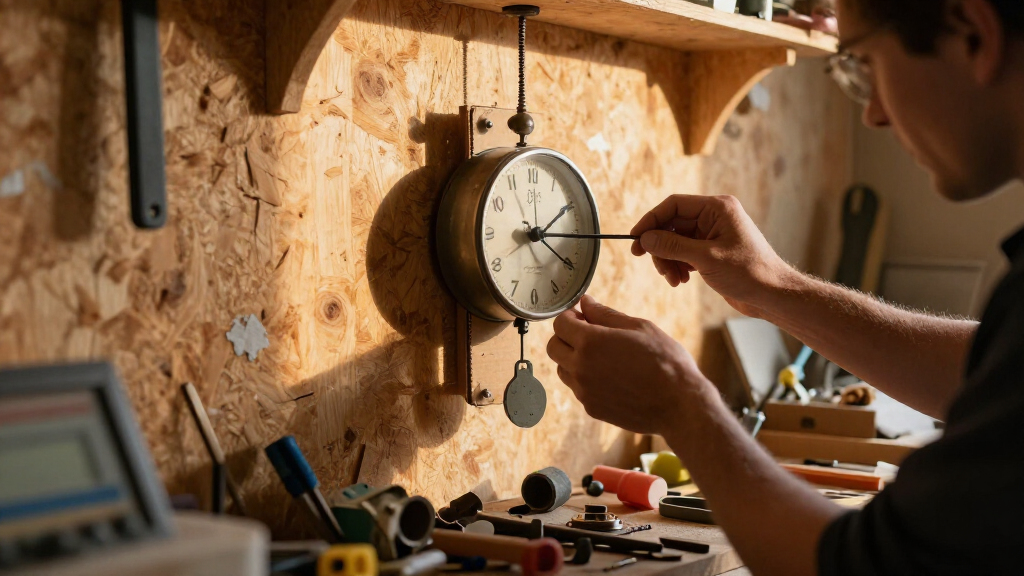
Niklas Roy has built the Glashütte Trash Clock, a functional pendulum clock made from materials he found locally during an artist residency in Glashütte, Germany. Roy says it runs for about half an hour and includes a paperclip escapement, a glass bottle gong and a chance-based feature called “Now or Never?”
Berlin-based artist and inventor Niklas Roy has built a working pendulum clock from materials he scavenged locally during an artist residency in Glashütte, Germany, a town associated with the country’s watchmaking industry. Called the Glashütte Trash Clock, the project turns found objects into a mechanical sculpture that Roy says runs for about half an hour.
The clock uses an assortment of discarded or readily available materials, including tape, zip ties, hot glue, cardboard, a yardstick and pieces of plastic. The report describes the construction as limited to objects and materials Roy could find locally. It does not provide a complete inventory, measurements or a detailed account of how each part was assembled.
Among its working features are a paperclip escapement and a gong made from a glass bottle. An escapement in a pendulum clock releases a gear in steps as the pendulum moves, helping the mechanism advance. Roy says the clock runs for about 30 minutes; the source does not specify whether that duration is measured from a full wind, a particular setup or repeated trials.
The piece also has what Roy calls a “random complication”, which poses the question “Now or Never?” The report links this feature to games and chance rather than to a conventional clock function. No further operating instructions or details about how the random element works are provided.
A Clock Built Against Glashütte’s Tradition
The project sets an improvised object against the reputation of its location. Glashütte is described in the source as a center of German watchmaking, known for precision and a long craft tradition. Roy said he wanted to make the opposite of that association, using locally found materials to construct a clock rather than following the visual language of a precision timepiece.
That contrast gives the work its clearest point of interest: it is both a functional mechanism and an artwork about how people make and interpret technology. The paperclip escapement and bottle gong make familiar clock components visible in an unconventional form, while the chance-based “Now or Never?” feature introduces an element that does not measure time in the ordinary way. The source presents this as a playful tension, not as a claim that the clock keeps time with the accuracy of a commercial watch.
For readers, the project offers a small-scale example of creative reuse joined to mechanical design. Its reported half-hour run shows that the assembly functions as a clock for a limited period. How accurately it keeps time, how durable it is and whether it can be replicated from the description remain unreported.
Top picks for "nikla construct functional"
As an affiliate, we earn on qualifying purchases.
Made During a Saxony Residency
The Glashütte Trash Clock takes its name from Glashütte, a town in Saxony where Roy participated in an artist residency in 2026. The location is more than a setting in the report: its connection to watchmaking provides the contrast that Roy says informed his approach. The available material does not name the residency program or give its dates.
Roy’s wider practice, as described by Colossal, brings together art and technology. His projects have included robotics, gaming systems, sculptures and installations, often using mechanical or interactive elements. The clock continues that interest through a basic technology—telling time—while presenting its components in a deliberately improvised construction.
The source report includes a video of the clock and says readers can find more of Roy’s work on Instagram. It does not provide a release date for the video beyond the September 2026 report, nor does it say whether the clock is part of a public exhibition or available for sale.
““Glashütte is synonymous with precision and centuries-old watchmaking craft, and I wanted to make the opposite.””
— Niklas Roy, quoted by Colossal
Accuracy and Operation Remain Unreported
The source says the clock is functional and runs for about half an hour, but it does not state how accurately it keeps time, how the duration was measured or whether the clock has been tested across multiple runs. It also does not explain the mechanism behind the “Now or Never?” feature, how the clock is powered, or whether it can be restarted without adjustment.
The report lists several materials but does not establish whether every component is reclaimed, how much was collected from waste, or whether additional tools or materials were used. It gives no information about long-term durability, exhibition plans or the clock’s current location. Those details should not be inferred from the project’s title or from the description of its construction.
Video Shows the Clock in Motion
The Colossal report points readers to a video of the Glashütte Trash Clock, which can show its motion and sound beyond the written description. The source does not announce a scheduled exhibition, further public demonstration or another milestone. Any claims about future display, continued operation or additional versions would require new information from Roy or the residency organizers.
For now, the reported development is the completion of a working clock made from locally scavenged materials during Roy’s residency. Further details that could clarify the project include the clock’s measured accuracy, the way its random feature operates and whether it will be shown again.
Key Questions
What is the Glashütte Trash Clock?
It is a functional pendulum clock made by Berlin artist and inventor Niklas Roy from materials he scavenged locally during an artist residency in Glashütte, Germany.
How long does the clock run?
Roy says it runs for about half an hour. The report does not describe how that duration was measured or how accurately the clock keeps time.
What materials and features does it use?
The report lists tape, zip ties, hot glue, cardboard, a yardstick and plastic, among other found objects. Roy also identifies a paperclip escapement, a glass bottle gong and a chance-based “Now or Never?” feature.
Why did Roy make it in Glashütte?
Roy made the clock during an artist residency in Glashütte, a town associated with German watchmaking. He said the town’s reputation for precision and centuries-old craft led him to make something deliberately opposite in approach.
Source: rss
Fall yard work Picks
leaf blowers
As an affiliate, we earn on qualifying purchases.